
The livestock organization México Sin Barrenador (Mexico Without the Borer) believes that the second phase of the pest control program implemented by the State Secretariat for Rural Development serves only to monitor and detect the transmitting fly, rather than to eradicate the pest.
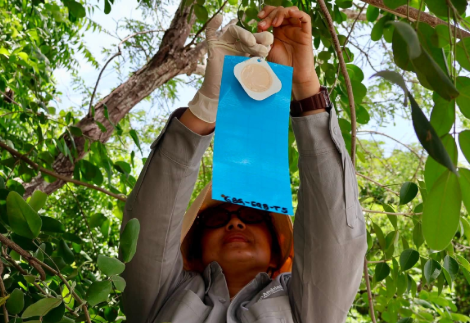
During Governor Joaquín Díaz Mena’s morning press conference last Wednesday, the 8th, the Secretary for Rural Development, Edgardo Medina Rodríguez, announced the launch of the second phase of the program against the cattle screwworm (GBG). This phase involves installing 625 traps across 13 municipalities in the Mérida metropolitan area and its outskirts, aiming to suppress the pest.
Medina Rodríguez stated that technicians had conducted thousands of inspections and ruled out thousands of suspected cases. This procedure confirms strict sanitary control, with confirmed cases in cattle and other species remaining below 24%.
When asked about this strategy, México Sin Barrenador argued that it is essentially a basic epidemiological surveillance program being presented as a control strategy—two very different things: monitoring is not controlling, and detection is not eradication.
“Until sterile flies are released in Yucatán in sufficient numbers, everything else is merely a containment measure,” notes Alberto Banuet Abhari, a member of the livestock organization.
“At best—and viewing it in the most favorable light—these measures merely slow or slightly reduce the pest’s spread; they do not reverse it, and ultimately, it is a waste of time and money.”
Results of previous strategy still unknown
México Sin Barrenador points out that in December 2025, the state government—in collaboration with Senasica—launched a pilot plan to suppress the cattle screwworm in Yucatán. While the plan was intended to expand nationwide, livestock producers remain unaware of the results.
Producers also do not know when the sterile flies will arrive in Yucatán, in what quantities, or whether an agreement has been reached with the National Service for Agri-Food Health, Safety and Quality (Senasica). The sterile flies will be produced at the Metapa, Chiapas facility, recently inaugurated by President Claudia Sheinbaum Pardo and U.S. Secretary of Agriculture Brooke Rollins.
Banuet Abhari explains that the traps for the New World screwworm (GBG) serve a monitoring and detection purpose, not one of population suppression.
Not for sale
A trap baited with kairomones is a good idea, but it is not a product available for commercial sale, he notes.
If the state government knows where to obtain them, it should disclose that information, as trapping is a method used to determine the presence and density of flies at specific sites.
However, the traps do not significantly reduce the fly population.
“Labeling the installation of traps as ‘pest suppression’ is a serious technical error or a deliberate exaggeration,” the rancher says.
“The Rural Development figure showing that less than 24% of suspected cases in cattle were confirmed as screwworm is useless without context. 24% of what total pool? Of samples submitted voluntarily—which already implies a selection bias within a population characterized by massive under-reporting? Or of field inspections?” he asks.
“The confirmation rate for suspected samples depends entirely on who decides to submit them,” he points out.
“I speak from experience here, because most ranchers—at least in my area—no longer report cases, let alone submit samples. Existing pest control expertise in the region allows affected animals to be treated quickly and efficiently.”
Banuet Abhari believes that if ranchers do not submit samples, it is because they are uninformed, distrustful, or have simply absorbed the cost as a standard operating expense.
“That 24% figure does not reflect the reality of the pest problem; it reflects the reality of the samples received.” He also notes that the 636-million-peso investment for the “agricultural revival” is an opaque figure—a classic government communication tactic that conflates the general agricultural development budget with the specific program targeting the GBG.
He therefore asks: How much of that 636 million is specifically for the GBG? How much has already been spent? What measurable results are there?
“They want to make it appear that the investment is larger than it actually is,” he points out.
Source: yucatan