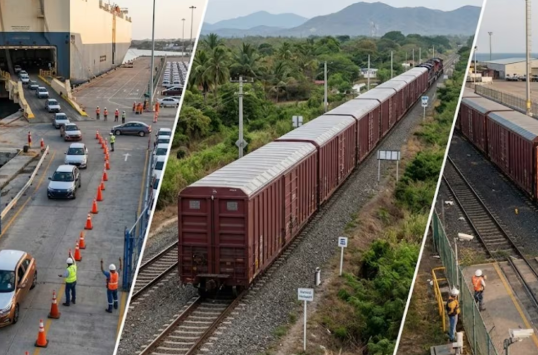

A shipment of 3,000 Hyundai vehicles has begun an international route connecting South Korea, Mexico, and the United States using a combination of maritime and rail transportation. The vehicles arrived at the Port of Salina Cruz, Oaxaca, where they will cross the Isthmus of Tehuantepec by train before continuing from Coatzacoalcos, Veracruz, to the eastern United States by sea.
According to information from the National Port System Administration (ASIPONA) of Salina Cruz, reported by El Universal Oaxaca, the vehicles will be loaded onto specialized railcars operated by the Isthmus of Tehuantepec Railway. Once they reach Coatzacoalcos, they will be transferred to another cargo vessel for the final leg of their journey. This marks Hyundai’s second automobile shipment using this transportation corridor.
How Did the 3,000 Hyundai Vehicles Reach Oaxaca?
The vehicles were transported aboard the Glovis Condor, a cargo ship designed specifically for international automobile transport.
The vessel departed from the Port of Masan, South Korea, on June 22, 2026, and arrived in Salina Cruz on the evening of July 9, according to port authorities.
Following its arrival, workers began unloading the vehicles, organizing them within the port facilities, and preparing them for rail transport.
What Route Will the Vehicles Follow Through Mexico?
The automobiles will travel across Mexico from the Pacific Ocean to the Gulf of Mexico via the Z Line of the Interoceanic Corridor.
The route includes:
- Departure from Salina Cruz, Oaxaca
- Rail transport across the Isthmus of Tehuantepec
- Arrival at Coatzacoalcos, Veracruz
The shipment will be carried using Bi-Max railcars, which feature multiple levels specifically designed for transporting automobiles.
Once in Coatzacoalcos, the vehicles will be unloaded from the train and loaded onto another cargo vessel. They will then continue across the Gulf of Mexico and the Atlantic Ocean to the east coast of the United States.
In simple terms, the vehicles will be transferred from ship to train, then back to ship to complete their international journey.
How Long Will the Journey Take?
According to available reports, the shipment is expected to reach Coatzacoalcos on July 12.
From its departure from South Korea on June 22 until its expected arrival in Veracruz, the trip will have taken approximately 20 days.
This timeframe does not include the remaining voyage to the United States. Authorities have not announced the estimated arrival date at the final U.S. destination.
After arriving in Coatzacoalcos, the vehicles must still undergo port handling operations, be loaded onto another cargo ship, and complete their voyage across the Atlantic.
Is This Hyundai’s First Use of the Interoceanic Corridor?
No.
The first pilot operation took place in March 2025, when 900 Hyundai vehicles followed the same route.
During that operation, the vehicles were unloaded in Salina Cruz, transported by rail to Coatzacoalcos, and then shipped to the United States. According to the Government of Oaxaca, the rail segment between the two ports was completed in approximately nine hours.
The current shipment is more than three times larger, increasing from 900 to 3,000 vehicles. This larger operation will help evaluate the capacity of the ports, rail equipment, and logistics needed to handle international shipments on a greater scale.
What Is the Interoceanic Corridor of the Isthmus of Tehuantepec?
The Interoceanic Corridor of the Isthmus of Tehuantepec is a logistics system connecting the ports of Salina Cruz and Coatzacoalcos through a railway network.
Its purpose is to facilitate cargo movement between the Pacific Ocean and the Gulf of Mexico, allowing companies to:
- Unload goods at one port
- Transport them across southern Mexico by rail
- Reload them onto ships at the opposite coast
The corridor is intended to provide an alternative trade route between Asia and North America. However, it is not currently considered a replacement for the Panama Canal, as its long-term competitiveness will depend on factors such as transportation costs, service reliability, cargo capacity, and total delivery times.
Why Is This Shipment of 3,000 Vehicles Significant?
The operation will test whether the corridor’s infrastructure can efficiently handle larger international shipments without causing delays in port or rail operations.
It will also evaluate the coordination between:
- The Port of Salina Cruz
- The Interoceanic Railway
- The Port of Coatzacoalcos
Each stage must operate smoothly to prevent the vehicles from remaining idle for extended periods.
The 3,000 Hyundai vehicles are not intended for the Mexican market and will not be sold in Mexico. Their transit through Oaxaca and Veracruz is part of an international logistics route connecting South Korea with the United States through Mexican territory.
Source: elimparcial