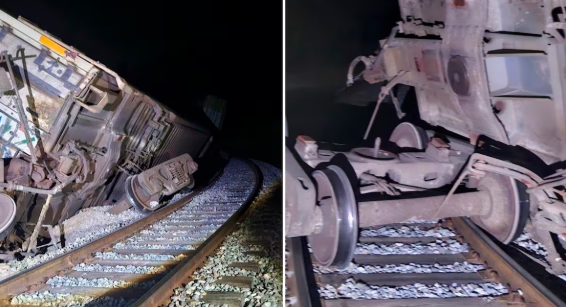

Authorities report that no one was injured in the accident in Asunción Ixtaltepec—occurring on the same stretch of track where another train derailed six months ago, leaving 14 dead and around a hundred injured.
Interoceanic Train derails in Oaxaca on Tuesday night.
The Interoceanic Train, which runs across the Isthmus of Tehuantepec, derailed again on Tuesday night near the municipality of Asunción Ixtaltepec in southeastern Oaxaca, the Secretariat of the Navy reported in a statement on Wednesday. “The incident resulted in no injuries or impact on the local population,” the authority stated, adding that safety protocols were immediately activated. The event revives memories of the derailment involving the same train on the same stretch of track late last December—just over six months ago—which left at least 14 people dead and more than a hundred injured.
In its statement, the Navy emphasized that the locomotives and the rest of the train cars had already been “safely” removed from the accident site. “The Isthmus of Tehuantepec Railway is conducting a technical review to determine the causes; operations are continuing as normal,” the note concluded. Images shared on social media show one of the cars overturned with its axles detached, while another image shows a different car that had also derailed.
The December derailment also occurred in that mountainous area between the communities of Nizanda and Chivela. One of the four passenger cars plunged down a six-meter ravine, while another was left hanging precariously. There were 250 people on board the train at the time; 14 of them lost their lives. A month later, authorities arrested the train engineer and the chief dispatcher—the person responsible for overseeing train movements. The Attorney General’s Office (FGR) attributed the accident to excessive speed—the train was traveling at 65 kilometers per hour, 15 km/h above the limit for that section of the route—and identified certain workers as allegedly responsible, noting that their railway licenses were not valid. In the weeks that followed, survivors recounted feeling that the train was moving “very fast.”
Source: elpais