
Even before Jalisco hosted the FIFA World Cup 2026, water supplied to many areas of the Guadalajara Metropolitan Area was already arriving with unusual colors, unpleasant odors, and visible sediment. A study conducted between March and June 2026 in 90 neighborhoods found that water distributed by the Intermunicipal System for Water and Sewer Services (SIAPA) contained lead, mercury, fecal bacteria, and lacked chlorine.
In response, the Ministry of Health and SIAPA, with support from the state government led by Movimiento Ciudadano, announced a 30-point action plan to address the water problem.
One proposal includes asking the state Congress to approve a budget of 20 billion pesos for long-term infrastructure projects. Opposition parties such as Morena and the PRI have opposed the proposal, arguing that SIAPA has failed to provide adequate accountability.
While the proposal is being debated in Congress, political figures and pages on Meta platforms have paid for advertisements promoting narratives both in favor of and against the requested budget.
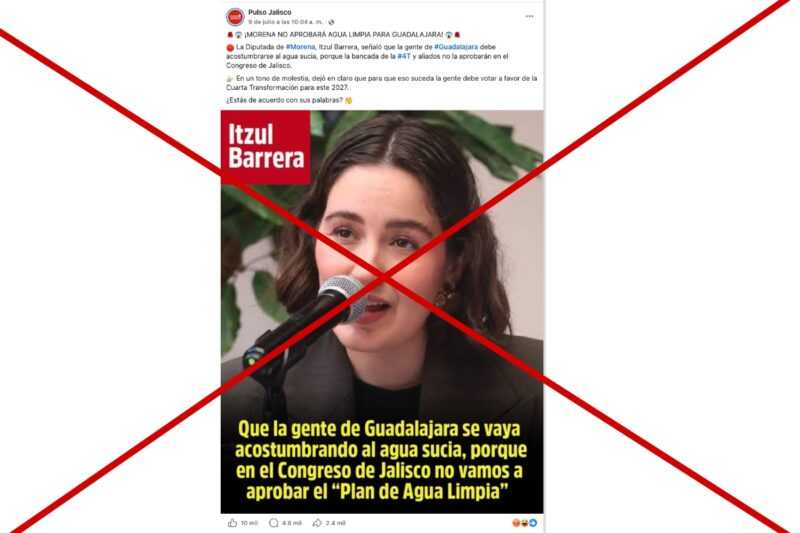
One Meta user, for example, asked Verificado to review a July 9, 2026 Facebook post with 10,000 reactions and 4,500 comments, published by a page called Pulso Jalisco, whose website is currently unavailable.
The image featured Morena legislator Itzul Barrera alongside the statement:
“People in Guadalajara should get used to dirty water, because in the Jalisco Congress we are not going to approve the ‘Clean Water Plan.'”
The page did not specify where or when the statement had supposedly been made.
False Statement Attributed to Legislator
The alleged quote could not be found in the legislator’s recent appearances in Congress, media interviews, or videos discussing the water crisis and criticizing the current state government. Some of those videos had been promoted on Facebook and Instagram with advertising investments ranging from 900 to 2,000 pesos.
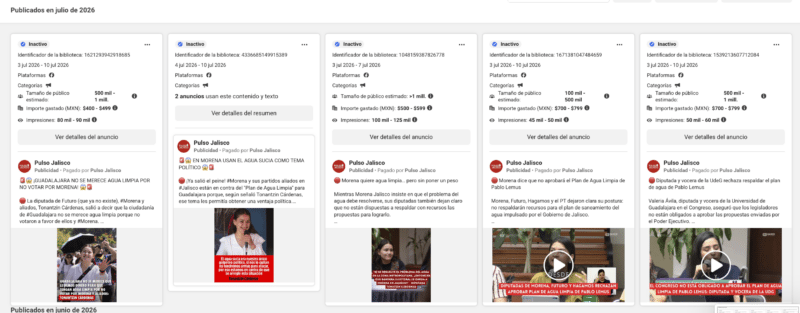
Similarly, the Facebook page that published the false quote spent between 400 and 700 pesos promoting at least five posts criticizing Morena’s position and legislator Tonantzin Cárdenas.
Complaints About Dirty Water in Guadalajara
On July 6, the Jalisco Ministry of Health reported that 200 of the approximately 2,000 neighborhoods in the Guadalajara Metropolitan Area had reported receiving poor-quality water.
Meanwhile, the Jalisco State Human Rights Commission (CEDHJ) reported that 600 neighborhoods have experienced water-related problems since 2019, according to information published by the Jesuit University of Guadalajara (ITESO) based on statements made by Deputy Ombudsperson Katya Rico Espinoza on July 9. No official explanation has been provided regarding the discrepancy between the figures reported by both institutions.
The 2026 study also revealed that 93% of the 184 water samples collected from Guadalajara, Zapopan, Tlaquepaque, Tonalá, and Tlajomulco contained no chlorine or other disinfectants but did contain substances such as lead, mercury, fluorides, nitrates, nitrites, and Escherichia coli, according to Zona Docs.
After the study became public, Jalisco health authorities stated that while samples collected from private homes may serve as a citizen reference, an official public health assessment requires a formal sampling process before decisions can be made.
However, as of July 14, 2026, authorities had not yet released official government diagnostic reports regarding the contaminated water. They did, however, advise residents to purchase bottled water and avoid using tap water for drinking or preparing food.
Regarding water from the public supply network, authorities stated:
“Water from the distribution system may be used for washing dishes, laundry, and general cleaning, provided it does not have noticeable discoloration or a strong odor.”
Jalisco Governor Pablo Lemus stated that the main issue was not water availability but rather the failure in recent years to properly treat the water before it reached households.
He promised that in the following days the government would provide water trucks, purification plants, water distribution services, and vouchers for purchasing sealed bottled water or refills.
As part of a second phase, he also committed to having SIAPA clean storage tanks, inspect distribution systems, verify water treatment plants, and construct additional infrastructure. He also said the federal government had not yet responded to the requested funding.
Budget Debate, Misinformation, and Paid Advertising
The poor water quality triggered debate in Congress over SIAPA’s performance and public demands to declare a health emergency because of the conditions of the water reaching homes.
In recent weeks, lawmakers have held votes, issued statements, and organized press conferences to discuss the issue.
On July 9, Congress approved resolutions requesting that SIAPA Director Ismael Jáuregui Castañeda report on storm drain cleaning, infiltration wells, and drinking water shortages. Lawmakers also requested that independent experts inspect the agency’s water infrastructure.
During the legislative session, representatives from several political parties, including Morena legislator Itzul Barrera, questioned the government’s request for 20 billion pesos to address the water crisis. They also pointed out that the government’s proposed 30-point action plan had not yet been formally submitted to Congress for review.
Barrera stated:
“Before asking this legislature for another 20 billion pesos… have all outstanding debts owed to SIAPA been collected, including those from municipalities governed by the same political group for many years? For example, the Guadalajara municipal government owes SIAPA 1.1 billion pesos that remains unpaid.”
The image containing the false quote attributed to Barrera was published on the same day. Verificado reviewed the official transcript of the Jalisco Congress YouTube channel and found no evidence that she made the alleged statement during the debate.
The quote also did not appear in Morena’s July 2, 2026 public statement requesting that certain officials appear before Congress, nor in a recent interview Barrera gave to Canal Red.
An examination of Pulso Jalisco showed that the Facebook page had not only published the fabricated statement but had also spent approximately 3,400 pesos promoting posts featuring legislators such as Valeria Ávila and Tonantzin Cárdenas discussing the proposed water budget. The page has also promoted images attributing other controversial statements to legislators and has published anti-Morena political content since 2023.
Meta Advertising Transparency
Although Pulso Jalisco claims to be associated with a news website, its website (pulsojalisco.com) is currently unavailable.
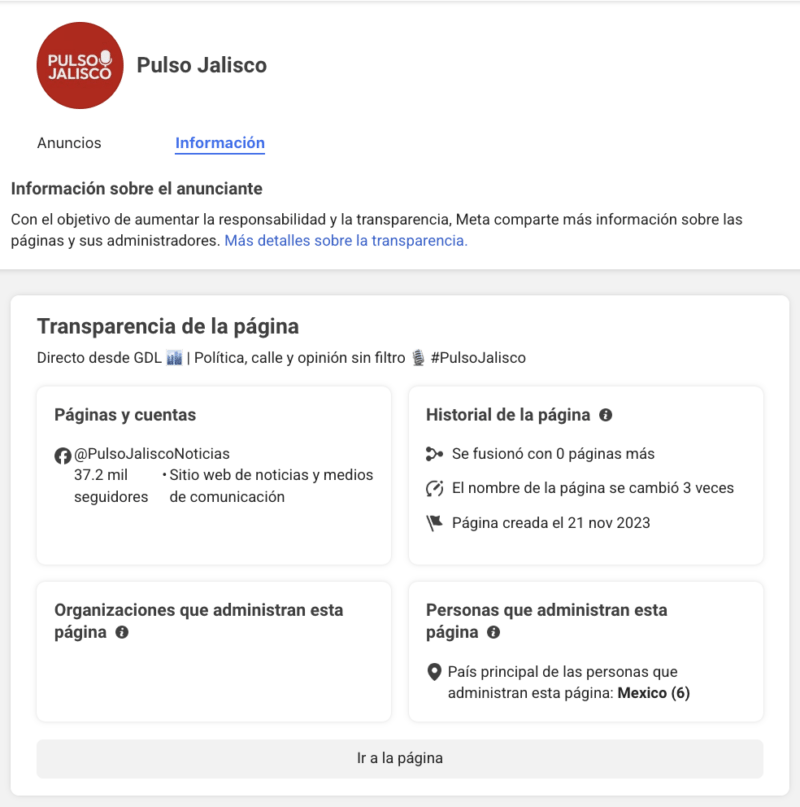
Meta’s transparency information indicates that the page is managed from Mexico by six administrators, has changed its name three times, and is not officially affiliated with any organization.
The disclaimer registered with Meta since late 2023 identifies only the Facebook page itself as responsible for its advertisements, listing an address in Guadalajara, Jalisco, but providing no specific individual or company.
A review of older advertisements showed that one of the page’s previous names was Gabi Pulso Jalisco, and instead of its current logo it used the image of a woman with a red background.
Searching for that identity led to an X account describing itself as:
“Story hunter in Jalisco. Reporting with passion from the heart of Guadalajara. The news that matters, the debates that define us. Join the conversation.”
The account uses both the Pulso Jalisco logo and the same former profile image as the Facebook page. Hive Moderation estimated a 100% probability that the profile image was generated using artificial intelligence. Its posts contain content similar to that published on the Facebook page.
Meanwhile, Barrera has never stated that people should “get used to dirty water” in any of her videos discussing the water crisis. Instead, she criticized the Movimiento Ciudadano government and argued that the current situation “appears to have been manufactured to justify the privatization of a human right.”
An analysis of her Meta advertising activity also found that she invested approximately 8,000 pesos between June and July to promote Facebook and Instagram posts about Guadalajara’s water crisis and her party’s position, although she did not provide evidence supporting her claim that the water crisis had been intentionally created.
As these competing narratives continue across social media platforms, the Jalisco Congress will ultimately decide whether to approve the requested 20 billion pesos while government agencies continue implementing measures to address the water crisis affecting neighborhoods throughout the Guadalajara Metropolitan Area.
Source: verificado