
What do the states of Nuevo León, Coahuila, and Tamaulipas, a remote ranch in Texas, and the moment when northern Mexico nearly split in two have in common?
In 1840, while Mexico was torn apart by conflict between federalists and centralists, a group of northern politicians and military leaders made a decision that could have changed the country’s map forever. Frustrated with the centralist government of Anastasio Bustamante and the Seven Laws that had abolished federalism, the leaders of Coahuila, Nuevo León, and Tamaulipas decided to follow Texas’ example. On January 17, 1840, at Rancho Oreveña, near Laredo, they proclaimed the Republic of the Rio Grande—an independent nation that would last only 283 days.
THE REPUBLIC THAT WAS NEVER MEANT TO BE
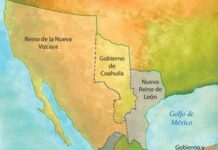
Leading the movement were figures such as General Antonio Canales Rosillo, a lawyer and military officer from Nuevo León known as the “Fox of the Chaparral,” and Jesús de Cárdenas, who was appointed president of the new republic. The provisional capital was established in Laredo before later being moved to Victoria, Texas. The territory they claimed included the present-day Mexican states of Nuevo León, Tamaulipas, and Coahuila, as well as part of Texas.
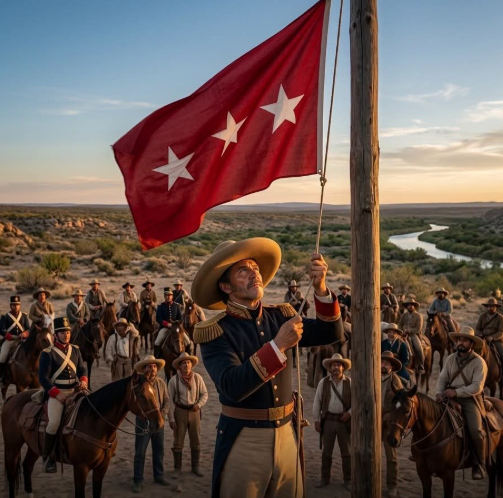
The flag that flew over this short-lived nation featured a distinctive design: three white stars on a red background, representing the three states seeking independence. However, the Republic of the Rio Grande never had a congress, its own currency, a budget, or even a formal constitution. It was more of a dream than a functioning nation.
THE BATTLE OF CAMARGO: THE BEGINNING OF THE END
Canales took command of the rebel army and confronted the centralist forces led by General Mariano Arista. On March 24 and 25, 1840, in Morales, Coahuila, the rebels suffered a devastating defeat. Colonel Antonio Zapata, commander of the cavalry, was captured and executed. The rebellion began to collapse.
Canales fled to Texas, where he recruited about 300 Mexicans, 140 Americans, and 80 Native Americans to rebuild his army. He even sought the support of Texas President Mirabeau B. Lamar, who privately sympathized with the cause but could not openly support it without jeopardizing Texas’ international recognition.
THE SURRENDER: THE DREAM THAT LASTED 283 DAYS
On November 6, 1840, after the federalists’ defeat in Saltillo, Canales signed the surrender in Camargo, Tamaulipas. In exchange for laying down his arms, the centralist government offered him the rank of brigadier general in the federal army. The Republic of the Rio Grande ceased to exist without ever being recognized by any nation.
Canales, the “Fox of the Chaparral,” survived the failure of his dream. He died in 1869 in Camargo, the same place where he had signed his surrender. The three-star flag became a forgotten symbol, and the northern states remained part of Mexico.
A LESSON THAT ENDURES
The Republic of the Rio Grande was a desperate attempt by a group of federalists to preserve the system of government established by the 1824 Constitution. Its failure demonstrated that, in the turbulent Mexico of the 19th century, ideas of regional autonomy repeatedly clashed with centralist power.
Today, few people remember the three-star flag that flew for less than a year. Yet its story serves as a reminder that, during the 19th century, Mexico came close to fragmenting into multiple republics—and that sometimes dreams of independence die before they are ever fully born.
Do you think Mexico should have allowed those three states to separate, or was preserving national unity the right decision? 👇
Source: mexicodailypost