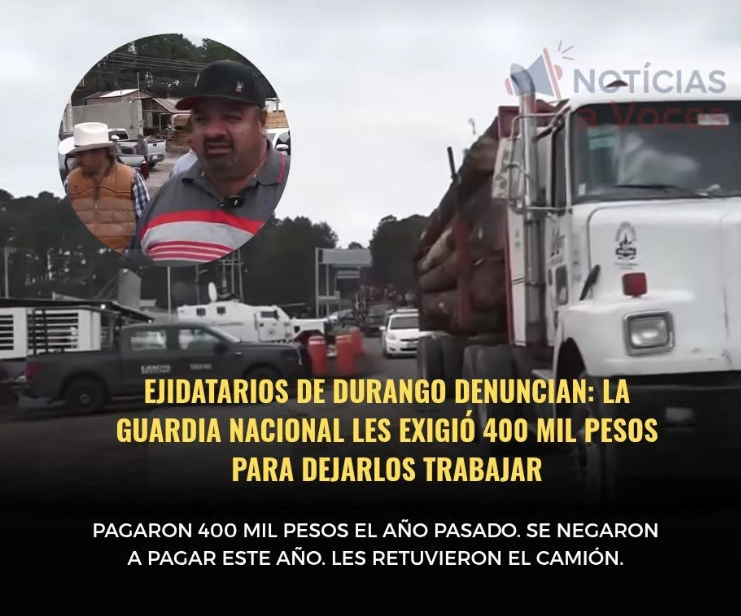

It is not a rumor. It is a public complaint with names, surnames, and even a road blockade involved.
Eduardo Silva Ravelo, president of the Pueblo Nuevo Ejidal Committee in the mountains of Durango, reported in July 2026 that members of the National Guard allegedly demanded payments to allow trucks transporting timber to pass through the region.
According to his statement, the previous year an ejido representative handed over 400,000 pesos so they would be allowed to continue working.
When Silva Ravelo assumed the presidency of the ejidal committee and refused to continue making payments, problems began: the National Guard seized at least one truck and transported it to the city of Durango, where it remains detained because the owner does not have the resources needed to recover it.
The ejidatarios acknowledge that the vehicles —known as “camiones mostrencos,” imported from the United States without complete documentation— have an administrative irregularity.
However, they are clear that the timber cargo is legal, and that fully regularizing the vehicles would increase costs to the point of making the work impossible for low-income families who depend on the forestry sector.
The response was a partial and peaceful blockade of the Durango-Mazatlán free highway, along with a gathering outside National Guard facilities demanding intervention from higher-ranking authorities. The videos of the complaint spread widely on social media starting July 10.
On July 9, a meeting was held in El Salto with representatives from the National Guard, the Mexican Army, the Durango Mobility Undersecretariat, and ejidal authorities.
The official document from that meeting does not mention the word “extortion” at any point. Instead, it refers to a “problem regarding the transit of unregularized vehicles” and establishes agreements related to documentation, schedules, and permanent military presence in extraction areas.
To date, there have been no arrests. There is no public criminal investigation against the officers who were accused. Authorities addressed the situation through the regularization of procedures, rather than through accountability measures.
This case is not isolated. Durango joins a growing list of complaints against National Guard members for alleged improper charges on highways throughout the country: against transport workers, Mexican citizens returning from the United States, and ejidatarios.
The pattern described in these complaints is always the same: the irregular situation of the affected person becomes a tool for pressure, and when the complaint becomes public, the institutional response focuses on “regularization” instead of investigating the person accused of wrongdoing.
How long will the State’s response to allegations of extortion by its own members be to regularize the procedures of those affected instead of investigating those accused of carrying out the extortion?
Source: mexicodailypost