
179 Archaeological Artifacts Discovered in Chiapas Cave Preserved for Centuries
In a site symbolically associated with the underworld, 13 pre-Hispanic ritual deposits were discovered, representing one of the most significant archaeological findings in the region in recent decades.
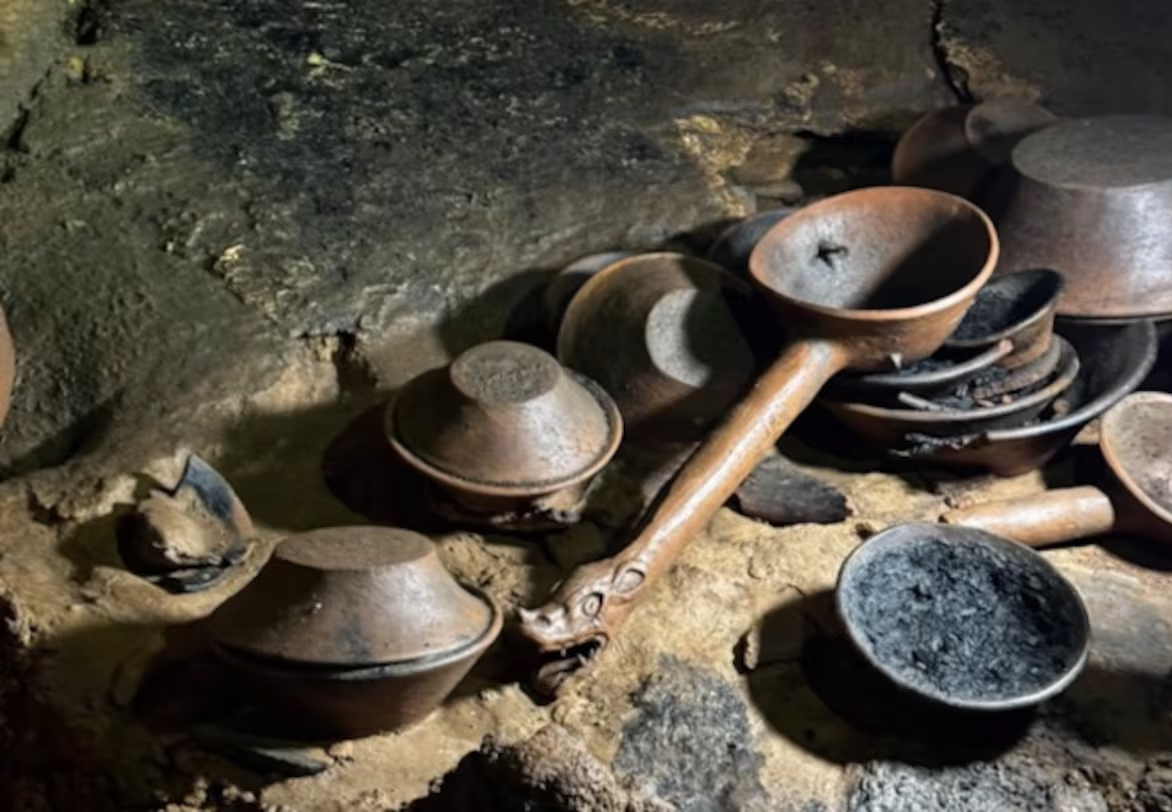
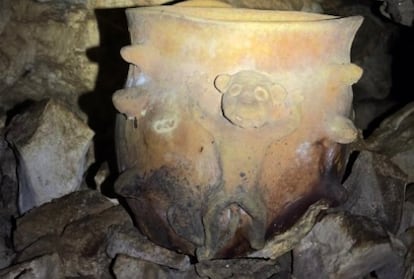
Denominated Mundo Zoque, this formation housed urns, bowls, and incense burners featuring human and animal figures.
The National Institute of Anthropology and History (INAH) has reported the discovery of 179 archaeological artifacts inside a cave located in the municipality of Cintalapa, in the southern Mexican state of Chiapas. The site was named Mundo Zoque, in honor of the Zoque people who inhabit the region. The cave measures 100 meters in length, and access requires a rappel descent of more than 10 meters, which helped keep it untouched for centuries.
The investigation was carried out by the Directorate of Archaeological Studies of INAH and was led by researcher Josuhé Lozada Toledo, assigned to INAH Chiapas, with the collaboration of archaeologist and professional climber Martha Arcelia García Sánchez and speleologist Gabriel Merino Andrade.
Incense burner decorated with a cross representing the directions of the universe, or quincunx, a Mesoamerican cosmological symbol.
Inside the cave, researchers found 13 pre-Hispanic ritual deposits containing ceramic objects, including incense burners, effigy urns, and decorated bowls featuring representations of jaguars, owls, and snakes.
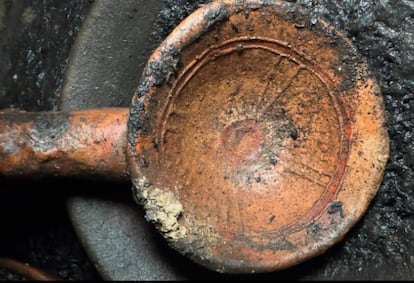
“In the Zoque worldview, these three animals are linked to the nocturnal world and caves: the jaguar symbolizes darkness and serves as the guardian of the underworld and the heart of the mountain; the owl is associated with the night and wisdom; and the snake represents strength and the cycle of life and death,” Lozada explained.
The incense burners display motifs that evoke the spines of the ceiba tree—a sacred tree for the ancient Zoque people—leading archaeologists to believe they may have formed part of a ritual procession inside the cave. After passing through narrow passages, the space opens into large chambers filled with stalactites and stalagmites, an environment symbolically associated with the underworld, or ts’uan. Based on a preliminary analysis of the ceramics and their iconography, the materials have been dated to the Late Classic regional period (A.D. 600–900). Researchers have specified that the cave was most likely used as a ceremonial space for rituals related to rain and agricultural fertility, rather than as a place of habitation.
The discovery was made by local guide Jairo Díaz Barreiro, who notified INAH Chiapas in January 2026, allowing the site to be investigated and documented between February and June.
“The protection of cultural heritage begins when there is a relationship of trust between communities and the institutions responsible for researching and preserving it. The discovery of Mundo Zoque Cave demonstrates that this collaboration makes it possible to preserve archaeological contexts of exceptional value and expand our understanding of the cultures that have shaped Mexico’s history,” said Claudia Curiel de Icaza, Mexico’s Secretary of Culture, in an official statement.
In Zoque culture, the jaguar (kank) symbolizes darkness and serves as the guardian of the underworld and the heart of the mountain.
INAH archaeologists have announced that, as part of the ongoing research, they will create a 3D photogrammetric record of the findings, along with specialized studies that will help better understand the cultural significance of the archaeological site.
Source: elpais