
Industrial Park Construction Shows Early Progress Under Plan México
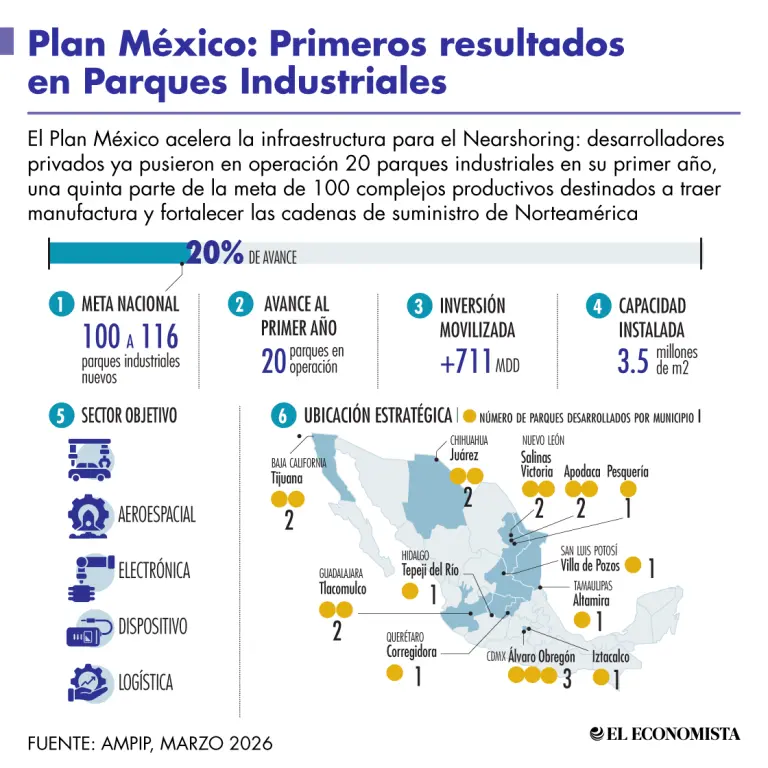
The construction of industrial parks continues to show tangible progress under Plan México. Just over a year after the initiative was launched, the private sector has completed 20 new industrial park developments, representing one-fifth of the target set for 2030.
According to the Mexican Association of Private Industrial Parks (AMPIP), these initial projects represent more than 700 million U.S. dollars in investment and were developed by 15 real estate firms. They are located across 10 Mexican states and, once fully occupied, are expected to accommodate more than 240 companies.
As explained by Claudia Esteves, Director General of AMPIP, industrial park development in Mexico is primarily driven by private investment rather than public infrastructure programs. Developers determine project locations, acquire land, and carry out construction based on demand from domestic and international companies. Meanwhile, the public sector supports these investments through regulatory conditions, infrastructure, and public services.
Esteves also clarified that an industrial park is not considered operational until at least one company has established operations within it. Under this definition, the 20 newly completed projects are now part of the 477 industrial parks currently operating in Mexico.
The expansion comes amid the ongoing nearshoring trend, as companies relocate supply chains closer to North America. Industries such as automotive manufacturing, electronics, logistics, and light manufacturing continue to drive demand for industrial space.
Northern and Central Mexico Lead Growth, While the South Remains a Challenge
AMPIP acknowledged that industrial park growth remains highly concentrated in northern, central, and Bajío states, including Nuevo León, Chihuahua, Jalisco, and Querétaro, where well-developed logistics infrastructure, skilled labor, and established supplier networks already exist.
This geographic concentration highlights one of the main challenges facing Plan México: extending industrial development to the country’s southern and southeastern regions. Although investor interest exists, these areas continue to face significant gaps in energy infrastructure, water availability, transportation networks, and skilled workforce development, limiting their competitiveness for large-scale industrial investment.
Source: eleconomista