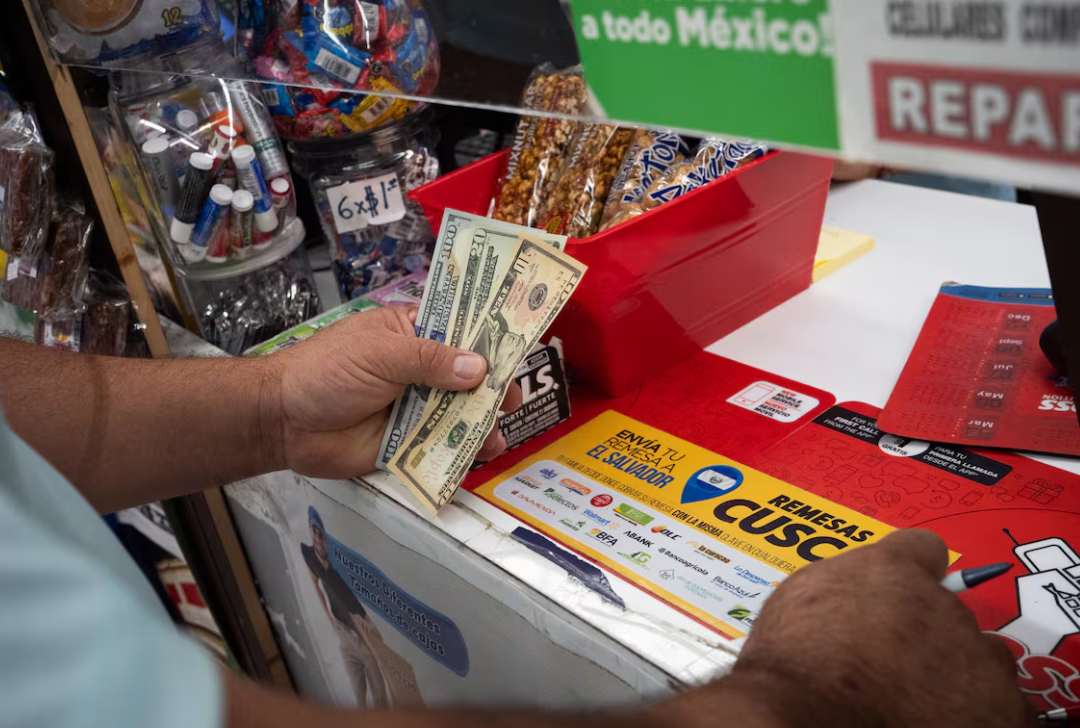

Remittances flowing into Mexico in June remained strong, even as a series of measures signed by U.S. President Donald Trump—aimed at limiting undocumented migrants’ participation in the country’s financial system—came into effect. Transfers reached $5.472 billion during the month, representing a 4.2% year-on-year increase driven by a rise in the average remittance amount, according to figures released this Monday by the Bank of Mexico (Banxico). With this latest figure, total remittances for the first half of the year reached $30.759 billion, a 3.1% increase compared to the same period last year.
The continued positive trend in remittances—which are vital to the economies of Mexican families—suggests that the Republican president’s recent measures to restrict undocumented migrants’ participation in the U.S. financial ecosystem will have a limited impact on these transfers. In May, the president issued an executive order urging banks to investigate their clients’ immigration status. The goal was to prevent foreign nationals without permanent residency from opening accounts, accessing credit, or making international transfers—an unprecedented move for the banking sector, which had never before requested such information from its customers. Consequently, the industry leveraged political pressure to ensure the measure was not a mandatory requirement, but rather a request to gather information and refine customer screening processes.
The president has defended the executive order—titled “Restoring Integrity to America’s Financial System”—as a safeguard for a financial system that has at times been accused of exploitation by drug-trafficking money-laundering networks. Viewing financial regulation as an extension of national security, the measure instructs the Department of the Treasury to strengthen due diligence criteria and transaction monitoring to address risks such as money laundering and human trafficking. For Mexico, this measure is particularly significant due to its deep integration with the U.S. ecosystem—spanning remittances, cross-border payments, bilateral trade, correspondent banking, and digital platforms that millions of users and daily transactions rely on.
Under this same mandate, the Financial Crimes Enforcement Network (FinCEN) has identified sectors relevant to Mexican migrant workers—such as agriculture, construction, domestic services, hospitality, and employment agencies—as areas of interest, particularly when clients claim to be self-employed or small business owners.
According to BBVA’s analysis unit, the impact of this new crackdown will be limited, despite potential effects on the migrant population in the U.S. “It is important to remember that ‘mixed-status’ households are common among Mexicans in the United States, with undocumented individuals living alongside family members or acquaintances who have legal immigration status,” the bank notes. “If measures become stricter, it is highly likely that people will turn to these support networks to send remittances to Mexico,” it adds.
With the June figures, remittances have now seen five consecutive months of growth. However, in real terms, these transfers represent an 8% drop in purchasing power, occurring against the backdrop of a strengthening Mexican peso. The data suggests that the rebound is driven more by an increase in the average amount sent per transaction than by a rise in the number of transactions, which has remained stable.
“This aligns with a migrant base that, while maintaining its commitment to sending money, faces a U.S. labor market that is becoming less dynamic for the population of Mexican origin,” Valmex Casa de Bolsa wrote in an analysis. “Looking ahead, the risks are skewed to the downside: a more restrictive U.S. immigration environment, the possibility of reduced economic activity in sectors reliant on migrant labor, and the appreciation of the peso could temper the growth rate observed for the remainder of 2026,” the institution forecasts. Over the last twelve months (from July 2025 to June 2026), the accumulated flow was $63.389 billion, higher than the $63.171 billion reported last May.
Source: elpais