
Sheinbaum’s Scientific Committee Recommends Using Saltwater Instead of Freshwater for Possible Fracking in Mexico
The scientific committee appointed by President Claudia Sheinbaum recommended that, if hydraulic fracturing (fracking) is carried out in Mexico, only underground saltwater should be used in order to prevent contamination of freshwater sources.
“Under no circumstances should freshwater be used (…) what we are recommending is that only saltwater be used. Where is this saltwater found? Deep underground at great depths,” said José Antonio Hernández Espriú, PhD and director of the Faculty of Engineering at the National Autonomous University of Mexico (UNAM).
Hernández Espriú explained that saltwater can be found at specific depths and that using it would represent a safer option for the environment.
The proposal seeks to balance natural gas extraction with measures aimed at protecting water resources and promoting sustainability.
What are the general requirements for the possible use of fracking in Mexico?
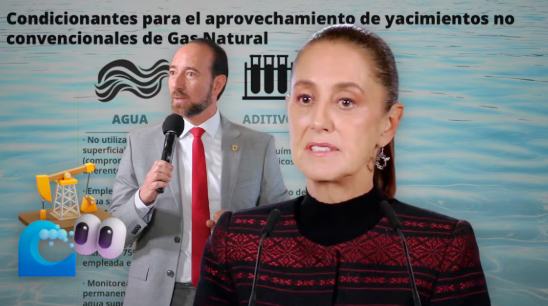
Among the general requirements proposed by the scientific committee for the possible implementation of fracking in Mexico are:
- Do not use surface water or groundwater that is already committed to different uses.
- Use exclusively saltwater from deep geological formations and/or wastewater.
- Reuse and recycle at least 75% of the water used during the process.
- Permanently monitor the quality of surface water and groundwater.
- Do not use highly toxic or harmful chemicals.
- Prioritize the use of closed-loop systems for the storage and treatment of returned water.
- Report and publish the list of additives used and how they are managed.
How will water resources be protected if fracking is implemented in Mexico?
When proposing the use of saltwater for fracking operations in Mexico, the group of experts and scientists recommended the following measures:
- Confirm the existence and volume of deep underground saltwater through deep wells.
- Drill exploratory wells specifically for saltwater evaluation.
- Verify the separation between shallow aquifers and unconventional reservoirs, as well as deep saltwater formations.
- Conduct geological and geophysical studies to guarantee hydraulic separation.
- Begin monitoring the quality of surface and groundwater.
- Establish a baseline study of water resources and ecosystems.
- Estimate reserves and evaluate their economic feasibility in unconventional reservoirs.
- Drill wells to estimate reserves and confirm the economic viability of extraction.
- Verify the applicability of technologies with lower environmental impact.
- Conduct proof-of-concept tests to validate technological advances and new extraction methods.
Source: sdpnoticias