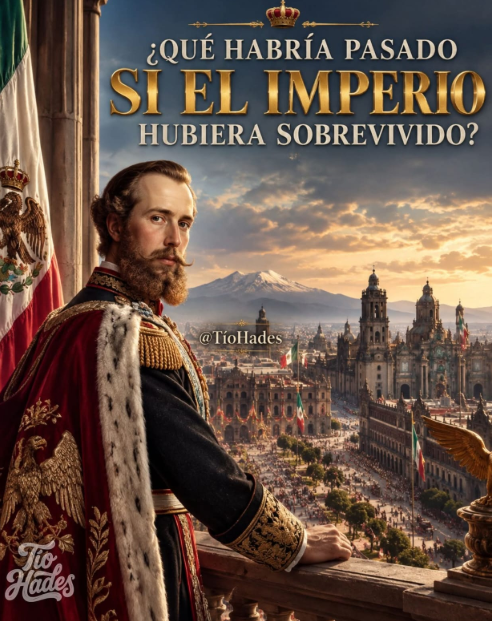

Here’s the context, nephews:
Before anyone starts crying in the comments, let’s make one thing clear: this is purely counterfactual history. It’s an exercise in imagining what might have happened if the Second Mexican Empire had never fallen in 1867.
Now, imagine a Mexico where Maximilian I of Mexico was never executed at the Cerro de las Campanas. France manages to negotiate an orderly withdrawal, the Empire survives, and constitutional monarchy takes root. What would that country look like?
We probably wouldn’t have had presidents changing every few years through military uprisings, because one of the functions of a constitutional monarchy is to separate the head of state from partisan political struggles.
Political stability could have attracted more investment, accelerated the construction of railways, ports, and cities, and turned Mexico into a stronger economic power during the late 19th century.
Maximilian, moreover, was not the absolute monarch many people imagine him to have been. He maintained several liberal reforms, promoted scientific projects and education, and sought to protect Indigenous communities through various decrees.
That doesn’t mean his government was free of mistakes or that all of his projects would have succeeded. It means that the country’s path could have been very different—and probably much better than what it is today.
Would Mexico today be a parliamentary monarchy similar to Spain, Belgium, or the United Kingdom? It is certainly a strong possibility, although impossible to prove.
In 1867, not only did an emperor die; one of the paths Mexico could have taken also disappeared.
And here comes the most uncomfortable part of all:
If Mexico was born as an Empire, is an Empire what Mexico should be today?
If you enjoy this kind of content, don’t forget to follow me so you don’t miss more uncomfortable truths about Mexican history.
—Uncle Hades 👑🔱
Source: mexicodailypost