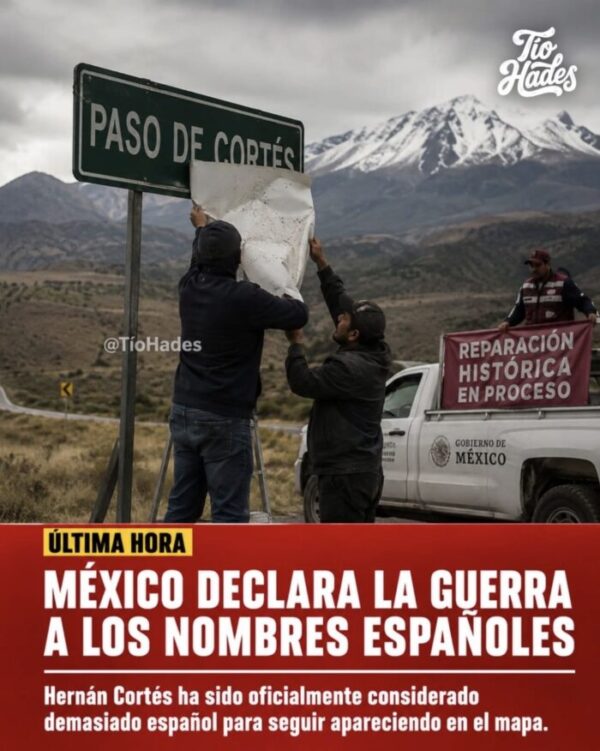

Political satire often uses sharp humor to critique government decisions, and a recent satirical commentary regarding the iconic Paso de Cortés highlights ongoing debates over national identity, historical legacy, and indigenous representation in Mexico.
The commentary targets a proposal attributed to President Claudia Sheinbaum to rename the historic mountain pass nestled between the Popocatépetl and Iztaccíhuatl volcanoes to “Paso de los Pueblos Indígenas” (Pass of the Indigenous Peoples). Named originally after Spanish conquistador Hernán Cortés—who crossed the high-altitude pass on his march toward Tenochtitlan in 1519—the geographic landmark has carried its colonial designation for nearly five centuries.
Proponents of renaming geographic landmarks argue that replacing Spanish colonial names with indigenous designations is an essential step toward decolonizing public spaces, honoring native heritage, and correcting historical imbalances that glorify conquerors. From this perspective, public monuments and place names should reflect the rich pre-Hispanic history and the resilience of Mexico’s indigenous communities.
Conversely, critics and satirical commentators often push back against symbolic administrative changes, questioning their practical impact on pressing socio-economic challenges. Opponents argue that altering historical place names risks erasing centuries of layered history, suggesting that heritage should be preserved in its entirety rather than selectively modified.
As conversations surrounding historical memory, monuments, and geographical nomenclature continue to evolve across Latin America, the discussion over Paso de Cortés exemplifies the broader tension between honoring indigenous roots and preserving established historical narratives.