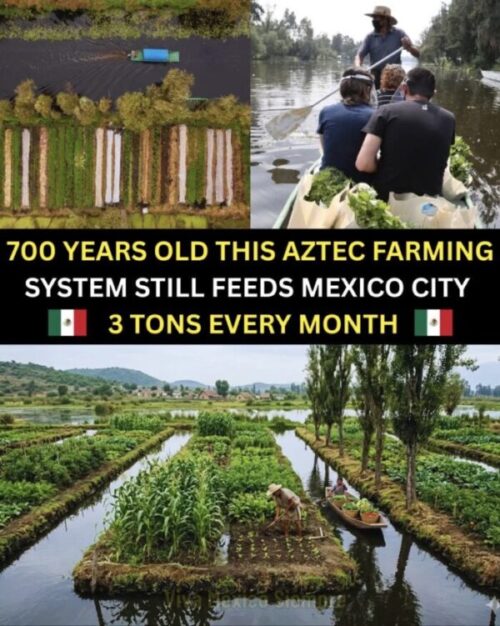

Deep within the historic canals of Xochimilco, located on the southern edge of Mexico City, modern farmers are quietly continuing a agricultural tradition developed by their ancestors over seven centuries ago. Utilizing an ancient Aztec farming method known as chinampas, contemporary producers are proving that indigenous ecological engineering is not just a relic of the past, but a highly viable solution for sustainable food production today.
Chinampas are rectangular artificial islands built entirely by hand. Farmers construct them using layers of nutrient-rich lake mud, decaying aquatic vegetation, and woven reeds, securely anchoring each plot into the wetland ecosystem using rows of native ahuejote willow trees. Originally engineered by indigenous civilizations in the Valley of Mexico to reclaim shallow waters, this system creates an intricate network of navigable canals that provide every field with natural irrigation, continuous hydration, and direct waterway access.
Historically recognized as one of the most productive agricultural systems in the ancient world, chinampas yield crops in soil so naturally fertile that seeds germinate significantly faster than in standard terrestrial farmland. Today, this traditional method is once again feeding the capital. Organizations such as Arca Tierra, established in 2009, have partnered directly with local chinampero families to restore abandoned plots. By rehabilitating historic chinampas, they have established thriving agroecological farms that produce tons of fresh food every month without relying on synthetic pesticides or chemical fertilizers. Instead, the crops flourish entirely on the organic richness of the reconstructed wetland soil, yielding dozens of diverse varieties of vegetables, herbs, and traditional produce.
This localized food model also drastically reduces supply chain emissions. Rather than traveling long distances, the harvests are supplied directly to neighborhood markets, households across Mexico City, and top-tier culinary kitchens, establishing a farm-to-table connection with minimal intermediaries.
Beyond food security, the chinampas serve as vital ecological sanctuaries. They represent the last surviving fragments of the vast wetland landscape that once surrounded ancient Tenochtitlan. Their waterways remain home to the critically endangered axolotl, Mexico’s endemic salamander, while the wetlands themselves act as essential natural buffers that help absorb urban flooding for a modern megacity of millions. Recognizing their immense historical and ecological value, UNESCO designated Xochimilco a World Heritage Site in 1987, and the United Nations Food and Agriculture Organization formally recognized the area as a Globally Important Agricultural Heritage System in 2018.
Despite these accolades, the preservation of the chinampas faces severe ongoing challenges. Out of approximately 12,500 hectares comprising Xochimilco, fewer than 1,000 remain actively farmed as chinampas, with many plots sitting abandoned, urbanized, or converted into recreational spaces.
The dedication of these farmers highlights a profound truth about indigenous heritage. While contemporary society searches for cutting-edge answers to global agricultural crises—such as soil regeneration, chemical-free cultivation, and localized urban farming—Mexico has preserved a working model that has sustained communities on the exact same water and soil for centuries. The chinampas stand as a powerful reminder that ancient engineering achievements are not merely archaeological ruins, but a vital, living inheritance capable of shaping the future of sustainable agriculture.