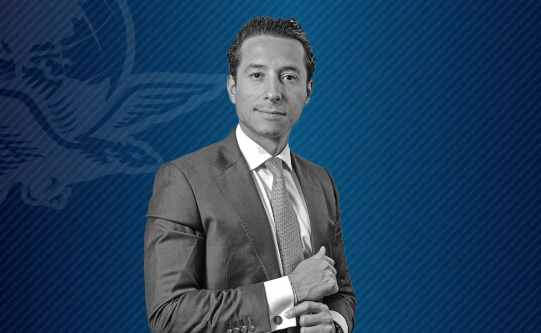

Raúl Piña Horta, one of the men closest to Jorge Emilio González, known as the “Green Child,” has been arrested, triggering a scandal that goes far beyond vehicle emissions testing centers in the State of Mexico. The former director general of Prevention and Control of Atmospheric Pollution was charged in connection with his alleged participation in a network that, according to the State of Mexico Prosecutor’s Office, obtained tens of millions of pesos every month through extortion, threats, and dispossession targeting concession holders. However, within the leadership circles of Morena and the Green Party, the arrest is being interpreted as a political message aimed at Piña’s true boss.
Sources who have known them for decades claim that Piña Horta and Jorge Emilio are so close that they once shared a residence and built an intimate friendship that continues to this day. Piña served as the Green Child’s private secretary, a federal deputy for the PVEM, and a member of the party’s leadership and justice bodies. His appointment to the government of Delfina Gómez in October 2023 was part of the positions granted to the Green Party following the alliance that allowed Morena to win the State of Mexico.
The investigation states that Piña Horta and Carlos Eduardo Solares Vega demanded payments from owners of vehicle emissions testing centers in exchange for allowing them to operate, avoiding the closure of testing lines, and guaranteeing the renewal of their authorizations. Complaints describe monthly payments ranging from 100,000 to 250,000 pesos at 145 establishments, as well as an extraordinary fee of 500,000 pesos for each testing lane. The purpose of this latter operation was allegedly to raise as much as 435 million pesos before permits were renewed for 2027.
The business owners who filed complaints identified Piña Horta, Green Party leaders and operators, and claimed that the financial demands were justified as instructions from Jorge Emilio González. Sources close to the investigation maintain that one pending line of inquiry is determining whether part of those funds ended up financing PVEM political structures or activities.
Piña’s arrest coincides with tensions between Morena and the Green Party over the succession in Quintana Roo. Jorge Emilio, Governor Mara Lezama, and her group are supporting Senator Eugenio “Gino” Segura for 2027. The Obradorist wing, meanwhile, is promoting Rafael Marín Mollinedo, a founder of Morena in the state, former head of Customs, and a figure close to López Obrador and his sons.
The confrontation intensified with an investigation by Mexicanos Contra la Corrupción y la Impunidad into Alejandro Enrique Arcos Romero, whom the organization identifies as one of the alleged financial operators of the organization led by Florian Tudor, known as the “Shark” and described as the leader of the Romanian mafia that operated in the Riviera Maya.
Despite these allegations, Arcos joined the National Customs Agency during Marín Mollinedo’s first administration. Official documents place him in the agency head’s office and at the handover ceremony with Horacio Duarte. He currently appears regularly at events promoting Marín in Quintana Roo and even filed the trademark “Rafa Marín” with the Mexican Institute of Industrial Property. The Morena candidate acknowledged that Arcos participates as a volunteer in his project and requested that he be investigated, although he denied any personal responsibility. So far, there is no formal accusation directly linking Marín to Tudor’s organization.
Those close to Marín attribute the revelations to the Green Party’s political apparatus and consider them part of an effort to prevent him from becoming a candidate. According to sources from both parties, the response allegedly came from the State of Mexico with the arrest of the man closest to the Green Child. The message would be that Morena also possesses investigative files, institutional capacity, and control that could increase the political cost of the dispute over Quintana Roo.
Horacio Duarte, Secretary General of Government and former head of Customs, maintains communication with Marín and belongs to the group close to López Obrador’s sons.
Thus, the downfall of Raúl Piña Horta may be the result of a legitimate investigation and, simultaneously, become an instrument of political pressure. If the Prosecutor’s Office follows the money trail, it will determine whether the scheme ended up benefiting officials or funding a higher-level structure.
For now, Jorge Emilio González finds himself under considerable pressure ahead of the alliances he will have to form for the 2027 elections.
Postscript 1
A new dispute has emerged within the Supreme Court of Justice of the Nation, this time over next year’s budget. The highest court requested 6.104 billion pesos, representing a 17.2% increase over the 5.208 billion pesos authorized for this year, although not all justices agreed. The increase must still go through the Judicial Administration Body and the Chamber of Deputies, but it was approved by the Full Court on August 6.
Justice Lenia Batres voted against it and highlighted one of the most controversial components of the preliminary budget: the restoration of major medical expense insurance for more than 300 public servants, including mid- and senior-level officials. She also criticized the fact that reductions to the pensions of retired justices remain pending—she estimates the excess at more than 54 million pesos—as well as the elimination of positions assigned to former members of the Court, which would represent another 39 million pesos.
The majority argues that the increase would allow the Court to recover the 661 million pesos that the Chamber of Deputies cut from the budget requested for 2026. The problem is that the Court created by the judicial reform promised to be less expensive than its predecessor.
The dispute has already caused a split within the Full Court. Batres stated that her position generated an “unhealthy animosity” among her colleagues; the other justices rejected the idea that their legal disagreements were retaliatory. That is how tense things have become within the Court.
Postscript 2
After months of blockades, demonstrations, and disagreements, Section 22 of the CNTE returned to the National Palace to meet with President Claudia Sheinbaum, Education Secretary Mario Delgado, and Governor Salomón Jara. It was the first formal and orderly meeting between the parties following the escalation of protests; a meeting that the governor of Oaxaca helped arrange and which will be followed up on September 3.
The Section 22 leaders arrived with an attitude described as “mature.” Politically, the change in tone reveals that the mobilization strategy had lost its ability to pressure a president who refused to negotiate under blockades and kept the meeting focused on Oaxaca’s educational problems rather than the Coordinadora’s national agenda. Demonstrations and attempts to intercept her during her tours failed to change that position.
The meeting produced concrete agreements: authorization of more than 1,000 positions, reclassifications, additional teaching hours, outstanding payments, and new support for school uniforms. Judicial cases arising from protests against the educational reform were also reviewed. In other words, the government opened a path to resolve labor and educational issues without giving the CNTE political control over the negotiations or accepting its central demand to repeal the 2007 ISSSTE Law.
The contrast is with the SNTE, led by Alfonso Cepeda, which maintains permanent communication with the Ministry of Education and has resumed bilateral negotiations to address permanent appointments, transfers, consolidation of positions, promotions, and benefits. The union says that during the past seven years, job security was provided to 1.15 million education workers. Thus, while the SNTE processes its demands through institutional negotiations and its teachers prepare for the new school year, the CNTE ultimately accepted dialogue that it had sought for months to replace with street pressure.
Postscript 3
Trafalgar Companies appointed Carlos Septién Michel as the group’s chief executive officer, which includes a Popular Financial Company and TRF Brokerage House. His assignment will be to coordinate both operations and lead a new stage of expansion, technological transformation, and institutionalization of the firm founded in 1996 by Porfirio Sánchez Talavera.
Septién Michel has accumulated more than 45 years of executive experience, including three decades as a CEO and vice president at companies in the financial and healthcare sectors. He holds a degree in industrial engineering from Universidad Iberoamericana and a master’s degree in business administration from Purdue University. His career includes expansion processes, financing strategies, and the development of new business models.
Trafalgar’s strategy is to integrate the liquidity solutions of its Sofipo with the investment and wealth-management services of its brokerage house on a single platform. The goal is to support small and medium-sized businesses, entrepreneurs, and investors as their financial needs grow and become more complex.
Postscript 4
The United States fully resumed the activities of its personnel in Michoacán related to avocado inspections and exports after evaluating the security measures implemented by the Mexican government. Ambassador Ronald Johnson recognized the work of the Security Cabinet in restoring the suspended operations and preventing a greater blow to an industry that depends on the U.S. market.
The decision, however, did not alter the risk assessment for the state. Michoacán remains at Level 4 of the State Department’s travel advisory—“Do Not Travel”—because of violence and criminal activity. The United States considers that conditions exist for its inspectors to work under an enhanced protection system, but not that the state is safe.
The reopening represents a success for the efforts led by Omar García Harfuch, but it does not resolve extortion, protection rackets, criminal control of orchards and packing facilities, or the traceability problems surrounding avocados. Trade was restored because Mexico provided specific guarantees to U.S. personnel; the safety of producers, transport workers, and residents of Michoacán remains unresolved.
Source: eluniversal