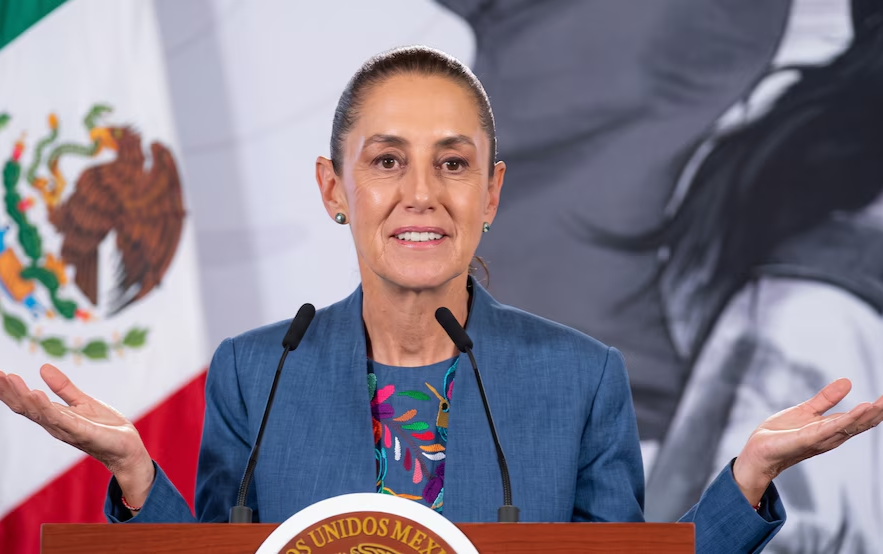

President Claudia Sheinbaum responded Thursday to the new international offensive by PRI national leader Alejandro “Alito” Moreno, describing his strategy of turning to the United States as the “lowest level” a political party can reach. The president was referring to Moreno’s complaint filed with the U.S. Department of State, in which he requested sanctions and the revocation of visas for three members of Mexico’s National Electoral Institute (INE).
“A party on the verge of extinction,” says the president
During her morning press conference, Sheinbaum was blunt: “He is the president of a political party on the verge of extinction,” she said, criticizing the PRI leader for seeking support from foreign authorities instead of convincing Mexican voters.
The president contrasted that approach with what she said a government should do:
- Seek votes and support within the country, not abroad.
- Strengthen democracy and freedoms.
- Remain close to the people in order to maintain political viability.
“Who do you have to convince? Mexicans,” she insisted, adding ironically that Moreno’s strategy “is almost laughable.”
The president criticized the PRI leader for seeking support from foreign authorities rather than voters after filing a request with the U.S. Department of State to sanction and revoke the visas of INE officials.
The origin of the dispute: the INE sanction
Moreno’s complaint in Washington came after the INE prohibited him from referring to Morena as a “narco-party” through a precautionary measure ordering him to remove his related publications.
In response, the PRI senator asked the United States to apply the Magnitsky Act against council members Arturo Castillo Loza, Rita Bell López Vences, and Frida Denisse Gómez Puga, alleging “serious human rights violations.” Moreno announced that he would also take the case to the United Nations, the Organization of American States, and the Inter-American Commission on Human Rights.
Arrests hit Alito’s inner circle
The PRI leader’s international offensive coincides with a series of legal setbacks against people close to him in Campeche, the state he governed from 2015 to 2019:
- Luis Antonio Espinosa Campos, accountant and legal representative of companies belonging to Alito’s brother, Emigdio Gabriel Moreno Cárdenas, was arrested in Mexico City over an alleged diversion of 97 million pesos to the television company Mayavisión.
- Carlos Alberto Medina Hernández, who served as director of Social Communication during Moreno’s administration in Campeche, was arrested for allegedly participating in a network of shell companies that allegedly diverted 36 million pesos.
Both arrests were carried out by the Specialized Prosecutor’s Office for Combating Corruption of Campeche.
Does the prosecutor’s office have authority to charge Alito?
Regarding whether the Attorney General’s Office of the Republic has any involvement in the Campeche case, Sheinbaum clarified that it does not: the matter falls under the state prosecutor’s office in Campeche, not the federal prosecutor’s office.
Regarding the possible removal of Moreno’s immunity, a process that could resume in September at the beginning of the new regular legislative session, the president explained that the decision belongs to Congress, not the prosecutor’s office.
Sheinbaum insisted that this is not a political matter originating from the National Palace, but rather a possible crime and, therefore, that the underlying investigation already falls under the Campeche Prosecutor’s Office.
The PRI leader’s complaint before the U.S. Department of State, following a precautionary measure by the National Electoral Institute, has reopened debate over the legitimacy of institutional checks and balances and the political use of language during campaigns.
The dispute escalates in the Senate
Tensions between Morena and the PRI also turned physical on Wednesday. Arturo Ávila (Morena) and PRI legislator Carlos Gutiérrez Mancilla were involved in a confrontation involving shoving and insults in the Federalism Courtyard of the Senate after Ávila accused Moreno of “treason against the country” for seeking U.S. intervention in domestic affairs.
Gutiérrez Mancilla, described as an ally of Alito, responded with allegations of alleged links to organized crime, while Ávila called him “Alito’s thug.”
The confrontation occurred after PRI member Carlos Eduardo Mancilla demanded explanations regarding statements attributed to Alejandro Murat and Ariadna Montiel, amid unverified accusations and without an official written position.
Morena condemns the confrontation and warns about the PRI
The reaction was immediate within Morena. Party president and federal legislator Ariadna Montiel defended Arturo Ávila hours after the confrontation and described what happened as an act of political violence.
In a message posted on her social media accounts, Montiel wrote: “We strongly condemn the violence carried out by Carlos Eduardo Gutiérrez Mancilla, PRI legislator and operator for Alito Moreno,” while expressing her support and solidarity with the Morena legislator.
According to the party leader, the incident was not isolated but rather an example of the “authoritarian tradition” that she said characterizes the PRI. She also interpreted the confrontation as a warning from the PRI to those who publicly challenge its national leader.

Source: infobae