
Governor Joaquín Díaz Mena sought to present Yucatán as the country’s next industrial giant, but ended up exposing one of the main weaknesses of the current administration: a flood of multimillion-peso figures without clearly explaining how they will be financed, who will provide the money, and how much of that supposed economic boom will actually reach the pockets of Yucatecans.
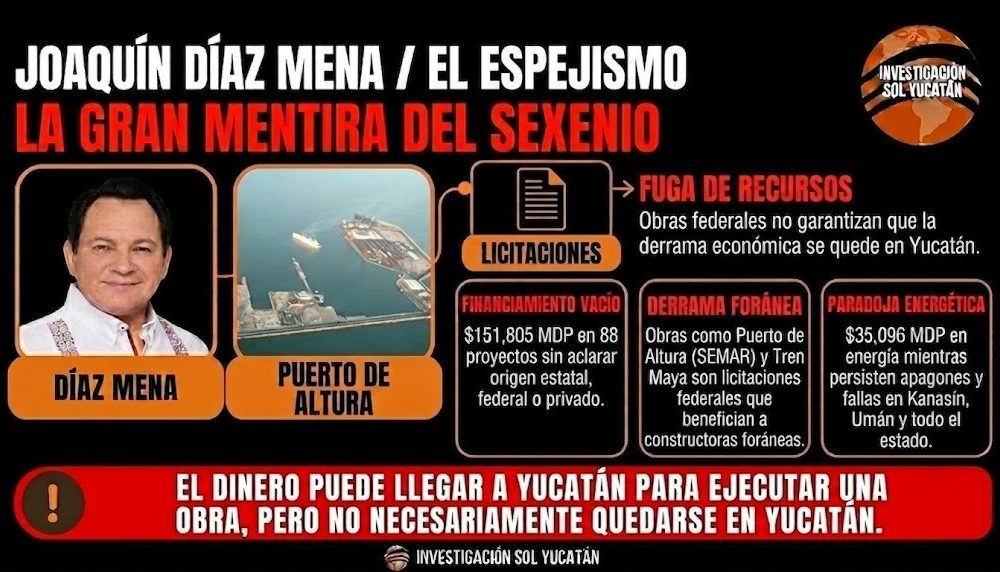
The script prepared for the governor boasts a portfolio of 88 projects with an estimated investment of 151.805 billion pesos, as well as the projected creation of 79,289 jobs.
On paper, the figures are spectacular. The problem arises when trying to answer an elementary question: Where will those 151.805 billion pesos actually come from?
That is where the gap begins.
In an interview with El Economista, he presented investment amounts and stages, but did not clearly break down what percentage would come from the Federal Government, how much would be contributed by the State Government, and what amount would come from private capital.
It is also unclear whether already-budgeted resources, the state’s own revenues, or some financing mechanism would be used.
And if a considerable portion of the ambitious portfolio ultimately depended on loans, the issue would cease to be simply a presentation of projects and become a financial risk for Yucatán.
Committing future resources under the expectation that investments will generate sufficient returns would mean depending on macroeconomic variables beyond the state government’s control. Development cannot be presented as a certainty when many of its financial conditions are still subject to external factors.
The economic benefits that could leave Yucatán
Another questionable point is how the so-called “local economic spillover” is presented.
The government highlights the expansion of the Port of Progreso and the use of infrastructure associated with the Maya Train as key components.
However, both projects involve federal infrastructure and areas under the administration of agencies such as the Secretariat of the Navy (Semar) and the Secretariat of National Defense (Sedena).
In projects of this scale, tenders and contracts do not necessarily go to Yucatecan companies. The participation of large construction companies from outside the state means that a significant portion of the resources could end up leaving the state.
In other words, money can arrive in Yucatán to execute a project without necessarily staying in Yucatán.
That small detail is fundamental when discussing a supposed economic transformation of the state.
The government takes credit for Vila’s projects
Another problem appears in the private investment section: a significant portion of the projects promoted by the current administration did not originate under Joaquín Díaz Mena’s government.
According to the information presented, around 80 percent of the multimillion-peso investments attributed to the current portfolio correspond to negotiations and financial agreements that were advanced during the administration of former Governor Mauricio Vila Dosal and his Secretary of Economy.
Among the projects now included in the industrial development narrative are the Heineken plant, with an investment of 8.7 billion pesos; ShineGreen Energy, with 3.85 billion pesos; and the Universidad Iberoamericana campus, with 2.5 billion pesos.
The discussion is not simply about who laid the first stone or who appears in the photograph.
The problem is presenting as one’s own achievement projects whose development began under the previous administration, while presenting the overall package as the direct result of the new economic policy.
There is another factor that cannot be ignored: private investments are not guaranteed by decree.
They depend on corporate plans, international market conditions, financial circumstances, and even stock-market movements involving the companies concerned.
For that reason, turning investment projections into accomplished facts is, at the very least, adventurous.
79,000 jobs, but what kind of jobs?
The figure of 79,289 jobs is perhaps the most attractive part of the interview.
But behind the number lies a question that the governor’s advisers also do not appear to have considered: What kind of jobs will they be?
If the industrial projects ultimately materialize, there will obviously be new employment opportunities, and that would be positive for the state.
But simply counting positions is not enough.
The promise that this industrial development will automatically improve the quality of life of Yucatecan families risks becoming a utopia if the new jobs maintain precarious wage structures.
So-called industrial hubs and high-tech corridors could end up reproducing the modern maquiladora model: major investments, production for international conglomerates, and a local workforce earning wages that barely exceed the minimum wage.
In that scenario, Yucatán could be offering something very concrete to large companies: cheap labor to increase their profit margins.
Meanwhile, families face a different reality: inflation, rising housing costs, and accelerating gentrification that is making it more expensive to live in the state.
Therefore, 79,000 jobs do not automatically mean 79,000 families escaping poverty.
35 billion pesos for electricity, but blackouts continue
The energy sector is also not free from contradiction.
The administration boasts 35.096 billion pesos in investment to achieve a generation capacity of 5,184 megawatts.
Again, the figure sounds monumental.
But while major energy projects are being promoted, thousands of Yucatecan families continue to experience blackouts and electricity supply failures, particularly during periods of extreme heat.
The problem is not necessarily generation, but also transmission and distribution infrastructure.
That is why another simple question arises: What is the point of boasting about thousands of megawatts if electricity does not reach homes reliably?
Large energy investments do not necessarily solve the everyday problems of municipalities such as Kanasín or Umán, where residents continue to suffer service interruptions.
The fundamental issue is not that Yucatán is seeking investment.
Nor is it that the government wants to promote industrial projects.
The real concern is selling as an accomplished transformation what is still, to a large extent, a set of projections, conditional private investments, and projects whose execution and financing depend on other institutions.
The governor still has four years left in his administration.
What he needs are not interviews filled with spectacular figures that later prove difficult to sustain, but precise information about who is putting up each peso, who is executing each project, how much money will remain in Yucatán, what jobs will be created, how much they will pay, and what concrete benefits families will receive.
Because citizens do not measure economic growth through a financial interview or an investment table.
They measure it at the supermarket.
They measure it through their salary.
They measure it when trying to pay rent.
They measure it against the price of housing.
And above all, they measure it when the transformer explodes in the middle of the night and they are left without electricity in the heat.
Therefore, the message to the governor is direct: stop being held hostage by the figures prepared by your advisers and demand verifiable, transparent, and tangible results.
The 151.805 billion pesos could become real development or remain a spectacular figure for an interview.
The difference will lie in knowing where the money will come from, who will benefit, and how much of this supposed Mayan Renaissance will actually remain in Yucatán.
Source: por-que