
International Caves and Karst Day Is Celebrated for the First Time
Today marks the first-ever International Caves and Karst Day, proclaimed by UNESCO during the 43rd session of the 2025 General Conference, with the objective of “raising awareness in the global community about these fragile ecosystems and promoting their protection, study, and sustainable management,” according to a statement.
What Is Karst?
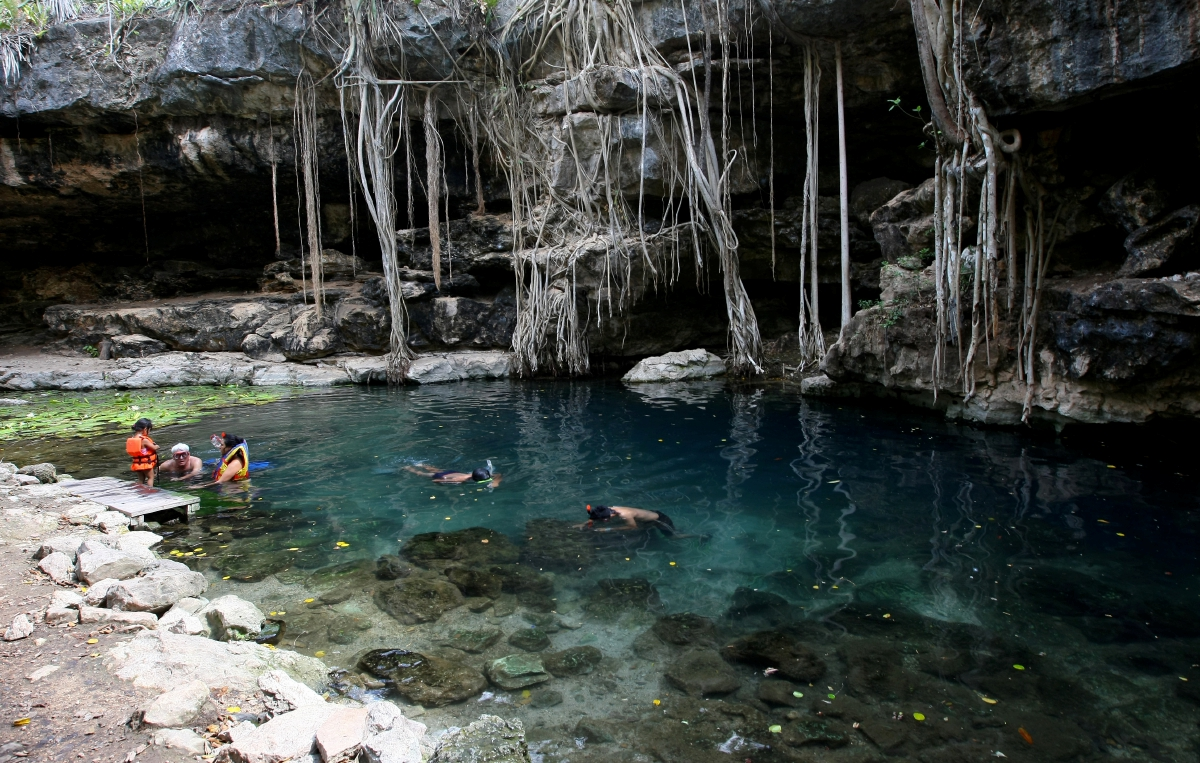
Óscar Álvarez Rivera, a researcher at the Autonomous University of Yucatán (UADY), explains that “karst landscapes develop mainly over partially soluble rocks, which slowly dissolve through the action of water and give rise to formations such as cenotes, caves, caverns, and networks of underground conduits.”
The connection between the surface and groundwater “is an essential characteristic of karst” and “at the same time, it is one of its main vulnerabilities, since it facilitates the transport of pollutants into the aquifer.”
This condition creates an “apparent paradox: there can be large volumes of groundwater and, at the same time, high water vulnerability.”
Ana Katalina Celis, director of Karst Lab México, an organization dedicated to the study, conservation, and dissemination of karst ecosystems and cenotes in the Yucatán Peninsula, says that the origin of this International Day lies in civil society initiatives, particularly those of the International Union of Speleology, and later the government of Slovenia. She highlights the participation of Mexico and civil society in these processes: Mexico voted in favor of the declaration establishing the celebration, and Karst Lab México also supported the proposal.
It is estimated that 20% of Mexico’s surface area has different karst systems in various types of climates, “from mountainous areas to the extensive limestone platform represented by the Yucatán Peninsula: cenotes, caves, grottos, rejolladas, haltunes, xuuchs, and sayabs (or water springs), which are local names for a variety of landforms characteristic of karst systems,” observes Yameli Aguilar Duarte, a researcher at the National Institute of Forestry, Agricultural and Livestock Research (INIFAP) and founding member of the Mexican Association for Karst Studies (AMEK).
In Yucatán, approximately 98% of its surface area is karstic. UNESCO recognizes that the Yucatán Peninsula, “formed by more recent limestone formations from the Cenozoic, is the karst area with the most extensive and complex system of flooded caves in the world.”
Héctor Estrada Medina, professor-researcher and head of the UADY Soil, Plant, and Water Analysis Laboratory, emphasizes: “the karst of Yucatán is not merely rock, caves, and cenotes; it is a much more complex system that integrates soil, water, vegetation, other natural resources and, of course, the people who depend on them.”
In addition to their importance as sources of water, karst territories have also served as places of refuge for human beings and have had religious and cosmological significance.
“Since the dawn of our human species,” says Carlos Evia, a founding member of the Ajau Speleological Group, “its members used caves to protect themselves from harsh weather conditions, especially at night, during winter seasons, or throughout prolonged glaciations.”
Cavities for Prayer
He also recalls that “the first Christians used these cavities to pray” and that “caves served as the first places where the Christian religion was practiced and spread.”
In the Mesoamerican region, caves were also “used by Indigenous peoples to obtain construction materials for their great structures and also as a place to carry out their various rituals according to their worldview,” he adds.
For her part, Vanya Valdovinos, a researcher at the National Autonomous University of Mexico’s (UNAM) Center for Peninsular Studies in Humanities and Social Sciences (CEPHCIS), states that the karst landscape of the Yucatán Peninsula “constitutes a physical and symbolic space linked to subsistence, memory, belonging, and conceptions of the sacred.”
In Mesoamerican thought, “the cave is conceived as an entrance to the underworld and a space of origin and renewal.”
In Yucatán, the logogram ch’een, which can be translated as “well or cave,” has been recorded since the Classic period. Today, the Mayan word ch’e’en continues to be used in this sense. For her, “the continuity of these concepts demonstrates the close relationship between cave systems and the Mayan worldview.”
To learn more about karst, the 10th AMEK Meeting, “Explore, Understand and Protect Karst,” will take place from November 4 to 6 at the UADY Faculty of Veterinary Medicine and Animal Science.

Source: yucatan