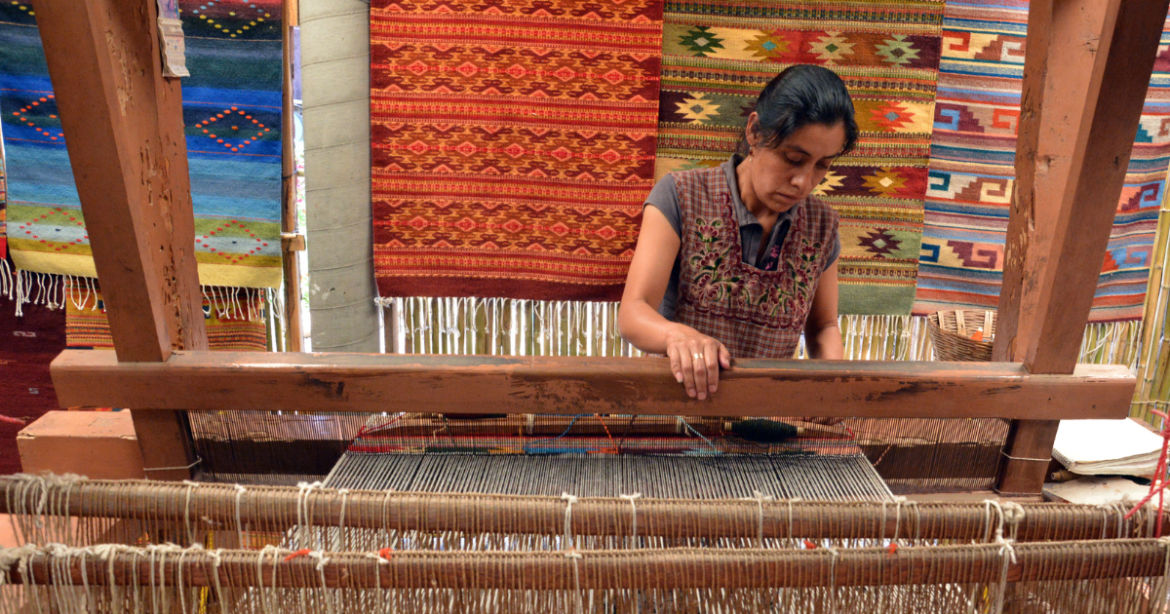

Textile craftsmanship is recognized for its cultural value and as Mexico’s living heritage, but the women who sustain it face informality, low incomes, lack of social security, care burdens, and economic violence, a report warns.
In Mexico, textile craftsmanship is celebrated as part of the country’s cultural identity: its techniques, designs, and knowledge are recognized as living cultural heritage, and public policies exist to preserve and promote the activity.
But there is a contradiction behind that recognition: craftsmanship is protected and marketed as a cultural expression, while the work of the women who produce it remains largely invisible and precarious.
This is documented in Weaving Change. For Fair Work for Women Textile Artisans in Mexico, a report prepared by Unidas, Red de Mujeres por el Trabajo Justo, based on documentary research, public data, information requests, interviews, and focus groups with workers and organizations from Chiapas, Puebla, and Baja California.
Craftsmanship is celebrated, but not the people who produce it
The report identifies a form of symbolic and cultural violence affecting the subsector: women artisans’ creations are visible as cultural commodities, but their work remains hidden.
Craftsmanship appears in markets, tourist spaces, promotional campaigns, and discussions about identity and tradition. However, this appreciation is often separated from the material conditions under which the pieces are produced.
The paradox is clear: an object can be recognized as heritage while the woman who created it is not fully recognized as a worker.
According to the report, this separation has concrete consequences. When the productive and labor dimensions of craftsmanship are not fully recognized, women’s access to labor rights, social security, and protection mechanisms is limited.
For this reason, the document argues that cultural recognition alone is insufficient: it must be accompanied by economic and labor recognition.
More than three-quarters of textile producers are women
The gender dimension of this activity is striking.
According to data from INEGI’s National Survey of Occupation and Employment (ENOE), cited in the research, 771,480 people aged 15 and over were engaged in textile craft production in Mexico during the fourth quarter of 2025; 78.5 percent were women.
In other words, women are not a marginal group within this activity: they constitute the majority of those sustaining textile-craft production.
The problem is that this feminization does not necessarily translate into economic autonomy or better working conditions.
Instead, the report documents a structure characterized by self-employment, home-based work, piece-rate payment, lack of contracts, and fluctuating incomes.
Artisanal work falls outside labor protections
One of the main difficulties is that much of the work carried out by artisans takes place under arrangements that do not fit the traditional model of formal employment.
Many work independently, within families, or in community settings. Others work from home, while some receive orders from intermediaries, workshops, or companies that establish designs, deadlines, and production conditions without formally recognizing an employment relationship.
The report refers to these situations as “concealed subordination”: an employment relationship exists, but the labor obligations that should accompany it are not recognized.
This situation leaves artisans in a vulnerable position in which they may be excluded from rights such as fair wages, benefits, and social security.
Informality also means being left without social security
The lack of labor recognition has another consequence: exclusion from social protection systems.
The report states that non-affiliation with the Mexican Social Security Institute (IMSS) is a structural condition of the subsector, related to self-employment, home-based production, low and intermittent incomes, and the absence of formal employment relationships.
Although voluntary affiliation mechanisms exist, artisans face economic, administrative, and geographic barriers to accessing them.
Even when they obtain some form of affiliation, effective access to healthcare can be limited by distance, waiting times, shortages of medication, and a lack of specialized personnel.
Thus, the right formally exists, but it does not necessarily reach the everyday lives of women artisans.
The market also benefits from their work
Inequality does not end with the lack of social security.
Artisans face commercialization relationships in which intermediaries and other actors with greater bargaining power capture a significant portion of the value generated by their pieces.
This is compounded by the plagiarism and appropriation of traditional designs and knowledge. The report documents cases in which designs created by artisans are used and marketed by third parties under other labels, without recognition of collective authorship or benefits for the communities.
In this way, cultural knowledge can become a commodity while those who produce it continue to face low incomes.
The document identifies this dynamic as economic violence and cultural extractivism.
Bordar y cuidar: dos trabajos que ocurren al mismo tiempo
Labor precarity also cannot be analyzed without discussing care work.
For many artisans, the place of production is also their home. There, they embroider, weave, or make garments while performing domestic work and caring for children, older adults, or other family members.
ENOE data cited in the report show that women textile artisans devote approximately 57 hours per week to domestic and care work, compared with approximately 38.5 hours for men in the sector.
This burden reduces the time available to produce and market their pieces, participate in collective organizations, and strengthen their economic autonomy.
For this reason, the report warns that any policy aimed at strengthening craftsmanship that does not consider care work risks reproducing the same inequalities it seeks to address.
FONART recognizes women, but guaranteeing their rights remains a challenge
The Mexican government has developed programs to support the artisanal sector. In March 2026, the Ministry of Culture presented an Integrated Policy for Strengthening the Artisanal Sector, which recognizes craftsmanship as a strategic sector in cultural, economic, and social terms and highlights the role of women artisans.
However, the report identifies limitations in implementation.
For example, FONART acknowledges that it does not have the authority to directly promote labor formalization or access to social protection schemes for artisans. In addition, although its programs formally incorporate a gender perspective, there are no specific indicators or evaluations to determine whether they are reducing the structural inequalities faced by women.
The result is a policy that can support production, training, or commercialization, but that still faces difficulties in guaranteeing that the people producing crafts have labor rights and social protection.
Recognizing the piece also means recognizing the artisan
For the organizations that participated in the research, the challenge is not simply to increase support or promote crafts in the marketplace.
The report calls for cultural, labor, economic, and care policies to be coordinated so that craftsmanship is simultaneously recognized as cultural heritage and as work.
Among the recommendations are:
- Adapt labor protections to the conditions of independent and home-based work.
- Identify concealed employment relationships.
- Facilitate access to social security.
- Strengthen direct commercialization.
- Protect collective designs and traditional knowledge.
- Develop territorialized and culturally appropriate care systems.
The challenge, the report concludes, is to move from valuing craftsmanship solely as heritage to guaranteeing dignified conditions for the women who make it possible for that heritage to remain alive.
Source: cimacnoticias