
U.S. President Donald Trump’s new offensive against so-called “birth tourism” has generated concern along the border with Mexico. For years, Mexican women have traveled to U.S. territory on tourist visas with the goal of giving birth there, a practice that is now facing greater scrutiny from immigration authorities.
The recent measures represent another attempt by Trump to restrict birthright citizenship, after the Supreme Court blocked a previous order that sought to limit this right, established under the 14th Amendment to the U.S. Constitution.
Two executive orders
“There are two executive orders issued by President Trump on August 6 to combat ‘birth tourism,’” anthropologist Víctor Clark Alfaro, director of the Binational Center for Human Rights in Tijuana, explained to EFE.
According to Clark Alfaro, the background to these executive orders is the Supreme Court ruling that stopped Trump’s previous attempt to eliminate birthright citizenship.
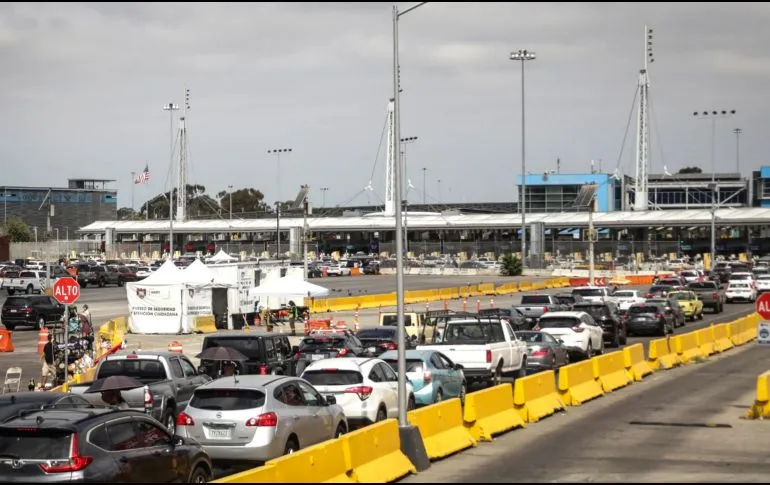
According to Clark Alfaro, the new provisions translate into greater scrutiny at U.S. ports of entry and consulates of pregnant foreign women seeking to enter the country legally.
“These are the people who will be questioned very thoroughly,” the specialist said.
A common practice along the border
The impact could be particularly significant in Tijuana, a city closely connected to neighboring California and where many families have members born on both sides of the border.
“Many people along the border, because it is part of the cultural and social phenomenon of the border, have tourist visas; their wives crossed so that their son or daughter could be born there and then returned,” Clark Alfaro explained.
The anthropologist warned that the measures could also affect parents whose children were previously born in the United States after entering with tourist visas.
“For several days now, they have already begun canceling B1/B2 visas belonging to parents whose children were born in the United States,” he stated.
The United States, however, had already restricted so-called “birth tourism” during Trump’s first term. In January 2020, the State Department changed its rules to allow consulates to deny visitor visas when they determine that the primary purpose of the trip is to give birth in order to obtain U.S. citizenship for the baby.
U.S. rules, however, allow visitors to enter the country to receive medical treatment, meaning pregnancy itself does not constitute a prohibition against entering the United States.
Concerns over potential health risks
Jesús Fabián R. Walters Arballo, president of the Baja Health Cluster in Tijuana, expressed concern about potential health consequences resulting from the tightening of border controls.
“What we do not want is for there to be a health problem or for people to be put at risk because of it,” he said.
The physician noted that a woman with a very advanced pregnancy could raise greater suspicion regarding the purpose of her trip.
“If a patient who is nine months pregnant goes to cross into the United States, it is very clear that she is going there to obtain that birth. There will probably be a restriction by CBP,” he said.
Washington’s offensive also includes actions against networks that facilitate these trips. U.S. Secretary of State Marco Rubio announced the creation of a task force to investigate so-called birth tourism and said that during its first month, authorities had taken action to revoke more than 600 visas belonging to foreigners suspected of participating in these schemes.
There are no official figures on how many foreign women travel to the United States each year specifically to give birth. The Center for Immigration Studies (CIS), an organization that advocates reducing immigration, estimated in 2020 that between 20,000 and 25,000 women did so during a one-year period between 2016 and 2017.
As Trump’s new offensive moves forward, birthright citizenship remains constitutionally protected for virtually everyone born on U.S. territory, but in border cities such as Tijuana, uncertainty is growing over the consequences that the new controls could have for binational families.
Source: informador