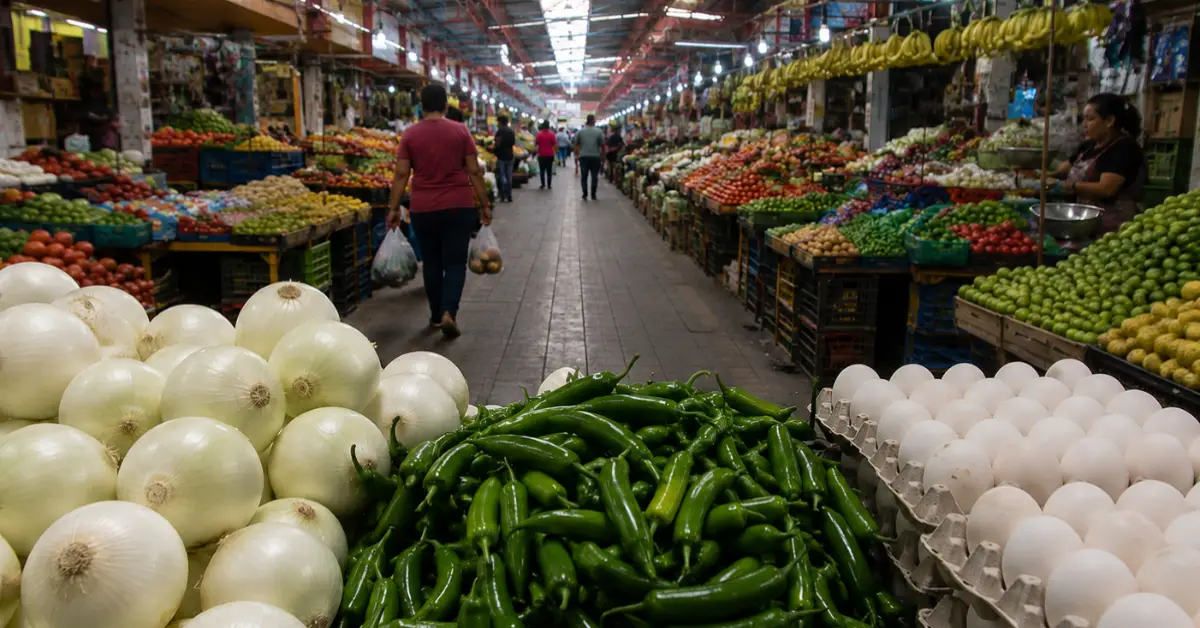

Buying groceries has become more expensive in recent months, and some products have increased more than others, such as eggs, which are among the foods that rose in price during the first half of August, according to the National Consumer Price Index (INPC).
The data show that, along with other food and beverage products, prices increased by 0.10 percent compared with the second half of July, according to the latest report from the National Institute of Statistics and Geography (Inegi).
Which foods increased in price?
During the first half of August 2026, the food and beverage products that recorded the largest price increases on a biweekly basis were the following:
Onions: Recorded the largest increase, rising 19.03 percent.
Serrano peppers: Increased in price by 8.92 percent.
Eggs: Increased by 7.92 percent.
Other fruits: Increased by 3.53 percent.
Tequila: Recorded an increase of 2.80 percent.
How many eggs are consumed in Mexico?
Without a doubt, the increase in egg prices has the greatest impact on Mexican households. According to figures from the National Poultry Association (UNA), Mexico ranks first worldwide in per-person egg consumption; each Mexican consumes an average of 410 eggs per year, equivalent to 24.1 kilograms.
In 1996, it was established in Vienna, Switzerland, that the second Friday of October each year would be celebrated as World Egg Day, with the objective of highlighting the important benefits of eggs for human nutrition and health.
Experts from the International Egg and Nutrition Center (IENC) highlight that eggs are a source of protein, contribute to healthy brain development, contain good cholesterol and vitamin A, among other nutritional benefits.
In contrast, within the same National Consumer Price Index (INPC) report, other widely consumed foods recorded biweekly price decreases, including potatoes and other tubers (-5.97 percent), tomatoes (-4.86 percent), avocados (-3.66 percent), and chicken (-1.21 percent).
Last May, tomatoes reached 80 pesos per kilogram, prompting the government to announce an agreement to contain the increase, involving government agencies and representatives of 60 wholesale food distribution centers across the country.
In addition, the head of the Federal Consumer Protection Agency (Profeco), César Iván Escalante Ruiz, proposed cooking with tomatoes or tomatillos as a way to protect household finances.
“We are proposing tomatoes or tomatillos as an alternative to using regular tomatoes. We have them starting at 30 pesos in public markets and wholesale distribution centers, and in department stores they are somewhat more expensive,” the official recommended during the People’s Morning Conference on May 11.
Foods included in the PACIC basket
With the goal of mitigating inflation, on May 29 the federal government and the private sector renewed the Package Against Inflation and Shortages (PACIC) for another six months to maintain a price cap of 910 pesos for a basket of 24 basic products, with the objective of cushioning the effects of inflation on Mexican families.
“If we had done nothing, inflation would be at 10 or 12 percent. There is nothing that harms the economy, and particularly low-income Mexican families, more than inflation,” Mexican President Claudia Sheinbaum emphasized at the time.
PACIC basic basket
The foods and products included in the PACIC basket are:
- Eggs
- Saladet tomatoes
- Jalapeño peppers
- Onions
- Carrots
- Limes
- Tuna
- Bar soap
- Toilet paper
- Pork
- Milk
- Vegetable oil
- Rice
- Chicken
- Potatoes
- Beef
- Standard sugar
- Supermarket corn tortillas
- Beans
- Apples
- Bananas
- Soup pasta
- Sliced bread
- Canned sardines
Source: expansion