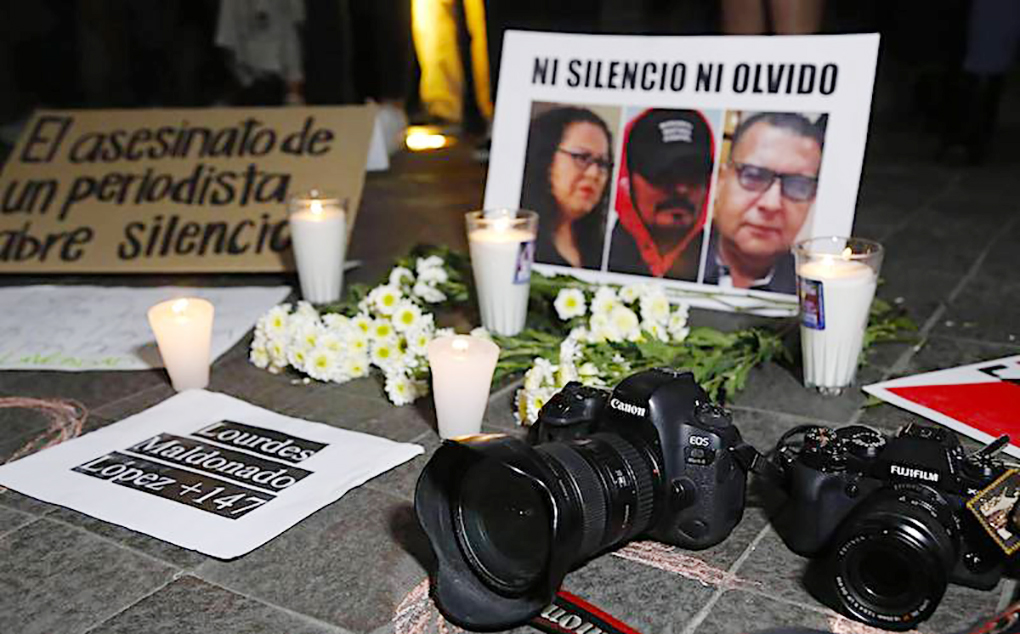

Veracruz is the deadliest state for journalists since 2000, when the alternation of presidential power began, through July 2026. Article 19 identifies the state with 34 of 181 journalist killings. It is followed by Guerrero with 17, and Tamaulipas and Oaxaca with 15 each. To date, the period with the highest number of victims, 18, occurred during the administration of Javier Duarte.
The trend of lethal violence against communicators is increasing in Veracruz, not only because of the three murders already recorded — Carlos Leonardo Ramírez Castro, Roxana Guzmán and Luis Ángel López Valdés — but also because of forced disappearances, where the state ranks second. The most recent case occurred last Monday in Poza Rica, involving reporter Eli Martínez, who, fortunately, was found alive after 12 hours.
These figures force us to reflect on why Veracruz is facing this situation. The statistics are transparent: violence in the state occurs constantly, regardless of the political party in government.
In the past, it might have been plausible to argue that the murders were solely related to political repression, but now that political alternation and legislative pluralism exist, what can be observed in Veracruz is a local governance crisis in guaranteeing freedom of expression.
In this case, governance means the ability of institutions to ensure that a person can investigate, publish and circulate information freely.
However, governments change while a territorial structure remains in Veracruz in which organized crime, municipal governments with significant institutional weaknesses or outright collusion, and impunity within the justice system converge.
The result is visible: an inability to prevent murders, despite the existence of the State Commission for the Attention and Protection of Journalists, established in February 2026; an inability to maintain territorial control, despite security operations and the federal public security strategy; and an inability to prevent political corruption.
Failures in Preventive Protection
The examples are evident. A poor assessment prevented an effective preventive strategy in the case of Luis Ángel López Valdés.
He had received threats and had protection measures, but these were only social measures because the threats were considered low risk. He was murdered on June 11 in Poza Rica.
The case of Eli Martínez is emblematic because it demonstrates the local authorities’ inability to exercise territorial control.
Eli was intercepted by armed men while he was working. He was subsequently found alive.
The incident occurred in the same location where Carlos Leonardo Ramírez and Luis Ángel López were murdered during this year.
We have already questioned this issue in this same space when analyzing other problems: who controls the territory, the constituted branches of government or the “invisible power” — which in Mexico is actually very visible: illegitimate interest groups?
Governing does not simply mean having security operations, a militarized National Guard or compliant prosecutors’ offices, or even having six-year government plans and annual budgets that include attention to these problems.
It means that institutions have the effective capacity to impose rules, protect rights and reduce risks.
The Capture of Local Authorities
Finally, the most serious issue affecting local governance is the capture and subjugation of municipal and even state authorities by organized crime or any other interest group.
In the case of Roxana Guzmán, the Veracruz Prosecutor’s Office attributed the alleged intellectual authorship of her kidnapping and murder to the mayor of Ixhuatlán del Sureste, Raúl González Martínez, and requested that his immunity from prosecution be lifted.
The investigation also indicated the alleged participation of municipal police officers and members of a criminal group.
This is an accusation made by the Prosecutor’s Office, and responsibility must be determined judicially, but politically, it is devastating.
Unfortunately, the solution to confronting the local governance crisis is not the concentration of power at the federal level. On the contrary, it can only be achieved, in the medium or long term, through the effective exercise of local powers and responsibilities within a democratic federalist system.

Source: excelsior