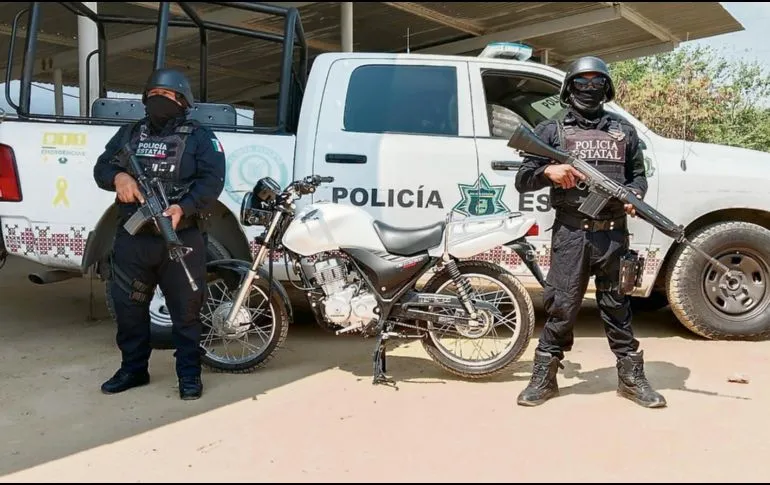

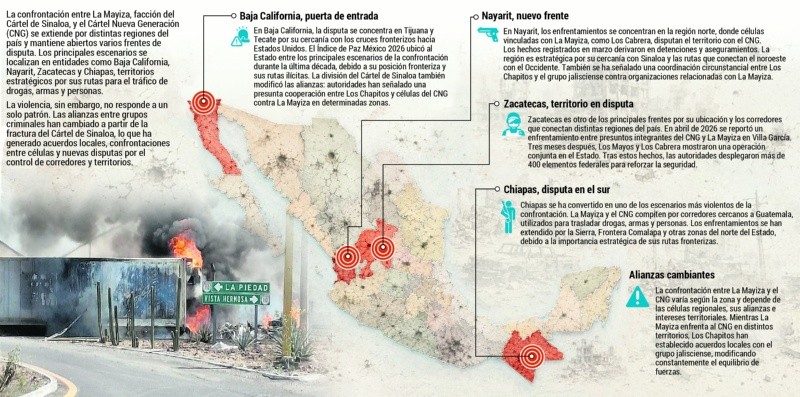
Nayarit has become a new territory disputed between the New Generation Cartel and La Mayiza. So far in August, banners attributed to criminal groups, executions, and bodies hanging from a bridge in Tepic have been found, accompanied by a message directed at state officials.
Specialists warn that the truce maintained by the criminal organizations may have come to an end with the conclusion of the World Cup, and therefore anticipate a scenario of uncertainty and a possible escalation of violence.
On August 13, two banners were found at different locations in Tepic, attributed to the CNG and La Mayiza, containing accusations and threats between the two groups. Governor Miguel Ángel Navarro Quintero questioned their authenticity but announced increased surveillance and called for calm among the population. He also acknowledged the need for federal support to confront these organizations.
Two days later, on August 15, two bodies were found hanging from the Los Lobos Bridge, at the junction of the free highway and the Tepic-Mazatlán highway. The incident increased concern over a possible expansion of the criminal dispute in Nayarit.
Violence had already reached the northern part of the state. In March, clashes and operations were recorded in municipalities near Sinaloa and Durango, resulting in 20 arrests. The presence of groups linked to La Mayiza has been reported in that area.
In addition, federal authorities have identified a suspected alliance between Los Chapitos —a faction of the Sinaloa Cartel that is at odds with La Mayiza— and the CNG.
According to the Mexico Peace Index 2026, published by the Institute for Economics and Peace, the situation stems from the fragmentation of the Sinaloa Cartel following the arrest of Ismael Zambada, “El Mayo.” The organization split into La Mayiza, linked to Ismael Zambada, and Los Chapitos, associated with the sons of Joaquín “El Chapo” Guzmán.
The report indicates that since May 2025, a suspected alliance between Los Chapitos and the CNG has been reported. This reduced clashes between the two groups in some areas, while La Mayiza and its allies focused on fighting them.
Among La Mayiza’s allies are Los Cabrera, a group that emerged in the Sierra de Durango and has been reported to have a presence in Zacatecas. In July, alleged members of both groups claimed responsibility in a video for the killing of 10 people in that state, five of whom were found hanging from a bridge.
On August 19, another clash was reported in Jerez, Zacatecas, between alleged members of the CNG and the faction linked to “El Mayo” Zambada. Six alleged hitmen were killed.
Francisco Jiménez Reynoso, an academic at the University of Guadalajara, warned that the truce between the cartels has ended. He considered that the two factions could intensify episodes of violence, particularly following the death of “El Mencho” and federal operations against regional leaders.
Rubén Ortega Montes, also an academic at the University of Guadalajara, stated that the Western Region will face a period of uncertainty, awaiting the reaction of criminal organizations, particularly the Jalisco-based group following the operation to arrest Heraclio Guerrero, “Tío Lako.”
Cartel conflict leaves thousands dead across the country
The conflict between the Sinaloa Cartel and the New Generation Cartel (CNG) left approximately 30,000 confirmed deaths between 2015 and 2024, although the actual toll could be higher, according to the Mexico Peace Index 2026, prepared by the Institute for Economics and Peace (IEP), based on records from the Uppsala Conflict Data Program (UCDP).
The report warns that the figures may not include all confrontations involving affiliated cells and allied groups. The 30,000 victims represent nearly 29% of all deaths resulting from cartel conflicts recorded in Mexico during that period, making the dispute between the Sinaloa and Jalisco organizations the deadliest of the last decade. In second place was the confrontation between the CNG and the Santa Rosa de Lima Cartel, with approximately 18% of the victims, followed by the conflict between the Sinaloa and Juárez cartels, with 13%.
In total, more than 103,000 Mexicans died between 2015 and 2024 as a result of conflicts between criminal organizations, violence that spread across much of the country and caused homicides, displacement, and disputes over territorial control.
Confrontations related to the rivalry between Sinaloa and the CNG, including clashes with affiliated groups, were recorded in at least 19 states. Baja California accounted for 55% of the deaths, followed by Zacatecas, with 14.9%; Colima, with 11.4%; Jalisco, with 9.5%; and Quintana Roo, with 4.1%. The Index states that the CNG’s national expansion was largely directed against the Sinaloa Cartel, contributing to the high number of homicides recorded during the final years of the 2010s.
Violence reached its peak in 2021, with approximately 15,000 deaths related to cartel conflicts. Although it subsequently began to decline, the level remained high. By 2024, the last year covered by the UCDP, documented deaths had fallen to fewer than 11,000, a reduction attributed in part to a reconfiguration of the criminal landscape and less direct confrontation between some groups.
However, the decline did not mean the end of violence. The internal war within the Sinaloa Cartel between Los Chapitos and La Mayiza altered the criminal balance. Deaths linked to this dispute increased from two cases in 2019 to 215 in 2023 and 1,005 in 2024.
The report also documents reports of a suspected alliance between Los Chapitos and the CNG since May 2025. This possible association may have reduced confrontation between the two groups in some territories and once again altered the map of alliances. Thus, criminal fragmentation, new alliances, and disputes over strategic territories keep the risk of new episodes of violence alive.
The peace pact has ended
Although the World Cup prompted a kind of “truce” among cartels and their various factions and allies, specialists warn that the agreement may have come to an end following the recent violent events recorded in several states. The dispute over territories, routes, and leadership could intensify and generate even more severe episodes of violence.
Francisco Jiménez Reynoso, a security specialist and academic at the University of Guadalajara, stated that during the World Cup, criminal groups may have reduced their confrontations because of increased security, the presence of state and federal forces, and international scrutiny of Mexico.
“As a kind of truce while the World Cup was taking place. Why? Because, in some way, the eyes of the world were going to be here and there was going to be extreme surveillance. In my opinion, it was not convenient for them to have violence in the streets,” he explained.
The academic anticipated that the pause would end after the event. “But I also said at the time that once this international event was over, the truce would very likely end and we would return to reality, but in an intensified manner.”
From July 19, when the sporting event concluded, through August 20, violent incidents were recorded in different states. In Tepic, Nayarit, banners attributed to La Mayiza and the New Generation Cartel (CNG) were found, in addition to two bodies hanging from the Los Lobos Bridge. In Tijuana, Baja California, a banner was also found alongside two pig heads: the message contained threats against the state prosecutor, María Andrade Ramírez, and other officials from the state Attorney General’s Office.
In Michoacán, the operation to capture Heraclio Guerrero, alias “Tío Lako,” triggered roadblocks and the burning of vehicles. On August 19, six alleged members of criminal groups were killed in a confrontation between the CNG and La Mayiza in Jerez, Zacatecas.
Jiménez Reynoso did not rule out the possibility that violence could spread to Jalisco due to the so-called “cockroach effect” and warned of a possible internal dispute over leadership of the CNG.
For his part, Rubén Ortega Montes, also an academic at the University of Guadalajara, stated that federal operations could provoke a criminal reaction and anticipated months of uncertainty while the new balance among organizations is determined.
“The presence of these cartels, cells associated with the Sinaloa Cartel or the CNG, makes Jalisco and the region unsafe,” he concluded.
They are fighting over territories
Source: informador