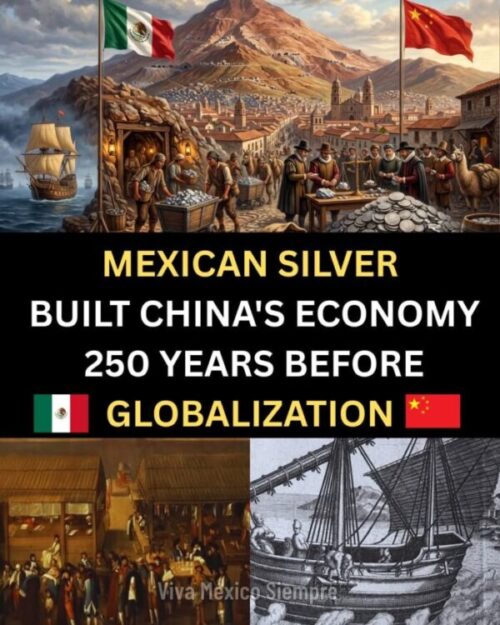

Long before modern supply chains defined international commerce, Mexico served as the vital geographical and economic bridge connecting Asia, the Americas, and Europe. Beginning in 1565, the Manila Galleon route-known historically as the Nao de China-established a nearly 9,000-mile maritime connection across the Pacific Ocean linking Manila to the port of Acapulco. For two and a half centuries, this grueling voyage operated with remarkable continuity, serving as one of the longest-running trade networks in human history and laying the structural groundwork for early global commerce.
The commercial exchange was built on a high-value bilateral trade of Asian luxuries for American mineral wealth. Chinese silk, porcelain, spices, jade, and lacquerware arrived in Acapulco to be traded at major colonial fairs, from where goods were transported overland to Veracruz for shipment to Europe. In return, Mexican silver extracted from mines in Guanajuato and Zacatecas flowed westward across the Pacific in massive quantities. This silver influx was so substantial that it became the foundation of Chinas monetary standard, fueling its domestic economy for generations and illustrating Mexico’s central role in the emerging world economy.
This centuries-long transpacific contact left an indelible mark on Mexican culture, craftsmanship, and daily life. The iconic traditional Puebla dress, the China Poblana, carries cultural roots tied to this Asian-Mexican exchange, while Puebla renowned Talavera pottery reflects direct stylistic influences from traditional Chinese ceramics. Furthermore, agricultural mainstays like mangoes and coconuts reached Mexican shores via these very galleons, integrating permanently into the nation’s culinary identity. Ultimately, the Manila Galleon route demonstrates that sustained globalized trade is far from a modern invention, with colonial Mexico acting as its historic epicenter.