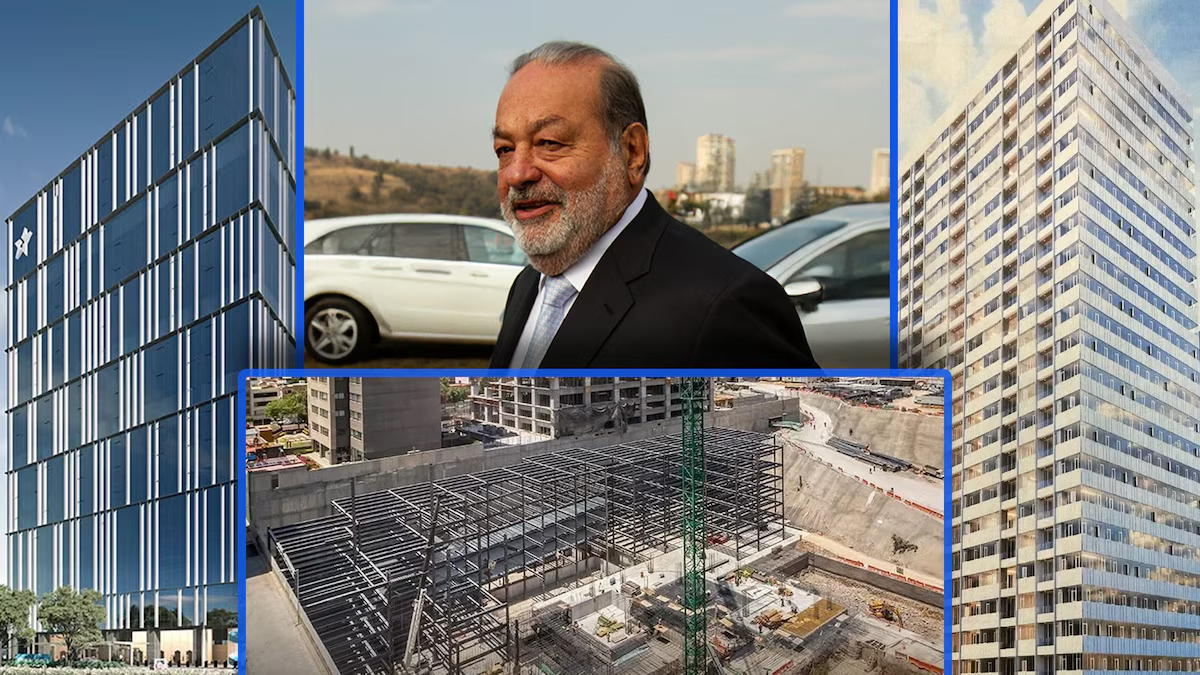

Mexican businessman Carlos Slim is building, brick by brick, a mini-city within Polanco. His real estate arm, Inmuebles Carso, currently has three major projects underway in this area of Mexico City: a hospital, a shopping center, and a complex combining residential and office space.
Together, the projects represent an investment of 17.3 billion pesos, according to the company’s latest annual report filed with the Mexican Stock Exchange. All of the projects have been active since late 2025, and most are expected to be completed in the final months of this year or in early 2027, according to the company.
Carlos Slim is not only one of Mexico’s most prolific businessmen and an important Pemex partner through his infrastructure companies; he also has a long history as a real estate developer in the capital, and Polanco has been one of the areas where he has invested most heavily for more than a decade.
Why is Polanco key for Carlos Slim?
Polanco is not just any area for Slim’s business empire. More than a decade ago, what is known as Nuevo Polanco emerged there, in an area that was previously home to facilities belonging to General Motors, Chrysler, and General Tire.
That project is called Plaza Carso and, according to Inmuebles Carso’s report, involved an investment of more than 800 million dollars. The complex brings together office towers, luxury apartments, a shopping center, the Museo Soumaya, the Museo Jumex, the Acuario Inbursa, and the Telcel Theater.
The three projects Carlos Slim has in Polanco
The largest project currently underway is Carso III, managed by the Plaza Carso II subsidiary. It includes the construction of three apartment towers, one office tower, and an expansion of the existing shopping center.
The investment amounts to 10.2 billion pesos, and by the end of 2025, the project was 60 percent complete. The main contractor is Operadora CICSA —the construction company of Grupo Carso itself—, followed by Manufacturas Metálicas Ajax.
Another project is Pabellón Polanco, a shopping center that opened in 1990 and for years was aimed at a young upper- and upper-middle-class clientele. The work involves a complete renovation of the property.
The subsidiary Inmuebles SROM is developing a mixed-use project there, with an investment of 4.6 billion pesos. The construction progress reported at the end of 2025 was 41 percent, and once again, Operadora CICSA appears as the main construction provider.
The third project is a hospital. Plaza Carso II is building the Hospital Star Médica Polanco, part of the network of hospitals that Inmuebles Carso develops and leases on a long-term basis to Grupo Star Médica, one of the fastest-growing hospital chains in Mexico.
The investment in this development is 2.5 billion pesos, and it is the project with the greatest progress: 90 percent at the end of last year.
Outside Polanco, Slim has urban projects
Polanco is not the only area of Mexico City where Inmuebles Carso has a presence. According to its annual report filed with the Mexican Stock Exchange, the company has also promoted the rehabilitation of Mexico City’s Historic Center.
This includes improvements to properties such as the Hotel Bamer and Hotel Virreyes, as well as apartments and commercial spaces under the Carso Alameda brand.
In other areas of the capital, Inmuebles Carso participates in shopping centers such as Plaza Universidad, Plaza Satélite, and Plaza Insurgentes.
Added to this is an office and residential project identified as Palmas 265, located in the Lomas de Chapultepec neighborhood, which the company’s annual report lists among its developments of “great relevance.”
The contrast of the development promoted by Slim in Polanco
Not everything in Polanco’s history is skyscrapers and museums. A few meters from the Plaza Carso towers, Cerrada Andrómaco remains, an alleyway of approximately 60 to 80 houses where families descended from the former factory workers who occupied the area before Slim’s arrival continue to live.
While buildings of up to 20 stories, luxury offices, and haute cuisine restaurants have risen around them, single-story houses, neighbors who have known one another for decades, and even small home-style eateries remain in the alley.
Andrómaco residents have accumulated years of complaints about the traffic generated by the new towers, the loss of sunlight caused by the height of the buildings, and the lack of agreements with real estate companies regarding road-impact mitigation projects.
Social anthropologist Adriana Aguayo, from the Metropolitan Autonomous University (UAM), compared Cerrada Andrómaco to an island in the middle of one of the country’s most expensive real estate developments, according to BBC.
Source: elfinanciero