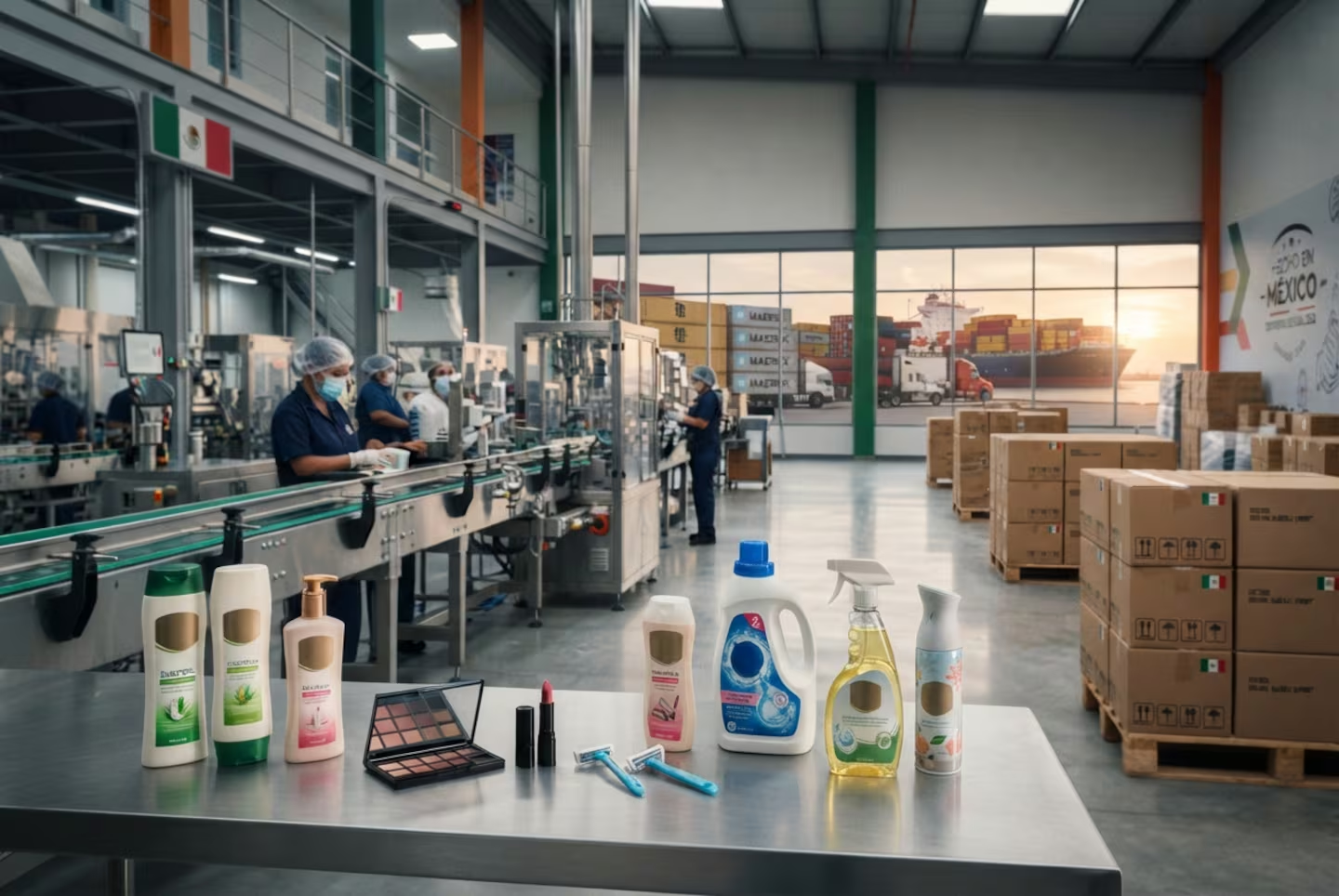

Mexico is not only a major consumer of personal care and household products. It has also become a relevant player in the international trade of this industry, with manufacturing capacity that allows it to supply both the domestic market and various destinations abroad.
Shampoos, conditioners, makeup products, razors, fabric softeners, air fresheners, and cleaning products are part of an industry that maintains intense commercial activity and that, according to the National Chamber of the Cosmetic Products Industry (CANIPEC), has one of its main production and export centers in Mexico within Latin America.
During a presentation on the sector’s foreign trade outlook, Carlos Pessuca, executive president of CANIPEC and the National Association of the Personal and Household Care Products Industry, highlighted Mexico’s importance within these value chains and the challenges facing the industry amid an increasingly changing international environment.
One of the figures that helps illustrate the importance of the sector is Mexico’s position in the international market.
The country is currently the leading exporter of cosmetic products in Latin America and the third-largest cosmetics manufacturer in the region, behind only the United States and Brazil. Worldwide, Mexico ranks twelfth among exporting countries in this industry.
This position is the result of a commitment by various companies to manufacture in Mexico. The industry not only seeks to meet the demand of Mexican consumers, but also to use the country as a platform for delivering products to other markets.
Trade also has a direct effect on production chains, employment, and foreign-exchange earnings. The industry maintains a positive trade balance, meaning that Mexico exports more products than it imports in both personal care and household care.
Which Cosmetic Products Does Mexico Export the Most?
Among the main export categories are hair preparations, including shampoos, conditioners, and other hair products.
Razors and makeup preparations also stand out.
In the household care segment, products with the largest share include air fresheners, fabric softeners, and surface cleaners.
This shows that Mexican export activity does not depend on a single product, but rather on a group of categories related to consumers’ everyday needs.
Mexican Exports Begin Growing Again
After a 2025 marked by various changes in the international environment and exchange-rate movements, the industry is reporting positive signs during 2026.
According to data presented by CANIPEC, between January and April 2026, Mexican exports from the sector exceeded 1.43 billion dollars, compared with approximately 1.3 billion dollars recorded during the same period in 2025.
This performance represents a recovery and points toward a favorable trend for the industry’s foreign trade.
The performance is significant because exports do not simply represent sales to other countries. They also mean economic activity, employment, and foreign-exchange inflows for Mexico.
The sector had also recorded a record year in 2024 and, although it experienced a slight decline during 2025, the industry considers the decrease explainable by external factors rather than a structural change in the sector’s strength.
The U.S. market continues to be the main destination for Mexican exports of cosmetics, personal care, and household care products.
More than 60% of the industry’s exports are destined for the United States, although this dependence is lower than that observed in other sectors of the Mexican economy, where concentration in the U.S. market can reach much higher levels.
For CANIPEC, this difference is important because it reflects the efforts made to expand destination markets and reduce trade concentration.
In addition to the United States and Canada, an important portion of Mexican exports goes to other countries in Latin America and the Caribbean.
This diversification has become one of the sector’s strategic objectives in response to the new conditions of international trade.
The USMCA, a Key Component for the Industry
The United States-Mexico-Canada Agreement (USMCA) occupies a central position in the industry’s trade strategy.
Trade relations among the three countries are entering a new stage, while Mexico seeks to preserve conditions that allow the largest possible number of sectors to remain tariff-free and continue taking advantage of North American production integration.
CANIPEC has participated in consultations and working groups organized by the Secretariat of Economy, while also maintaining communication with counterpart organizations in the United States and Canada.
For the sector, this coordination is particularly important because it is an industry with deeply integrated supply chains and companies operating in different markets.
One objective is to maintain free trade, but also to advance the adoption of better regulatory practices that eliminate unnecessary obstacles to trade without reducing consumer protection.
Mexico Seeks New Markets for Its Products
Although the United States remains Mexico’s main trading partner, the industry’s strategy is increasingly focused on other markets.
One example is the Pacific Alliance, made up of Mexico, Colombia, Chile, and Peru. Within this framework, organizations representing the cosmetics and household cleaning industries promoted joint proposals to facilitate trade and encourage better regulatory practices.
The work resulted in specific sectoral annexes for cosmetics and household cleaning products, an experience that the industry considers a reference for other trade negotiations.
Brazil is another market that the Mexican industry considers strategic.
CANIPEC and its Brazilian counterpart, ABIPEC, signed a bilateral agreement aimed at expanding trade between the two countries.
This is complemented by dialogue between the health authorities of Mexico and Brazil to advance regulatory harmonization and better practices.
The possibility of reducing regulatory differences could make it easier for more Mexican products to reach the Brazilian market while also facilitating the entry of Brazilian products into Mexico.
Diversification is not limited to the American continent.
Europe represents one of Mexico’s main trading partners, particularly in terms of imports, but the industry considers that there is room to increase the presence of Mexican products in that market.
Strengthening trade agreements with Europe is viewed as an opportunity to generate greater stability and competitiveness.
The Comprehensive and Progressive Agreement for Trans-Pacific Partnership (CPTPP) is also significant, as it supports important trade relationships, including the relationship between Mexico and Canada.
The United Kingdom’s accession to this agreement also represents an opportunity to expand trade ties.
More Resilient Supply Chains Without Closing the Doors to the Outside
One of the challenges facing the industry is building more resilient value chains.
However, resilience does not necessarily mean producing all inputs within Mexico. The industry recognizes that there are raw materials and components whose local production would be too costly or even unviable.
Therefore, the objective is to find a balance: strengthen domestic production where it is competitive to do so while maintaining access to inputs from other markets.
The goal is to build supply chains capable of responding to international changes without generating unnecessary costs for companies or consumers.
Beyond export figures and trade agreements, one of the main challenges is maintaining the industry’s competitiveness at the same pace as consumer needs change.
The cosmetics and personal care sector is characterized by constant innovation, with new products and formulations designed to offer greater benefits.
For these innovations to reach consumers efficiently, the industry considers it necessary for regulatory frameworks to evolve and for trade agreements to facilitate exchange.
Ultimately, the goal is to combine competitiveness, innovation, consumer protection, and trade openness.
Mexico starts from a strong position: it is the leading exporter of cosmetics in Latin America and has an industry that has maintained a significant presence in international markets. The next challenge will be to preserve that position while expanding its export destinations and strengthening its value chains.
Diversification toward Latin America, Brazil, Europe, and other markets could thus become one of the keys for Mexico to maintain and expand its international leadership in cosmetics, personal care, and household care products.
Source: cronica