
The noise of high-speed pickup trucks entering Nueva Colonia Hindú, a rural area of Tecate, woke several residents on Rubén Adame Street during the early hours of Monday, August 31. Neighbors said they intended to turn on the lights in their homes to find out what was happening, but after seeing a convoy of heavily armed men with their faces covered, one resident said he remained completely still to avoid being seen, fearing retaliation for witnessing the events.
Security cameras captured late-model Chevrolet Silverado pickup trucks speeding down the main street while playing “Ángel Azul” by Grupo Edición Especial at full volume. The convoy stopped in front of the gate of a ranch. Armed men got out of the vehicles and used a chain to tear down the entrance gate.
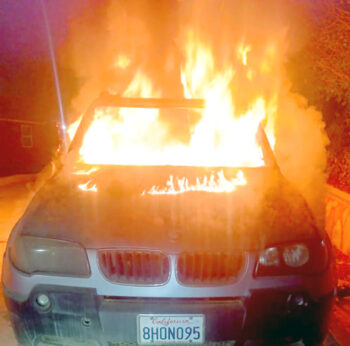
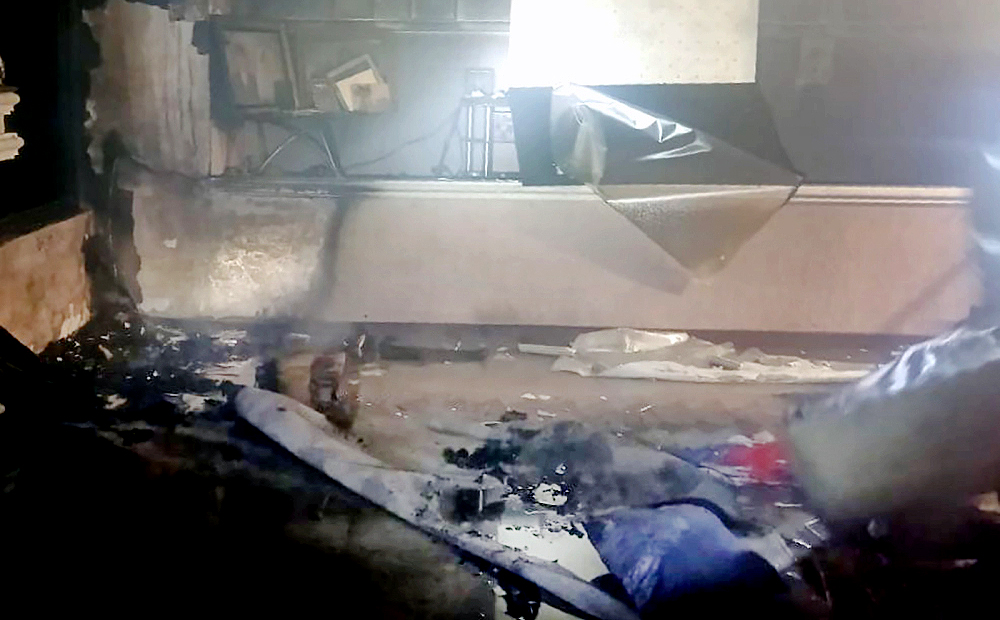
They entered along the main road toward the house, sprayed fuel on furniture and walls, and set the property on fire. Before leaving, they also burned a vehicle that was in the property’s yard. Authorities reported that the attackers were identified as members of the criminal structure of the Sinaloa Cartel. Days earlier, some of them had also been seen committing crimes in the neighboring delegation of Valle de Las Palmas, also in Tecate.
According to investigators, the armed group was searching for Sergio Serrano, known as “El Checo.” The attack took place at the home where he had lived until May 2026, the same property that had already been targeted three other times by convoys of hitmen from the Sinaloa criminal structure in attempts to kill him.
Authorities identify Serrano as one of the main leaders of the Jalisco New Generation Cartel (CJNG) operating in Tecate. He was arrested on May 13 during an air-and-ground operation on the Tecate–Ensenada highway. He attempted to flee for more than 30 kilometers in a gray Jeep with foreign license plates 9KHN808 and vehicle identification number 1C4RJXR68RW241187. He also allegedly fired weapons and used objects known as “tire puncturers” to obstruct the patrol vehicles pursuing him.
Despite his repeated entries into and releases from state prisons and previous arrests linked to organized crime, Serrano was provisionally released three months after his arrest, on August 23, 2026, by René Octavio Cardona González, a District Judge Specialized in the Accusatory Criminal Justice System assigned to the Federal Criminal Justice Center in Baja California.
The judge also granted provisional release that same day and at the same time to Arturo Zedillo Pulido, alias “El Pelucas,” who had been arrested in April while carrying an arsenal and quantities of methamphetamine while allegedly operating for the Sinaloa Cartel’s Los Mayos faction. He was turned over to the Attorney General’s Office (FGR) for offenses related to drug dealing and organized crime.
Three minutes after being released following Serrano’s release, and a few meters from the main entrance of the La Mesa Social Reintegration Center, “El Pelucas” was killed.
With Serrano back in freedom, violence in Tecate intensified. Investigators warned of a CJNG “settling of scores,” after the cartel accused several of its operators of betrayal. Following the arrests of Serrano and Salomón Barragán, known as “El Salo,” the criminal structure was weakened, and several operators allegedly joined the Sinaloa side to continue committing crimes.
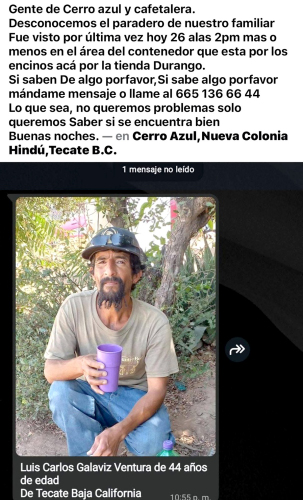
In less than 72 hours, six men were killed, including a 19-year-old athlete. Another 11 men were reported kidnapped or forcibly taken. When the violence appeared unable to escalate further, during the early hours of Tuesday, September 1, alleged CJNG gunmen threw Molotov cocktails at the same home where police officer Cristhian Alfredo Sandoval Aguilar, then head of the Robbery Unit and assigned to Tecate, had been killed. The attackers then fled in a black pickup truck.
That same Tuesday at 6:00 a.m., gunmen killed a man on Manganeso and Diamante streets in the Bondad neighborhood. He was driving a maroon Nissan that, according to relatives and acquaintances, was used to provide private transportation services through a group known as G4. Hours later, the transportation group announced that, “due to internal administrative matters, the company has made a name change,” and would now operate as Transporte Baja.
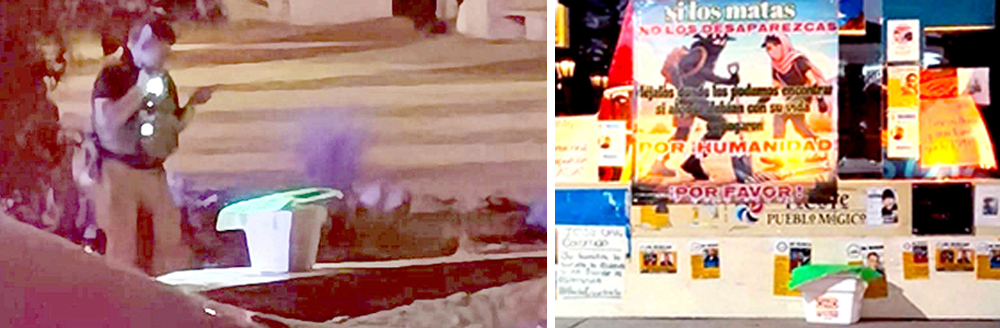
Nearly 12 hours later, the escalation reached a critical point when three narco-banners were placed at different locations, two of them accompanied by coolers, triggering a major police mobilization throughout the city.
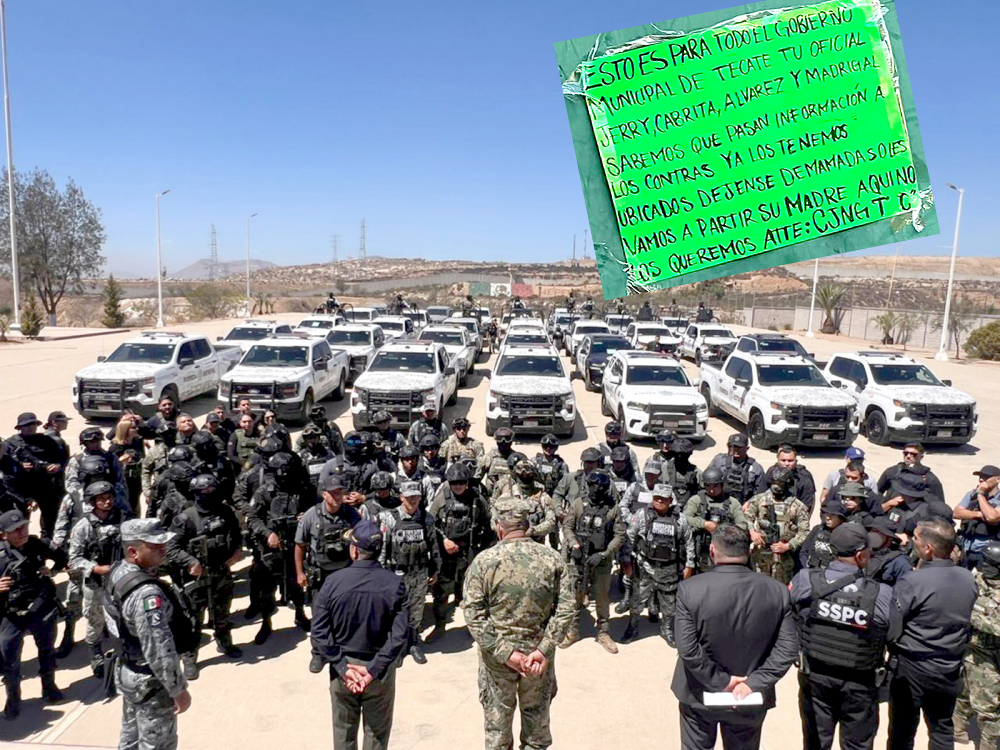
Minutes before 7:00 p.m., authorities were warned about the first narco-message placed in the El Descanso neighborhood on Luis Donaldo Colosio Murrieta Avenue. State and federal agents confirmed the discovery of a fluorescent green poster signed with the initials CJNG, containing a message directed at the government and municipal police:
“THIS IS FOR THE ENTIRE TECATE MUNICIPAL GOVERNMENT, YOUR OFFICERS JERRY, CABRITA, ALVAREZ AND MADRIGAL. WE KNOW YOU ARE PASSING INFORMATION TO THE OPPOSITION. WE ALREADY HAVE YOU LOCATED. STOP YOUR NONSENSE OR WE WILL BEAT THE HELL OUT OF YOU. WE DON’T WANT YOU HERE. ATT: CJNG T C” [sic].
Nearly an hour later, at 7:52 p.m., Officer Madrigal, who was named among the four officers allegedly collaborating with the Sinaloa group and threatened through the narco-messages, reported an armed attack at his home in the rural delegation of Nueva Colonia Hindú in Tecate. The incident turned the threats into a clear message to authorities that the Jalisco-based criminal group was willing to kill police officers.
The municipal officer, identified by the surname Madrigal, told fellow officers that a blue Suburban pickup carrying men with long guns had arrived at his home. The men fired at the house and then fled toward Cañón Manteca. Although a major search operation was launched to locate the attackers, no arrests were made.
Just days earlier, on Friday, August 28, Officer Madrigal had reportedly been “picked up” after failing to report for work for several days. He reappeared on Sunday, August 30, with visible signs of violence. Authorities said that, so far, no official complaint had been filed regarding what may have happened to the officer.
Almost immediately afterward, another emergency report was received. A cooler bearing the OXXO logo and another fluorescent green poster had been abandoned near the large Tecate letters in the city’s central park, where the Municipal Palace is located. The men who left them reportedly drove away in a compact vehicle along Ortiz Rubio Street.
Although more than 12 cameras operate in Miguel Hidalgo Park, considered the epicenter of the Magical Town area—with half belonging to C5 and another five positioned along the route the suspects allegedly used to flee—authorities were not alerted in time to what was happening. Even after receiving the alert and information from C5, authorities were unable to make any arrests.
Shortly afterward, a second cooler accompanied by another fluorescent green poster was abandoned on Defensores Avenue, in Bicentenario Park, also one block from the Municipal Palace. Both coolers were secured and authorities reported that they contained stones. The posters carried the same message as the first one found in the El Descanso neighborhood.
Among the officers threatened in the narco-messages was Officer Álvarez, whom investigators identify as Enrique Álvarez. He has been the target of at least three armed attacks in recent years and has repeatedly appeared in narco-messages dating back to the administrations of Olga Zulema Adams, Darío Benítez, and now the current administration of Román Cota Muñoz.
The person referred to as “Cabrita” was identified as Ángel Delgado, an active-duty municipal police officer who has been linked to the Sinaloa Cartel.
On Wednesday, September 2, Mayor Román Cota acknowledged the complexity of the security situation facing Tecate:
“Since the weekend, we became aware of an escalation of violent incidents. The issue has already been addressed at the state Security Meeting, and operations are already being carried out to address this. As these posters confirm, there is a dispute between criminal cells; they accuse each other of collaborating with one another, and they are seeking territorial control.”
Cota said that the process of removing officers who should not remain in service would continue:
“A month ago, two officers were suspended and arrested as part of investigations. We cannot rule out that there are still others, although I must clarify that not all police officers are bad; there are also good officers in Tecate.”
Three hours later, another man was killed in Colonia Militar. He was identified as Carlos, 30, who was shot while driving a Ford Super Duty with Baja California license plates.
Amid the escalation of violence and efforts to regain control of Tecate, General Laureano Carrillo, Secretary of Security in Baja California, announced the immediate activation of Operation “Cóndor 4 in Tecate.” The operation consists of more than 200 personnel from multiple law-enforcement and security agencies, operating with 40 patrol vehicles and K-9 units. These special groups are tasked with capturing and deterring individuals responsible for generating violence.
The operation includes personnel from the State Citizen Security Force (FESC), the State Attorney General’s Office (FGE), the Secretariat of Security and Citizen Protection (SSPC), the National Guard, the Army, the Navy, and the so-called “Harfuch” units.
“Tecate is not alone, and if criminals, regardless of which group they belong to, think there will be no response, we will make it clear to them that there will be one starting today,” one of the commanders warned.
Tecate has recorded 125 homicides so far in 2026, one of the highest figures in its history.
Source: zetatijuana