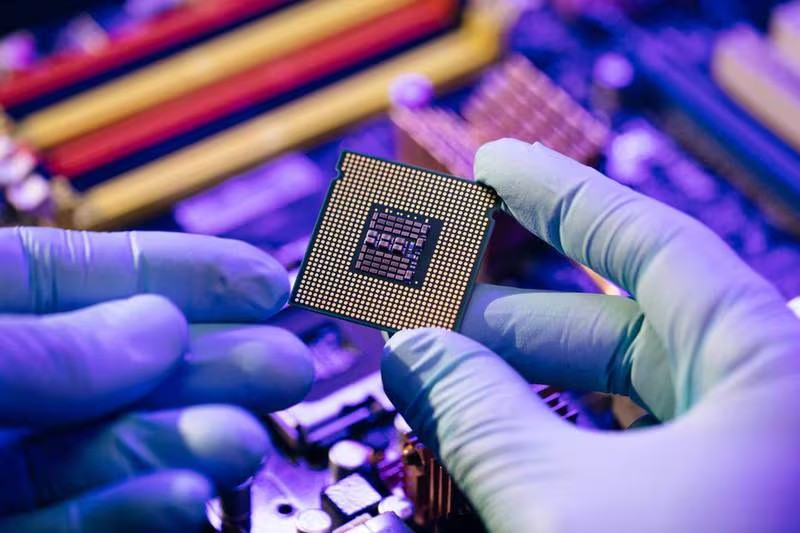

The automotive and telecommunications sectors, among others, depend 100% on semiconductor supplies
:quality(70)/cloudfront-us-east-1.images.arcpublishing.com/elfinanciero/QD7NZSEABZGPRB632FVDPVWKYI.jpg)
Mexico is in negotiations with more than a dozen companies from Taiwan, a leading country in the world manufacturing of industrial semiconductors, while the US announced an alliance to strengthen the region in the development of these essential microcomponents for some sectors such as the automotive industry.
Armando Cortés, general director of the National Auto Parts Industry (INA), told El Financiero that the country has become a pole of attraction for investments for the global semiconductor supply chain, which during the pandemic suffered a shock that paralyzed many industries, including automobile manufacturing.
“Currently, there are a number of Taiwanese companies already located in Mexico; perhaps the most representative are between 5 and 10 companies. We are going to hold business meetings, we hope that around 10 Taiwanese companies will be looking for business meetings in Mexico,” he said in an interview.
For almost a year, Mexico has received a delegation of more than 20 companies and representatives from the Taiwan External Trade Development Council (TAITRA), the Taiwan Electrical and Electronic Manufacturers Association (TEEMA) and the Taiwan Printed Circuit Board Association (TPCA), with national businessmen and chambers.
The main interest is in finding new opportunities, mainly for the semiconductor industry with the relocation of companies (nearshoring) in North America.
“We are looking to promote strategic partnerships between Mexican and Taiwanese companies linked to high technology projects and vehicle electronics mainly; we have a couple of business meetings that we are going to develop this year with Taiwanese companies to identify projects in powertrain issues or electronic modules within vehicles,” added Cortés.
The representative of the auto parts industry explained that currently the North American region has a very high dependence on semiconductors that come from Asia, as well as other components such as electric batteries.
According to a report by the international consulting firm TrendForce, only at the end of 2023 the Taiwanese semiconductor manufacturer TSMC became the largest company in the world with revenues in the last quarter of up to 19,669 million dollars, followed by the South Korean Samsung with 3,619 million dollars in sales and in third place the American GlobalFoundries with 1,854 million dollars.
Taiwan leads
“The dependence on semiconductors from the US is very high in Asia, 70 percent of the semiconductors that the US uses in the digital industry come from Taiwan and in that sense, for the first time in public policy (of the Biden administration) and in the law, the need to have a public policy to promote semiconductors in the region is mentioned,” he insisted.
It is worth mentioning that recently, in April 2024, the US government announced an alliance with Mexico to promote investment and semiconductor design in the region, given the great challenges facing the automotive industry with electromobility, as well as the progress in others such as medicine, the technology industry, household appliances and Artificial Intelligence.
The alliance between both countries proposes the creation of an International Technological Innovation and Security Fund (ITSI), created by the CHIPS Act (Creation of Useful Incentives to Produce Semiconductors) of 2022.
“This fund provides the State Department with 500 million dollars, that is, 100 million dollars annually for five years, to globally promote the development and adoption of secure and reliable telecommunications networks, as well as to guarantee the security of semiconductor supply chains and their diversification,” the Biden government reported in a statement.
Mexico has stood out for participating in the design stage of microchips or semiconductors for the entire industry, with large projects such as Intel in Guadalajara, Skyworks in Baja California, Infineon, QSM Semiconductores and Qualcomm, among others.
According to a survey by the consulting firm KPMG, in 2024 the automotive sector, AI, the Internet of Things, Data Centers and telecommunications will drive the demand for semiconductors.
Source: elfinanciero