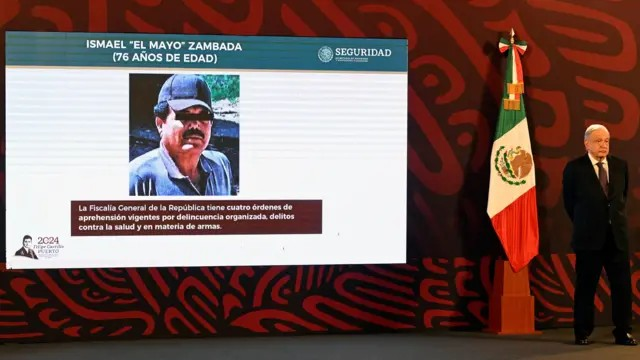

The arrest of Mexican drug lord Ismael “El Mayo” Zambada by the United States on Thursday caused international shock, but also left several questions unanswered.
Zambada, 76, had for decades avoided arrest in his home country as the leader of the Sinaloa cartel he founded with Joaquin “El Chapo” Guzman, who is serving a life sentence in a U.S. prison.
The first question is how exactly the arrest of a drug lord who seemed unreachable by law enforcement on both sides of the border came about.
U.S. media reports, citing anonymous U.S. officials, that El Mayo was tricked on a plane to El Paso, Texas, by a high-ranking member of the Sinaloa cartel.
Some even say that the person who turned him in was Joaquin Guzman Lopez, the son of El Chapo who was arrested with El Mayo.
Falko Ernst, senior analyst in Mexico for the International Crisis Group, warns that if this is confirmed, there could be new acts of violence within the Sinaloa cartel.
This expert on organised crime considers it likely that an internal struggle will arise for the new leadership of the organisation, but rules out major changes in the drug business in Mexico.
And he points out that another question is how much Zambada will reveal about his links with governments, since it is believed, according to different testimonies, that for years he gave bribes and collaboration in exchange for remaining free.
“If someone like El Mayo were to open up completely and release all the information, it would be something potentially quite destabilising for bilateral relations,” says Ernst in an interview with BBC Mundo.
How astonishing is the arrest of El Mayo Zambada in the US considering that he had managed to evade capture in Mexico for decades?
There was indeed a long career on his part. In that sense, the capture at this time is a surprise.
But if we also look at the trajectory of the biggest historical drug lords in Mexico, there has not been one who has escaped death, extradition or a Mexican prison.
So it should not be too surprising. But we do not know much about how this arrest came about.
Falko ErnstImage source,International Crisis Group
Image caption,Falko Ernst points out that there are about 200 criminal groups linked to drug trafficking in Mexico: “If you take away one or two, the structure does not change.”
Reports have emerged based on unidentified US security officials indicating that Zambada was flown to the US by deception by Joaquín Guzmán López. How do you take this?
It is still speculation. There are several journalistic sources that cite different sources within the US security forces.
There have been many internal tensions within the Sinaloa cartel, with the Chapitos, the Mayos and all the factions. In this context, a move of this type would make some sense.
The cartel is not a monolithic organization, it is an agglomeration of different currents, clans, families and factions where there has already been much internal fighting.
If the theory that it was an internal betrayal that led to the arrest is actually established, one could expect even greater friction and, therefore, greater acts of violence between those who identify themselves as part of the Sinaloa scene.
What the American sources say is that Guzmán López handed over Zambada to help his brother Ovidio, who is imprisoned in the US. Would such a betrayal be extraordinary in the world of drugs?
To betray a figure like El Mayo would be something quite extraordinary because, whoever does that betrayal, would have to face the fear of reprisals. That is not free.
But at the same time we are talking about drug trafficking in Mexico, which is a world of constant betrayal, of seeking profits and personal advancement, of protecting oneself and those closest to one. It comes down to loyalty to blood family.
Source: bbc