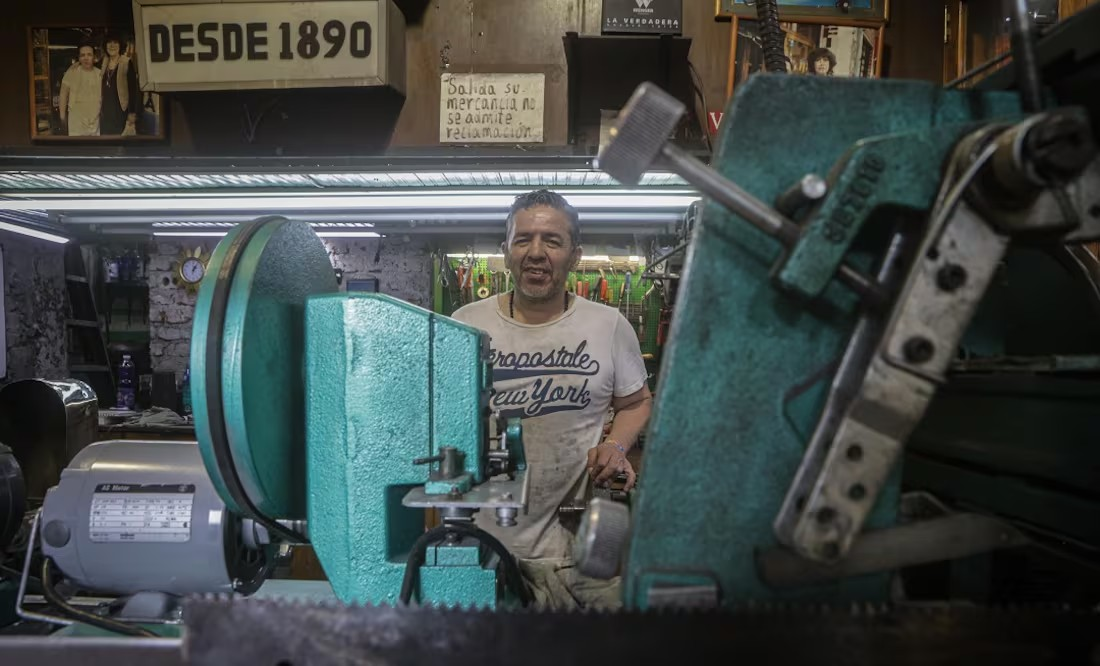

Federico Ruiz Vasconcelos arrived in Mexico City when the Revolution had broken out. The movement forced him to leave his tannery in Oaxaca and prevented him from returning to Spain, his country of origin. Once in the capital of the country, he received remittances of glass and ironwork from Europe that he almost sold to a Jew in his shop on Cinco de Mayo Street, in the Historic Center, but outside the business a man offered him money for his ironwork. Motivated by his first client, Federico founded La Montañesa in 1917, a hardware business that witnessed the transformations of the Center and that now gentrification has displaced.
From Federicio, La Montañesa passed into the hands of his son, Federico Jr., and from him to his son Ramón Ruiz de la Concha, who together with his son Andrés, 25 years old, run the current administration. Initially, the business was located in Plaza Primo de Verdad, in Pino Suárez, then it moved to number 1 of the same street, later the Montañesa moved to premises 100 on Uruguay Street, where it remained open until February of this year, when the rent increase to double forced them out of the premises. In its space, merchandise now enters and leaves moved by “Koreans”, as they call foreign merchants, who have concentrated a good part of the popular market in the streets of this area. In Allende, for example, bridal dress merchants have closed their premises, replaced by advertisements with Chinese letters that decorate the facades.
Although gentrification is a hot topic due to the number of cases of evictions, displacements and occupations that coincide with the arrival of foreigners and “digital nomads” —who can afford the prices of the real estate market—, this phenomenon, which has antecedents in the Center itself, “is not characterized by ethnic or nationality inequalities, but by economic and political inequalities linked to the differential capacity of consumption and private property, power over real estate and urban investments,” explains Vicente Moctezuma Mendoza, anthropologist and researcher at the SNI, author of The Fading of the Popular: Gentrification in the Historic Center of Mexico City (Colegio de México, 2021).
Play Video
La Montañesa never owned the premises where it was located. In contrast, one of its neighboring businesses is Hermanos Migliano, run by Antonio, Eugenio and Alberto Migliano, a business specializing in hardware and leatherwork founded by grandfather Juan in 1889. These brothers of Italian descent own part of the building located between Pino Suárez and Uruguay; on this last street, at number 108, La Montañesa had to set up shop improvisingly in an old house whose wooden gate contrasts with the life inside, far from the hustle and bustle. The establishment opens from Monday to Friday, from 10 in the morning to 2:30 in the afternoon, but it is behind closed doors; sales are made online and only the material is picked up or sent. Inside, Ramón walks back and forth, answering phone calls from his prospective clients. Meanwhile, Andrés, his son, displays the badges that decorate a room adapted as a warehouse.
Source: eluniversal