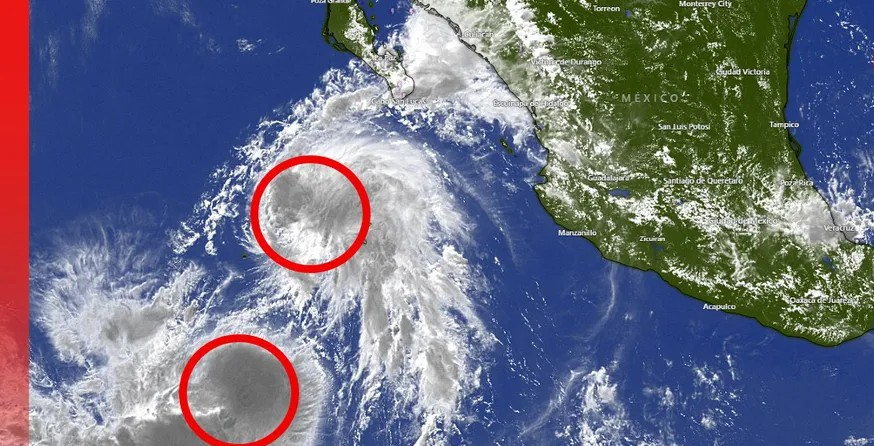


Tropical storm Fabio will be absorbed by tropical storm Emilia tomorrow Wednesday in the Mexican Pacific, reported the National Meteorological Service (SMN). It is a strange event, named Fujiwhara, and here we tell you what it entails.
Both systems will join “south-southwest of the coasts of Baja California Sur”, while moving west-northwest, the agency detailed in the 96-hour extended forecast.
When two cyclones join together, a strange event occurs, due to the rarity of its occurrence, which is called the Fujiwhara effect, according to the Meteorological Office of the Australian government.
The effect is considered rare because it does not usually happen that two tropical cyclones are in the same area at the same time, added the Australian agency. “The interaction begins to occur when they are about 1,400 kilometers away.”
If a system enters the domain of the other, a natural, almost magnetic attraction is recorded. “In this situation, the two cyclones begin to orbit around a common center, almost like a dance.”
In case one phenomenon is “stronger than the other, the smaller one will orbit it and eventually crash into its vortex to be absorbed,” said the National Weather Service (NWS) of the United States.
What happens when two cyclones of similar strength come together?
If both cyclones have a similar strength, then they gravitate towards each other until they reach a common point and merge; or they can simply rotate one on the other for a while before shooting off on their own paths.
“On rare occasions, the effect is additive when hurricanes come together, resulting in one larger storm instead of two smaller ones,” added the NHC.
Where are cyclones ‘Emilia’ and ‘Fabio’?
The SMN keeps watch on the phenomena surrounding the national territory. Here we share with you the latest report on tropical storms Emilia and Fabio.
Emilia is intensifying and could reach hurricane status as it moves away from national coasts. The center of the system is located 1,135 kilometers south-southwest of Cabo San Lucas, Baja California Sur.
On the other hand, Fabio is located 825 kilometers west of Manzanillo, Colima, and 610 kilometers south-southwest of Cabo San Lucas, Baja California Sur. It is not expected to increase in intensity, but its circulation will cause rain in Mexico.
Source: milenio