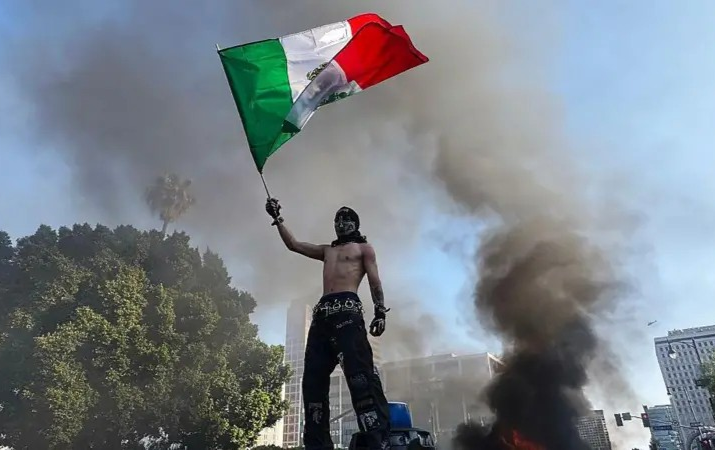

A man waves the Mexican flag while perched on a partially burned and graffiti-covered car in the middle of a street that resembles a battlefield.
This photograph, taken in Paramount, a town south of downtown Los Angeles where clashes between federal agents and protesters protesting the Trump administration’s immigration raids were reported over the weekend, has dominated front pages and circulated on social media, going viral.
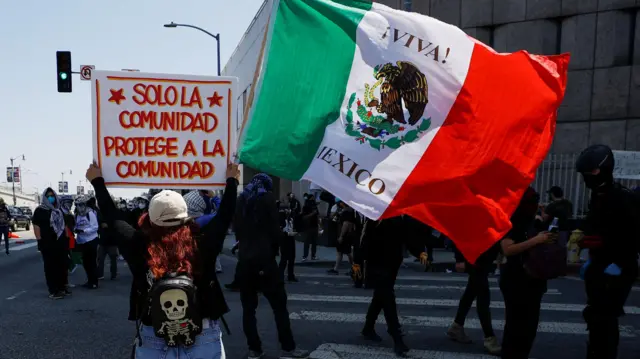
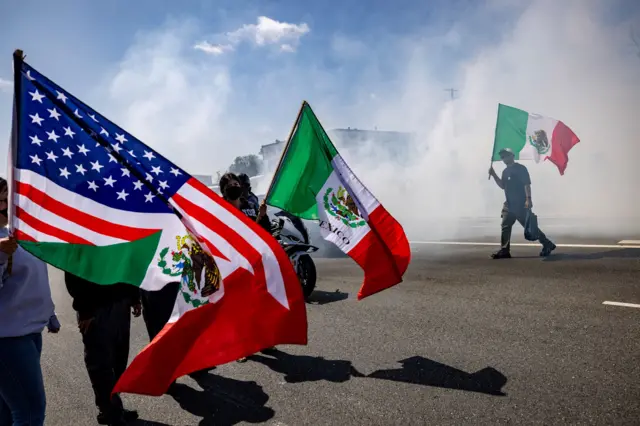
Other images have also been seen that reflect a more peaceful tone of the protests in the California city.
In them, the presence of the tricolor flag with the eagle, the snake, and the cactus is ubiquitous, so much so that mainstream US media outlets are already describing it as one of the symbols of the protests.
A fact that has not gone unnoticed by US government officials, who have been quick to condemn the scenes that, they say, portray those they describe as “insurgents waving foreign flags.”
“Our flags represent national identity, pride, and shared values, not division or lawlessness. Flying a foreign flag while attacking US law enforcement and destroying public or private property only damages a bilateral relationship that works together to make all our citizens safer and more prosperous.”
In response, some protesters are urging their peers not to wave Mexican flags. “Displaying them feeds the narrative that this country is experiencing an invasion,” says Beatriz Antún.
But others disagree. “When I see a Mexican flag at a protest, I feel less alone,” Carlos Ramírez, a university student of Mexican descent, tells BBC Mundo.
“It’s a statement of unity and visibility,” explains Patrick Díaz on his TikTok channel. By displaying the Mexican flag, “we express our identity and resist the idea that we must hide who we are to belong.”
“Insurrectionists with foreign flags”
“Insurrectionists carrying foreign flags are attacking immigration agents, while half of the US political leadership has decided that policing the border is evil,” US Vice President J.D. Vance wrote on the social media platform X on Saturday.
By then, after two days of protests and isolated riots, President Donald Trump had already ordered the deployment of 2,000 National Guard troops to help “restore law and order” to the California metropolis in the face of the “inability” of local authorities.
“Violent, insurrectionist mobs are harassing and attacking our federal agents in an attempt to halt our deportation operations. But these unlawful riots only strengthen our resolve,” the president wrote on his Truth Social social network.
“Order will be restored, undocumented immigrants will be removed, and Los Angeles will be free,” he added, despite the categorical rejection of the state’s governor, Democrat Gavin Newsom, who described the decision as a “maneuver that will only escalate tensions.”
In his ongoing standoff with the federal government, Newsom announced a lawsuit over the measure, while other Democratic governors have called it “an alarming abuse of power.”
Added to this is the Pentagon’s announcement on Monday that it is activating 700 Marines in the Los Angeles area to assist in the federal response to the protests.
Meanwhile, the marches don’t seem to be stopping, nor do the protesters seem willing to leave their flags at home.
“Not a single American flag in sight,” wrote one user on the social media platform X, sharing a video showing a burning car in the Los Angeles neighborhood of Compton and at least five Mexican flags.
This message was quickly echoed by Stephen Miller, White House advisor and one of the main architects of the administration’s harshest immigration policies, adding: “Insurrection.”
The use of the term by both Miller and Vance has led many to question whether the Trump administration is considering invoking the Insurrection Act of 1807, which allows the executive branch to deploy troops to the territory in the event of a rebellion.
The president first floated the idea in January, when, in issuing the executive order declaring an emergency on the border, he gave Defense Secretary Pete Hegseth and Homeland Security Secretary Kristi Noem 90 days to advise him on whether to invoke the law to help ensure “complete operational control” of the area bordering Mexico.
However, when asked Sunday whether he was willing to invoke the law now, Trump told reporters in New Jersey that “it depends on whether or not there’s an insurrection.”
When asked if he thought that was happening in Los Angeles, he said, “No, but there are violent people, and we’re not going to let them get away with it.”
Reference to roots and a sense of community
And in that sense, the Mexican flag is becoming associated with the protesters who wave it.
“Comments like those by Miller and Vance appeal to an audience that doesn’t know the history and only add fuel to the fire among those who don’t understand the reason the Mexican flag is flown,” Alexandro J. Gradilla, associate professor of Chicana and Chicano Studies at California State University, Fullerton, told BBC Mundo.
And by this, the expert isn’t just referring to the fact that California—as well as the US states of Nevada, New Mexico, Texas, and Utah—were once Mexican territory.
Or that California is home to more than 10 million foreign-born people, including some 1.8 million without legal status, according to 2022 data from the Pew Research Center.
A fact that Mexican President Claudia Sheinbaum recently alluded to, noting that “the United States would not be what it is if it weren’t for the Mexicans working on the other side.”
This Sunday, the president said she disagreed with the raids in the United States and urged its northern neighbor to pass immigration reform.
However, “many of those who fly the Mexican flag today are American citizens by birth,” Gradilla clarifies.
A Salvadoran day laborer who has lived in the US for five decades and managed to regularize his immigration status in 2000 emphasized the same thing to BBC Mundo at Paramount: “Many are coming out to protest because their parents or previous generations endured so much time in the shadows.”
“I am a very proud American,” Elizabeth Torres, 36, told The New York Times, holding a Mexican flag outside a Los Angeles detention center where protests have erupted.
“But I must also show support for our Mexican brothers and sisters,” added the woman, whose grandparents emigrated to the United States.
“In that sense, as full citizens, they should be able to raise whatever flag they want,” Professor Gradilla continued.
“Would it be a good idea to fly the American flag? Maybe so, but we should rather question why it generates such a rejection among some,” adds the expert, who believes it has to do with the fact that some sectors consider them “second-class citizens.”
Be that as it may, for Gradilla, the use of the flag in protests has nothing to do “with narratives of Mexico vs. the U.S.”
“It represents family, identity, culture,” he explains.
Those who are taking it to the streets these days “are people who have a sense of history, of community, because for a long time this flag has been a symbol of inclusion, of belonging, for an economically and socially marginalized community,” he concludes.
Source: bbc