An 8.8 magnitude earthquake struck eastern Russia yesterday, triggering a tsunami in the North Pacific, prompting alerts for Alaska, Hawaii, Japan, Ecuador, Mexico, and New Zealand.
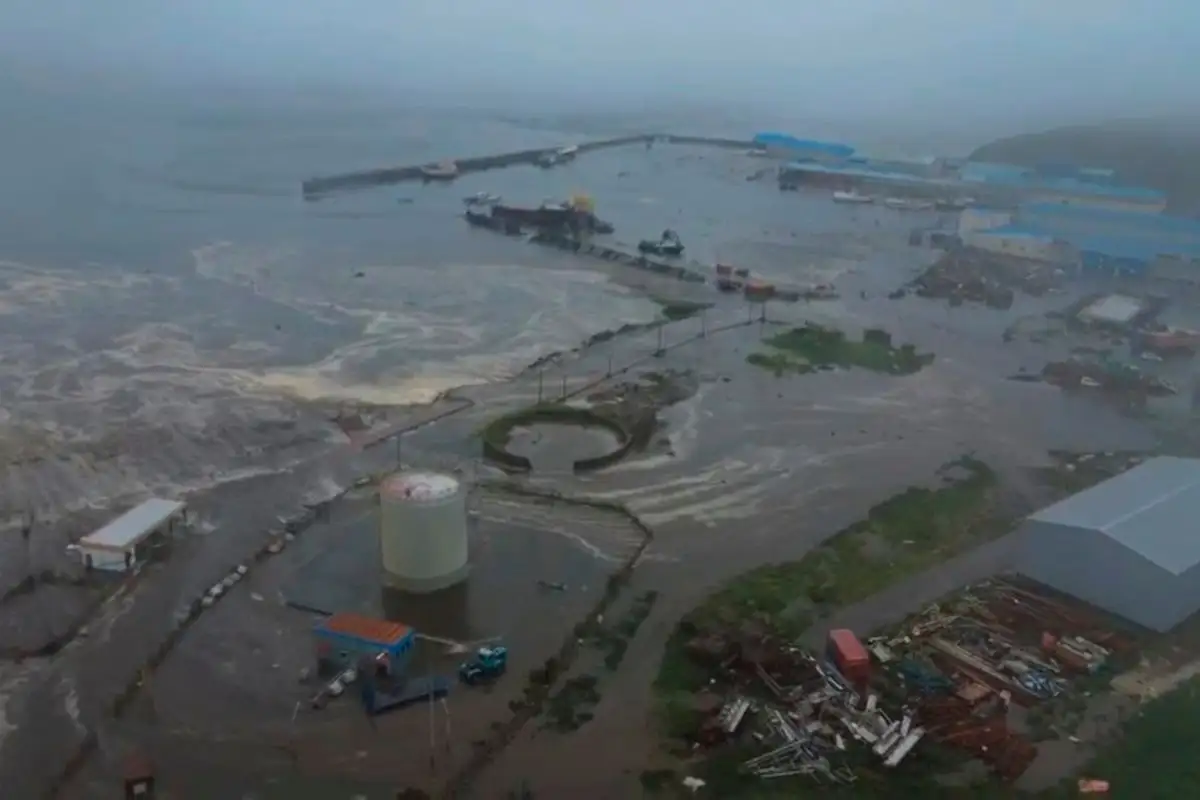
The wave triggered by the earthquake partially flooded the Russian city of Severo-Kurilsk, the Russian Emergencies Ministry reported, urging residents to remain on high ground until the tsunami threat passed.
Russian authorities said that rescue teams and firefighters on the peninsula were examining buildings for damage and said no casualties were immediately reported.
Russia’s Tass news agency reported that at the time of the quake, people in Petropavlovsk-Kamchatsky ran out of their homes with only a few clothes on, while some furniture fell inside the houses, cars swayed in the streets, and buildings shook noticeably. Power outages and cell phone service interruptions were also reported.
Workers at the Fukushima nuclear plant in northeastern Japan were withdrawn after alarms were raised about a possible scenario similar to the 2011 tragedy, when a magnitude 9 earthquake generated a huge wave, which flooded the facilities and caused meltdowns at a nuclear power plant at the Japanese plant. Plant operators reported no immediate abnormalities.
At press time, authorities in the Sakhalin region of Russia’s Far East declared a state of emergency in the Kuril Islands, where tsunami waves damaged buildings and caused flooding. In Ecuador, the Risk Secretariat ordered the preventive evacuation of beaches, piers, and low-lying areas in the tourist Galapagos Islands due to a tsunami warning.
In Crescent City, Northern California, tsunami warning sirens sounded, while Governor Josh Green reported, based on data from Midway Atoll, that waves could reach up to 1.8 meters, although he said it was too early to predict their magnitude.
Among the most intense
The earthquake struck at 8:25 a.m. Japan time. The U.S. Geological Survey said the quake occurred at a depth of 20.7 kilometers.
The quake appeared to be the strongest anywhere in the world since the March 2011 earthquake off northeastern Japan, which measured magnitude 9 and caused a massive tsunami. Only a few stronger earthquakes have been recorded worldwide.
Sirens also sounded in Honolulu, Hawaii, where authorities urged people to move to higher ground.
The Pacific Tsunami Warning Center reported that waves of one to three meters above sea level were forecast for some coastal areas of Hawaii, Chile, Japan, and the Solomon Islands, as well as some coasts of Russia and Ecuador.
The Pacific Tsunami Warning Center indicated that the tsunami could cause damage throughout the Hawaiian Islands.
President Donald Trump urged the public to stay strong and safe in a post on his Truth Social network.
The U.S. National Tsunami Warning Center, based in Alaska, also issued warnings for parts of the U.S. Aleutian Islands and an advisory for territories on the west coast, including California, Oregon, and Washington.
New Zealand authorities, meanwhile, issued warnings of unusual strong currents and unpredictable waves along the coasts of the entire country. The government emergency management agency’s alert indicated that people should leave beaches and stay away from ports, marinas, rivers, and estuaries.
New Zealand is located in the South Pacific, about 10,000 kilometers from the epicenter.
Alerts extended to Australia, according to the Pacific Tsunami Warning Center, with possible waves of 0.3 to 1 meter along the country’s coast.
Japanese media reported that several whales mysteriously appeared off the coast of Tateyama City, Chiba Prefecture, Japan.
Source: jornada