
The week is starting relatively calm, at least with regard to the extent of rainfall due to the effects of an anticyclone that brought stability. But this will change rapidly in the coming hours as tropical systems increase in frequency, increasing rainfall, storms, and hail, and cooling off.
Don’t be surprised by the changes!
A tropical wave is moving over the western part of the country, impacting the next 24 hours before moving away. A new tropical wave is moving across the Yucatán Peninsula today, Monday, and reaching the Isthmus region tomorrow, Tuesday, to cross the south-central region on Wednesday, encompassing the Valley of Mexico.
From Thursday to Friday, this wave is expected to move from the center to the west, and at the same time, a new tropical wave is expected to enter the southeast, moving from Quintana Roo to Chiapas. The effects of these systems are expected to continue over the weekend in the south-central region, with a further increase in heavy rain and storms.
The first week of August was a contrasting one, starting with heat and scattered rain, with an increase in storms due to a possible tropical cyclone that would help cool the atmosphere. It is important to take extreme precautions due to these variations.
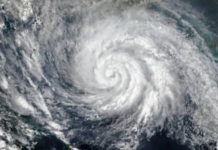
Midweek, a tropical cyclone is very likely to develop from Wednesday to Friday off the southern coast of Oaxaca to Jalisco, close enough to the coast to increase rainfall, but without any threat of impact. This system will once again bring heavy rain conditions from the southeast to the northwest.
Wind gust forecast in km/h
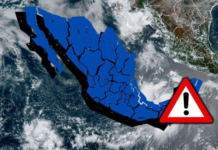
A disturbance with the potential to become a tropical cyclone is reportedly forming in the south of the country and moving parallel to the coast.
At the beginning of the week, the flow of moisture toward the Sierra Madre Occidental has reportedly slowed, causing the Mexican Monsoon to weaken significantly for a couple of days, generating very scattered storms. Starting Thursday, moisture will return due to the tropical cyclone, with its reactivation being more significant over the weekend with intense, more widespread storms.
Storms, Wind, and Hail
The instability generated by the rainy season in Mexico is due to tropical waves, cyclones, and the Mexican Monsoon, supported by the terrain to strengthen the storms. These are precisely the conditions we will experience in the coming days, and they will increase as the month progresses. We still have time to take preventive measures.
Which states will have the most rain?
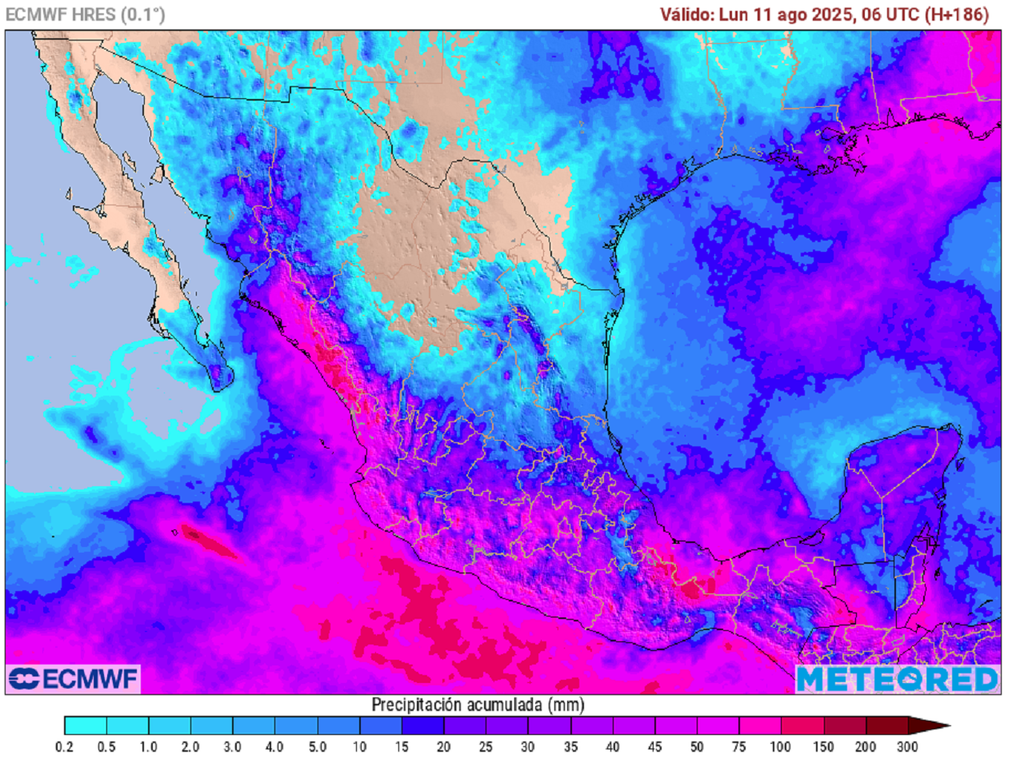
Sonora, Sinaloa, Nayarit, Jalisco, Colima, Michoacán, the State of Mexico, Mexico City, Morelos, Guerrero, Oaxaca, Veracruz, Chiapas, Tabasco, and the interior of the Yucatán Peninsula are still expected to average 50-75 mm, reaching maximums of 100-250 mm in the mountains and coasts from Chiapas to Nayarit.
Rainfall forecast in millimeters
From west to southeast, rainfall will become more abundant and frequent, with highs of up to 200 meters or higher expected as a cyclone approaches.
The most notable rainfall will begin Wednesday as the cyclone moves, and over the weekend, humidity and instability could combine to generate the strongest monsoon-induced storms in the Sierra Occidental and the central Sierra, from the Bajío region to the Valley of Mexico.
Where would it rain the least?
Baja California, Baja California Sur, and much of Chihuahua, Coahuila, Durango, Zacatecas, Aguascalientes, Nuevo León, Tamaulipas, and the San Luis Potosí Plateau would expect minimal to no rainfall, with isolated events of 5-20 mm not ruled out. From the mountains of Nuevo León to the southern Gulf of Mexico, occasional heavy rainfall of 20-50 mm would occur.
Trend for the Coming Weeks
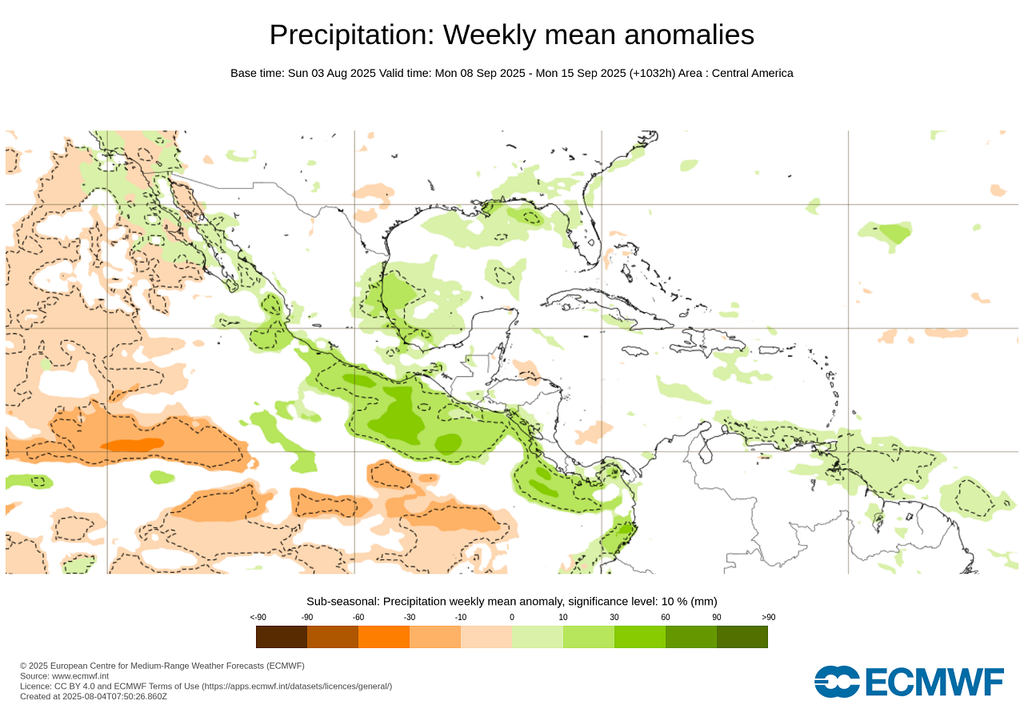
All suggested models and scenarios indicate increasingly rainy conditions as the days of the month pass, especially from mid-to-late August due to the interaction of several systems, not only locally but also regionally/globally.
Rainfall Anomaly Forecast
Over the next few weeks, tropical instability will increase significantly, with possible flooding; the south-central region, the Pacific, and the Gulf Coast are under close surveillance.
First, it has already been mentioned that we will have more cyclones and tropical waves in the country, an increasingly active monsoon, and the local effects of troughs and the relief. But what will this more active tropical system cause? The Madden-Julian Oscillation could enter its convective phase.
This will cause atmospheric circulation to become optimal for the rise of warm, humid air, forming large cloudy areas and enhancing any areas of disturbance with rotation. Therefore, cyclones will also increase, not only in the Pacific but also in the Atlantic. The entire population in the Caribbean, Gulf of Mexico and Pacific must be vigilant.
Source: meteored