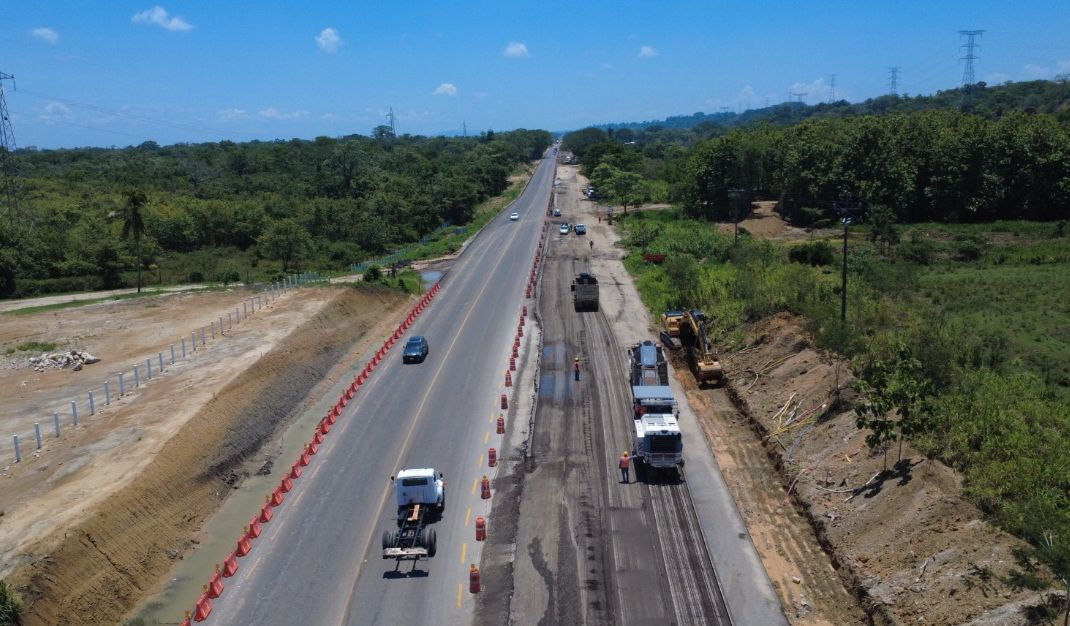

The Mexican government announced progress on two of the highway infrastructure projects considered “priority axes” within Plan Mexico, as well as on one of the “continuity projects” that began during the term of former President Andrés Manuel López Obrador.
Plan Mexico contains priority axes that will be implemented during President Claudia Sheinbaum’s six-year term, which ends in 2030.
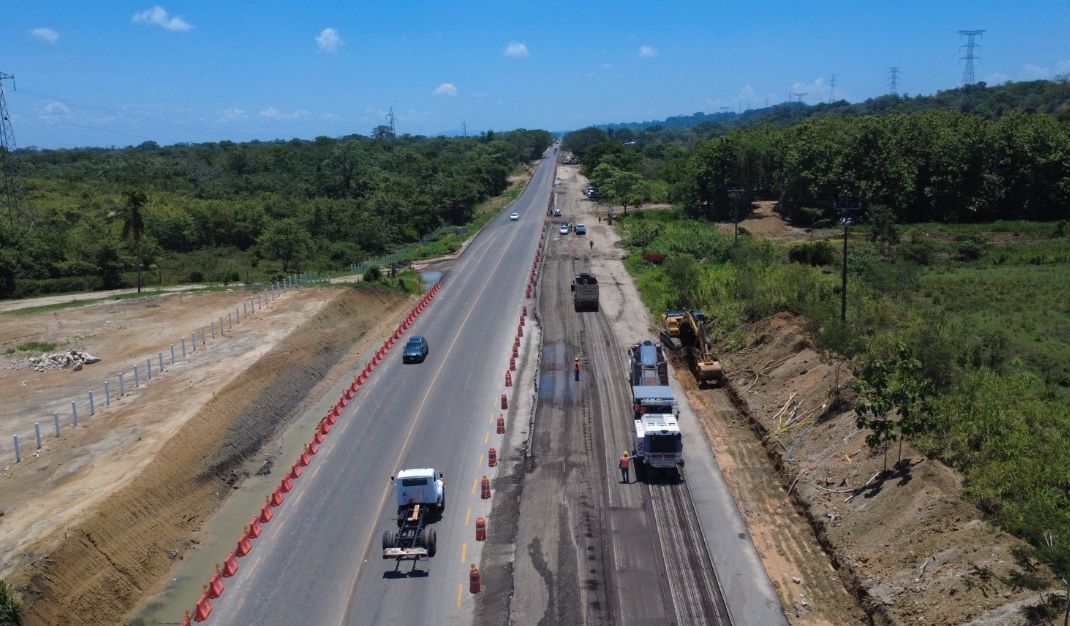
First, this is the expansion of the Villahermosa-Francisco Escárcega federal highway, which “will connect the southeast of the country, promoting tourism in the Palenque, Chiapas, and Campeche areas. The work, in this region alone, will benefit 370,000 users. The project will have an investment of just over 1 billion pesos [US$53.3 million] this year, which includes supervision and environmental monitoring,” said the Ministry of Infrastructure, Communications, and Transportation (SICT) in a statement.
In the highway infrastructure plan updated in May, the government reported that the priority axis called Macuspana-Escárcega contemplates a total investment of 11.6 billion pesos. However, the SICT reported in June that the project will cost 1.859 billion pesos and that it was 15% complete.
Willehado San Román, the SICT official responsible for the project, said in the statement that the Villahermosa-Escárcega project includes the modernization of 300 km and the construction of two vehicular bridges: Poza Azul and Agua Blanca.
He explained that, in the state of Tabasco, the initiative covers 106 km, and that this year work is being done on three 4-km sections. The total will extend from Macuspana to the border with the state of Campeche.
So far, the project has reached 40% completion, a pace that will allow for completion ahead of schedule, according to the SICT.
The 300 km stretch is planned to be completed in four years, in accordance with Sheinbaum’s instructions. “We are doing everything we can to fulfill that commitment,” San Román emphasized.
“According to the new study that was conducted, we need to raise the grade [road surface] in the area of the bridges to provide a greater hydraulic surface and prevent flooding” and other adverse factors, he added.
An interchange and four pedestrian bridges are also planned; these are already undergoing foundation work. The bridges will use aluminum to prevent corrosion and reduce maintenance costs.
The expansion of this stretch of highway from two to four lanes (two in each direction and a central barrier) will include a return lane every 2.0-2.5 km.
The federal official noted that the highway project will also improve the vertical alignment to prevent accidents.
Salina Cruz-Zihuatanejo
The other priority axis with progress is the expansion of the Salina Cruz-Zihuatanejo highway, or Federal Highway 200. The SICT reported progress on the Pochutla-Huatulco section in a separate statement over the weekend.
“With an investment of 1.3 billion pesos by 2025, this project will benefit more than 90,000 residents, primarily in the municipalities of San Pedro Pochutla and Santa María Huatulco,” the SICT said.
It added that the project includes 25.6 km, including earthworks, drainage works, hydraulic and asphalt paving, asphalt concrete paving, and signage installation to improve safety and operating conditions.
To expedite the work, intermittent traffic will operate from August 12th to December 31st to ensure user safety and allow for the proper development of construction.
“These works are focused on solving connectivity and transportation problems, and improving the conditions of the area and the citizens of Oaxaca,” emphasized Jesús Esteva, head of the SICT.
In the June update, the government reiterated that the Salina Cruz-Zihuatanejo project will require a total investment of 27.665 billion pesos over 453 km and that to date it has shown 8% progress.
Nichupté Bridge
Regarding the so-called “continuity works,” Esteva reported on Friday that the Nichupté vehicular bridge in the state of Quintana Roo is 85% complete.
The secretary indicated in a statement that the bridge has five spans: 6.5 km in the lagoon area, 1.5 km on land, and 700 m in the mangrove area, in addition to two interchanges and a metal bridge.
The project will benefit 1.3 million people and save 45 minutes in travel time, according to the SICT. An average annual daily traffic of 12,612 vehicles is expected.
Esteva emphasized that the project includes a 15-meter viaduct with three lanes—one in each direction—and one reversible lane in the center, as well as a bike lane.
At a press conference, he noted that section 1 (the Colosio interchange) is practically complete, with only expansion joints being worked on while waiting for paving conditions.
The land area is structurally complete, although work is underway on parapets and curbs.
In section 3 (the mangrove area), the top-down construction method was used from top to bottom to protect the ecological zone.
“We are about to complete the dismantling of this innovative system; it will be finished this month, so we will begin finishing the parapets, expansion joints, and rolling surface,” explained Esteva.
As for the steel bridge, the slab and pavements are still pending, which will be ready when the connection to the other sections is established. The structure is practically finished, with 90% progress.
In section 4 (the lagoon area), the work is the most intense, with six simultaneous work fronts: three focused on columns and capitals, and another three on the installation of beams.
Esteva acknowledged the complexity of this phase of the installation over water, but fortunately, the necessary workforce and equipment are available.
In section 5 of the Kukulkán junction, one branch is practically finished, and the second is nearing completion. Work is underway on the final sections. “Models have already been made for a bridge that will cross the interchange,” he explained.
The official also highlighted a prefabrication area: “We have three plants working at maximum capacity to complete all prefabrication.”
The capitals will be ready in September, and the beams and slabs will be assembled in October. The final work will be done in November and December.
The bridge construction work will be completed in December of this year.
Source: bnamericas