
A total of 6,305 people were found alive from 2010 to 2024. The new assessment by the CG CESP highlights the importance of prompt reporting and immediate searches, as more than 50% of those found occur within the first 72 hours.
According to statistics from the General Coordination of the State Public Security Council, between 2010 and 2024, 13,345 cases of Illegal Deprivation of Liberty and DFP were reported; of these, 47% were found alive, a figure lower than the national historical average of 59.2%.
Miguel Calderón Quevedo, general director of the CESP, commented that, in Sinaloa, the disappearance of persons continues to be an open wound that scars thousands of families and damages the social fabric.
According to the Diagnostic Report on the Deprivation and Forced Disappearance of Persons, prepared by the General Coordination of the State Public Security Council, of the total cases in Sinaloa, 6,305 correspond to people who were found alive.
In contrast, 1,412 were found dead (11%) and 561 remain unaccounted for (4%), while 5,067 people remain missing (38%).
The Importance of Acting in the First Hours
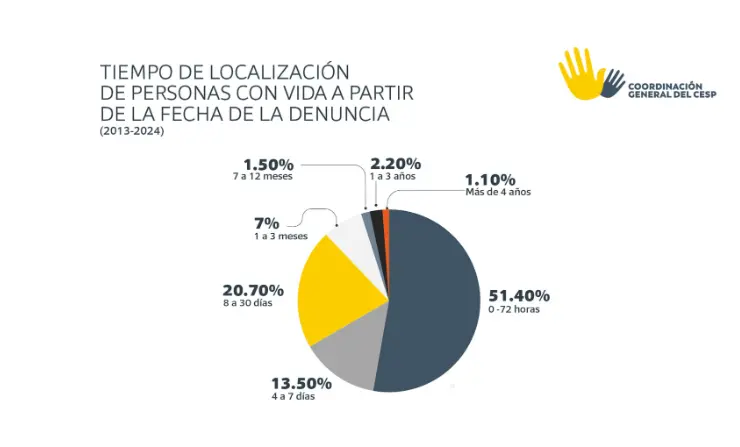
The report emphasizes that the speed of the response is crucial. Between 2013 and 2022, 51 percent of missing persons were located alive within the first 72 hours after the report was filed.
Another 21 percent were located within 8 to 30 days, and the rest within longer periods, even exceeding four years.
These data confirm the relevance of the presumption of life and search for life principle established in the Approved Protocol for the Search for Persons, approved in 2020, and show that every hour counts in returning victims to their homes.
The phenomenon of missing persons is complex in Sinaloa and has worsened in recent years. According to data from the National Registry of Missing and Unlocated Persons (RNPDNO), dating from December 31, 1952, to December 31, 2024,
This state ranks sixth nationally in the number of missing persons, with 5,366, and the second highest rate per 100,000 inhabitants, with 177.
Furthermore, it ranks second nationally in the rate of missing persons located, with 49.3 per 100,000 inhabitants. These figures reflect both the magnitude of the problem and the importance of strengthening institutional capacities to address it.
The assessment warns that, although three Temporary Shelter and Human Identification Centers have been created in Culiacán, Los Mochis, and Mazatlán, significant gaps persist. The State Search System has not yet been formally implemented, and the State Search Plan, key to coordinating efforts, has not been published since 2019.
The formation of the Citizen Council of the State Search Commission is also pending, a necessary step to guarantee social participation and give a voice to the family groups that drive the location efforts on a daily basis.
Missing Persons, a Debt to Their Families
The 15-year assessment, from 2010 to 2024, highlights that, although almost half of the missing persons were located alive, the persistence of 38% of unsolved cases is an outstanding debt owed to every family waiting for a loved one.
Reducing this figure requires strengthening institutional capacities, ensuring civil society participation, and prioritizing care for victims, because beyond the numbers, disappearances represent a profound blow to the social fabric.
It was stated that each case represents a fractured home and a search process that, in many cases, lasts for years.
The Diagnostic on the Deprivation and Enforced Disappearance of Persons recognizes the work of search groups, who have been a driving force in bringing the problem to light and demanding results from the authorities.
Source: tusbuenasnoticias