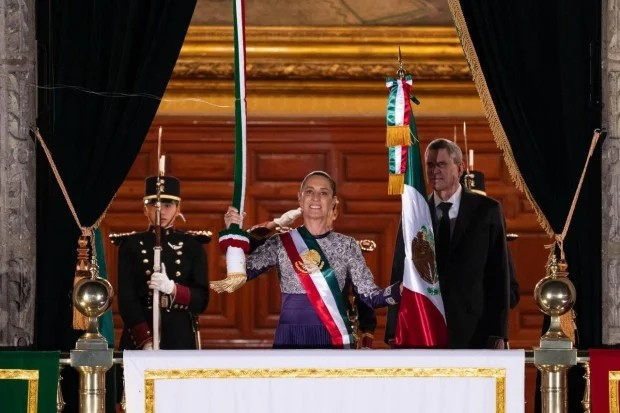

On the evening of September 15, 2024, President Claudia Sheinbaum Pardo led her first Grito de Independencia (Cry of Independence), an act that transcended mere celebration to become a declaration of principles. From the central balcony of the National Palace, Sheinbaum not only commemorated the past but also outlined the pillars of her administration through a meticulously orchestrated ceremony, laden with symbolism and messages seeking to mark a new era in Mexican politics.
The highlight of the evening focused on women’s rights. Dressed in a purple dress, a clear nod to the feminist movement, the president broke with tradition by giving pride of place to the heroines of independence. Names like Josefa Ortiz de Domínguez and Leona Vicario resonated with unprecedented force, underscoring the historical invisibility and her administration’s commitment to a gender perspective. This choice was not a mere detail, but the cornerstone of a discourse that seeks to legitimize itself through historical memory.
Inclusion extended beyond women. In a gesture of profound political significance, Sheinbaum dedicated part of her speech to migrants, an often stigmatized group. By referring to them as “our brothers and sisters,” the president not only showed solidarity but also integrated this group into the national narrative, positioning them as an essential part of Mexico’s identity, regardless of their location. This message also has an inescapable foreign policy dimension, suggesting a focus on defending the human rights of those who have left the country.
National sovereignty was the other pillar of the presidential speech. In a context of external pressures, President Sheinbaum forcefully affirmed that Mexico is a “free, independent, and sovereign” country, warning that “no foreign power has the power to decide for Mexico.” This position was reinforced with the announcement that in 2025 her government will propose a reform to Article 40 of the Constitution to legally protect the country’s defense against external interference, a clear signal that self-determination will be the guiding principle of her administration.
This first Grito marks, more than a break, a stylistic and political evolution. While Sheinbaum maintains a clear connection with the political project of the previous government, she differentiates herself by incorporating an unprecedented dimension of gender and symbolic inclusion. This approach seeks dual legitimacy: on the one hand, it legitimizes herself as the first female president, and on the other, it strengthens a political project that elevates historically neglected issues to the forefront.
In essence, Sheinbaum’s Grito was an act of political communication where every element was carefully chosen, from the dress and the honor guard led by female cadets, to the words of inclusion and the reaffirmation of sovereignty. The president not only paid tribute to the heroes, but also communicated the principles of her administration: a historical memory with a gender perspective, an unwavering defense of sovereignty, and a vision of a nation redefined for the 21st century.
Source: contraparte