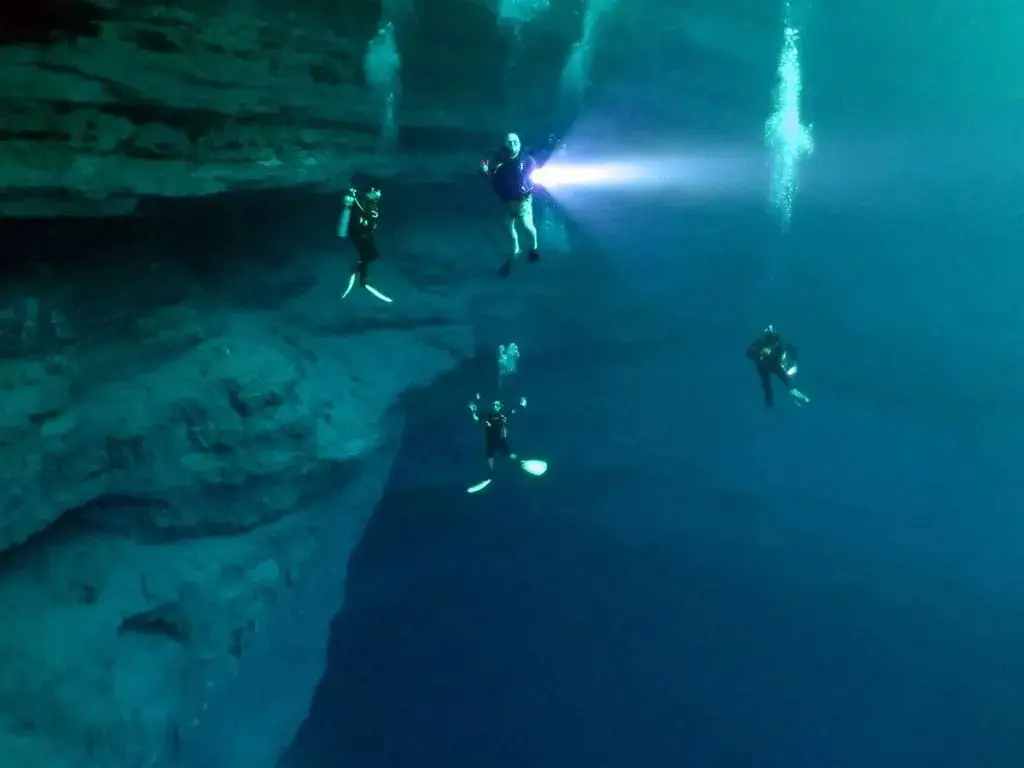

The Sabakha Cenote, known as “smoky water,” was the scene of a historic event: a group of expert divers managed to descend to a depth of 120 meters in what is considered the deepest karst window in Yucatán, more than 150 meters according to official records.
The dive, conducted by technical diving specialists from the peninsula, represented an extreme challenge due to the hydrogen sulfide cloud and the long decompression stops required to avoid health risks.
Sabakha, the deepest cenote in Yucatán
According to speleologist Erick Sosa, Sabakha is an open, free-fall cenote with a water surface 70 meters in diameter and a bottom that expands to over 100 meters. “Apparently, it’s more than 150 meters deep; explorations have reached up to 140 meters,” he explained.
The specialist explained that these types of dives require much longer decompression times than recreational diving. “In this case, we did a total of 130 minutes of decompression,” he noted, highlighting the complexity of the feat.
At a depth of 70 meters, the divers encountered a cloud of hydrogen sulfide that covered much of the cenote, making Sabakha a unique and extremely dangerous location for explorers.
The expedition was supported by Kay Vilchis, Gabriel Bergonzi, Pablo Bayardo, Michel Silva, and Manuel Chávez, who, along with Erick Sosa, completed this feat. The achievement sets a precedent in the underwater exploration of the region, revealing the magnitude and mystery hidden beneath the Yucatan soil.
This historic descent into Sabakha Cenote reinforces Yucatán’s importance as a world epicenter for speleology and technical diving.
Source: unotv