
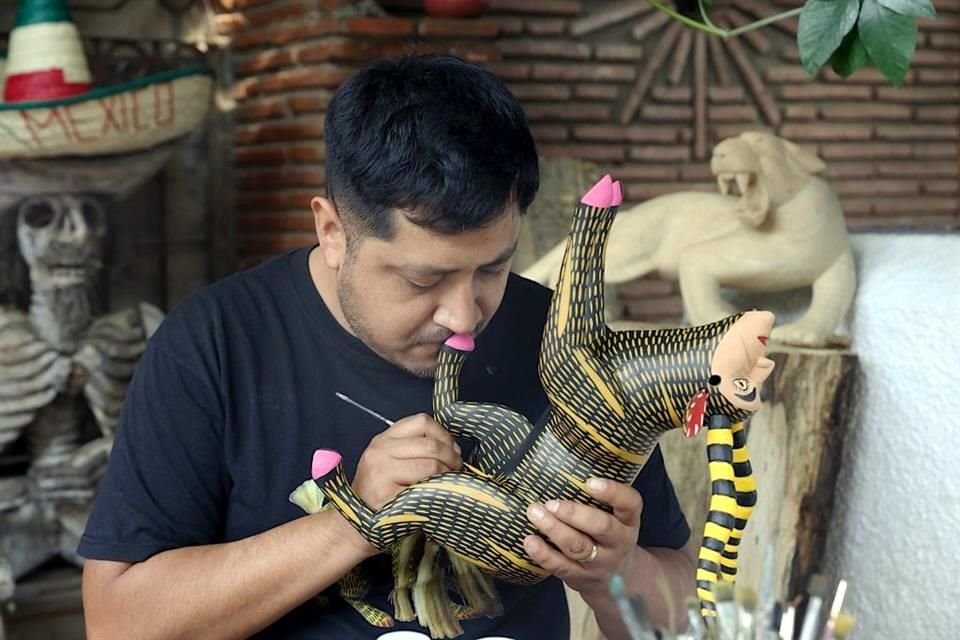
Young Mexican artisans Maricarmen and Roque Jiménez Carrillo grew up in a world filled with scents, textures, and pigments.
They belong to the third generation of a family that made wood an everyday language that connects cultures and preserves a legacy of Zapotec tradition in the state of Oaxaca.
From a young age, the siblings watched their grandfather and father shape protective animals and fantastical figures, learning that each carving could become a testament to identity, memory, and cultural resistance.
The artists’ grandfather, maestro Manuel Jiménez Ramírez, recounted that when a boy or girl was born in Oaxaca, the parents would draw a circle of ashes, and the first animal to cross it would become their protective creature, called a “tona” in the Zapotec worldview.
This ritual inspired many of the pieces Manuel created.
“My childhood was beautiful, magical, because I saw so many colors, so much wood, and the very peculiar aromas of wood—rich, moist, and made you feel at home,” says Maricarmen.
The artisan recalls that she first encountered the art of wood carving when she came home from school, eager to enter her parents’ workshop and start playing with the pieces her uncles and grandparents also made.
“We learned this craft through mischief; it was really through playing, and it was also how my grandfather learned, through playing.
“When I was very young, I have memories, very fond memories of a close-knit family that, day after day, regardless of the time, holidays, or whatever, always worked together.”
THE NAHUALAS
Maricarmen says that in the past, women only painted pieces in silence, unable to carve or explain their work.
“Of the three generations, I am the first woman who wanted to continue this legacy, which makes me feel even more proud because I come from a pioneering family, but I also come from a family where they never set limits on me by saying ‘you can’t,'” she emphasizes.
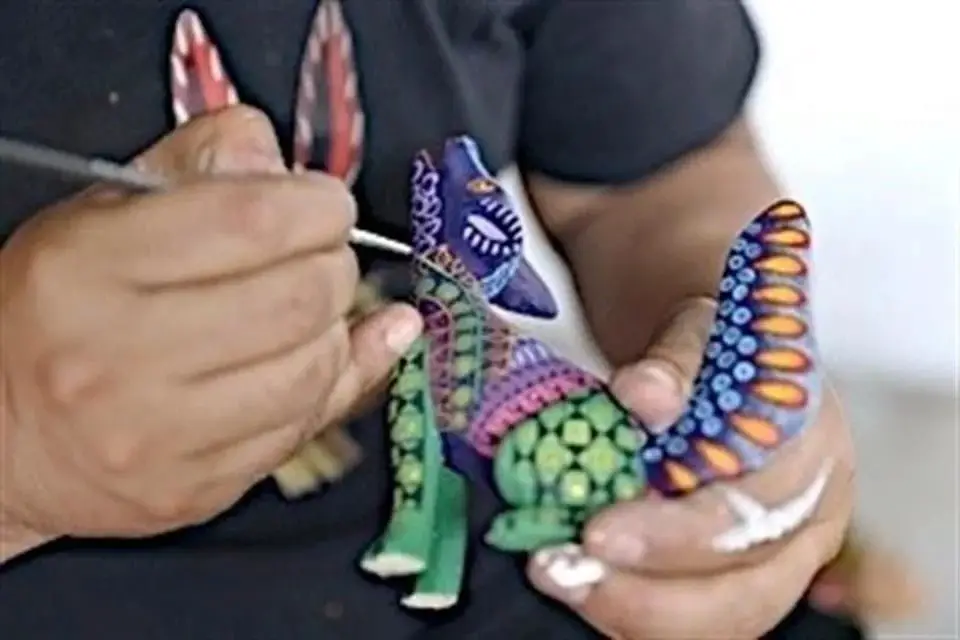
This also put a twist on tradition. In addition to the classic nahuales, which are half-animal, half-human figures, she has created “nahualas,” female versions with which she seeks to pay tribute to women.
“Being an artisan is my best title, because I carry within me Oaxaca, to Mexico and to my community. It motivates me to think that many girls and young women see themselves in me and say, ‘I want to be like you,'” the young woman says.
FROM MEXICO TO THE WORLD
Maricarmen’s father, Angélico Jiménez, made wood carving a central part of his life. In addition to making unique creations, he took his art to different parts of the world, sharing the richness of Oaxaca’s culture.
Roque and Angélico also followed in the footsteps of Manuel Jiménez Ramírez, who from childhood had to work to support his family, caring for animals and learning different trades, including wood carving.
At first, Manuel made figures to play with and masks that he sold in the city to earn money. Over time, he began painting his carvings to make them more attractive.
The shapes and decorations of the Oaxacan artisan’s pieces became more refined, and his works began to be exported, while his artisanal carving techniques amazed different nations.
For Roque Jiménez, showcasing craftsmanship Bringing Mexican art to the world represents an honor, but also a responsibility to keep the history, culture, and colors of their state alive, preserving a legacy that transcends borders.
The artist fondly recalls the trip his father, Angélico, and his uncle, Isaías, made to China in 2002, representing Mexico in an international woodcarving competition held there.
“My father and uncle,” Roque continued, “said that when they arrived at the competition and had their turn to do their demonstration, those present were delighted because the entire process the Mexicans carried out was done by hand.
“When it was their turn to demonstrate their work, my father and my uncle, Isaías, took out their machetes, their knives, their gouges. Everything was done by hand. For us, it was important to be able to bring this culture to other countries,” he says.
For them, Roque adds, it’s very satisfying that this type of Mexican craftsmanship has expanded to different parts of the world, because knowing that other people value artisanal work has motivated artisans to continue passing on this family legacy from generation to generation.
“Today, it’s a contemporary craft in its design, in its style, due to the years it’s been in the making. Wood has been worked with for a long time, but this type of artistic expression was generated by Manuel Jiménez.
“Fortunately, we continue to work with it today, we continue to promote it, and for us, it’s important that, through artistic expression, you convey the essence of Mexico, the essence of Oaxaca, and the essence of families. That’s important to us,” Roque affirms.
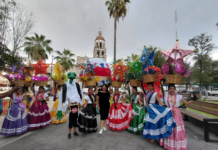
Oaxaca is one of Mexico’s most culturally rich states, where Indigenous heritage is reflected in every aspect of daily life.
Its crafts, such as black clay, textiles, and carved wood, are not only artistic expressions but also a fundamental economic driver for thousands of families in the region.
Source: elnorte