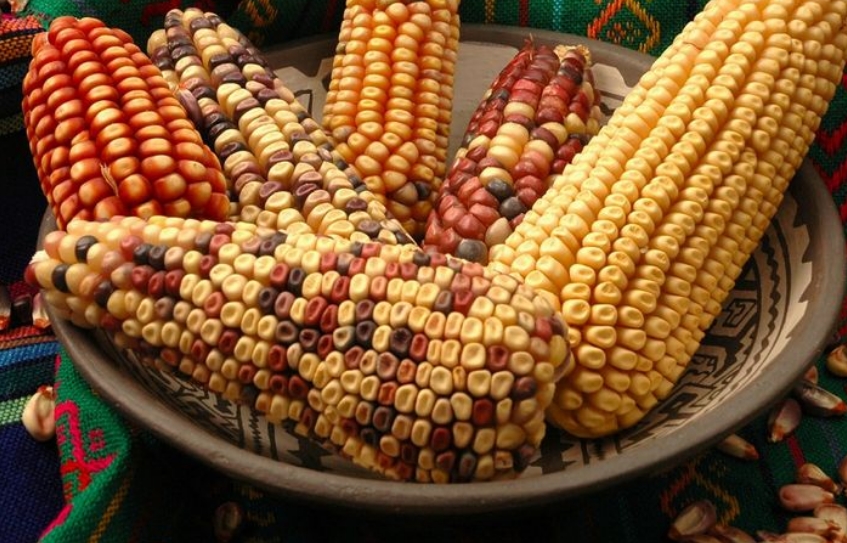

Corn (Zea mays) is one of the most important cereals for human and animal consumption, according to the Food and Agriculture Organization of the United Nations (FAO). It is also considered very nutritious and energetic, as it is rich in carbohydrates, adds an article from Agencia Brasil (the official news platform of the Brazilian government).
Originally from the Andean region of Central America, this plant’s origins date back thousands of years. An infographic from the International Maize and Wheat Improvement Center (CIMMYT) details that the cereal dates back some 10,000 years and that the oldest corn discovered so far (differentiated from teosinte, a grass with hard grains that preceded corn) is 9,000 years old and was found in Guerrero, Mexico.
As the article from the Brazilian source explains, “the Mayan, Aztec, Inca, and Olmec peoples had this cereal as their main food source.” It is also known that corn was used in sacred rituals.
Over time, the infographic continues, corn has transformed, and in the last 500 years it has evolved primarily through crossbreeding between breeds (groups with common characteristics). There are also methods “in which farmers and scientists identify desired variables (for their resistance to pests or drought tolerance, for example) and crossbreed to select the best plants with those characteristics.”
So, how many varieties of corn exist today? On National Corn Day, celebrated every September 29 in Mexico, National Geographic offers more information.
…
How many varieties of corn exist in the Americas and the rest of the world?
Precisely, there are around 300 varieties of corn on the American continent, according to the International Center. And in Latin America, nearly 220 have been described, according to the Mexican Biodiversity website, which operates under the National Commission for the Knowledge and Use of Biodiversity (Conabio) of Mexico.
Worldwide, the CIMMYT Germplasm Bank (which houses the world’s largest maize collection) safeguards the genetic material of 413 maize varieties identified to date. However, the source clarifies, many of these varieties are no longer planted in the fields, and “it is estimated that more than 50% of these varieties have been lost in the territories.”
Furthermore, the organization adds, maize diversity could be greater than estimated since, as a plant in constant evolution, new varieties could be generated in the future, and many others may have been lost.
It is worth remembering that not all maize produced in the world becomes food and can be transformed into “popcorn.” According to data from the Brazilian Agricultural Research Corporation (Embrapa), there are other uses that demonstrate the versatility of this product, such as the production of bioethanol from starch, which is a fuel, and as a pasture supplement.
According to data from the United States Department of Agriculture (USDA), 75% of global corn production during the 2024/2025 marketing year was concentrated in the five main producers: the United States (31%), China (24%), Brazil (11%), the European Union (5%), and Argentina (4%).
Meanwhile, in the period analyzed by the USDA, Mexico ranked eighth worldwide, with a 2% share of total corn production.

How many varieties of corn are there in Mexico?
Mexico has 64 varieties of corn, of which 59 are native and five are from the Caribbean and were introduced through Central America.
These Mexican corn varieties have been grouped into seven racial groups based on their morphological, adaptive, and genetic characteristics. As explained by the Mexican Biodiversity website, the seven groups of corn that exist in the country are: Conical, Late Maturing, Chihuahuan Sierra, Eight Row, Early Tropical, Tropical Dentate, and Chapalote.
“In Mexico, maize adapted to different climates, altitudes, environmental characteristics, and the tastes of its inhabitants. Thus, over time, numerous new breeds, subbreeds, and varieties were generated; for example, the Nal-tel and Chapalote breeds adapted to tropical regions; or the Palomero Toluqueño and Arrocillo Amarillo breeds adapted to temperate or cold regions,” CIMMYT concludes.
Source: nationalgeographicla