
An order from President Claudia Sheinbaum allowed the release of 50 musical instruments donated by the Swiss government to low-income children in Chiapas supported by a music program. These instruments had been held for several months at the Veracruz Port Customs and were to be destroyed under the pretext that they might be “infested with moths.” The container in which they were transported was classified as abandoned.
Maestro Roberto Peña Quesada, artistic director of the Youth Sinfonietta Chiapas A.C. association, reported that he was notified of the resolution through a phone call from the presidential advisor on economic affairs, Altagracia Gómez, who informed him that the container transporting the instruments “was officially released.”
“Advisor Altagracia Gómez called me to give me the good news. She told me that the container was classified as ‘abandoned’ and that no one knew anything about its origin. But everything has finally been resolved,” confirmed Maestro Peña.
The musician stated that it is inexplicable to him that the container was classified as abandoned, when he had previously been notified that the instruments would be destroyed because they did not have an invoice or any certificate, according to customs. He was also told that they could pose a health risk due to the possible presence of moths.
The transfer was coordinated with the Rotary Club in Switzerland and, in Mexico, with the clubs in Tuxtla Gutiérrez and Veracruz, which acted as intermediaries to facilitate both the shipment and receipt.
The donation was organized by the Swiss government through the Verein Youth Sinfonietta organization, based in Sumiswald, in collaboration with the Swiss company Nottaris Bauguss AG, responsible for international logistics, and NAUTA SA, part of the LEMAN Group.
The container, identified as TEMU6696231, was shipped on July 1, 2025, at the port of Antwerp (Belgium), aboard the vessel APL MINNESOTA V.0VBK1W1MA, bound for the port of Veracruz, where it arrived on time between July 25 and 26. Deconsolidation took place on July 26 at the Golmex warehouse.
Despite compliance with deadlines and supporting documentation, the cargo was detained by customs under the argument that the instruments lacked a commercial invoice or phytosanitary certificate, preventing their release.
What should have been an act of international cooperation ended up becoming a case of extreme bureaucracy that nearly prevented the delivery of the instruments.
Music for Those Who Need It Most
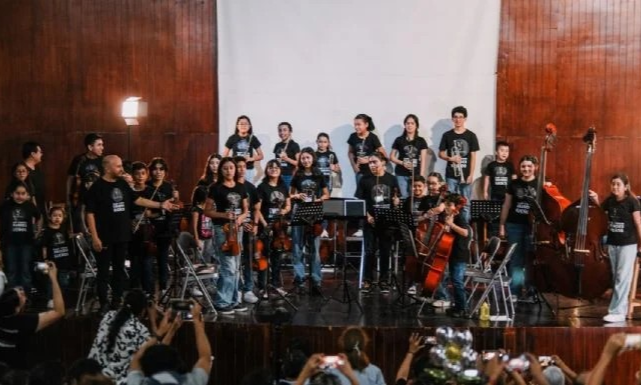
The shipment’s final destination is Youth Sinfonietta Chiapas A.C., a non-profit organization that works with children and young people—mainly from marginalized areas—to whom it offers musical training. As of April 2024, the group already had 40 children in training, albeit with limited resources.
“The goal is to decentralize musical training. These instruments were essential to consolidate the project,” explained Maestro Peña.
The project has been developed without budgetary support from any public entity and has a binational structure supported by Mexican and Swiss musicians, including Maestro Peña’s two sons, both Swiss and Mexican citizens, but living in Europe.
A Hopeful Closure
The case sparked outrage on social media, in the media, and in cultural circles, when it was learned that the instruments—donated for educational purposes—could be destroyed. However, after escalating the issue to the federal level, the direct intervention of President Claudia Sheinbaum and her economic team helped resolve the situation.
Maestro Peña expressed his gratitude for the support of the president and Altagracia Gómez, as well as the support of musicians, organizations, media outlets, and citizens who mobilized to prevent the loss of the donation.
“This is great news. Now, what follows is ensuring that the instruments reach the children’s hands as soon as possible,” he concluded.
Originally from Mexico City, maestro Roberto Peña Quesada studied at the Bern Conservatory, Switzerland, where he lived for a decade and raised a family. He returned to Mexico motivated by the desire to promote classical music in the south of the country, at a time when there were no youth orchestras or specialized schools in the region. Since then, he has trained several generations of musicians in Chiapas, where he has lived for several years.

Source: proceso