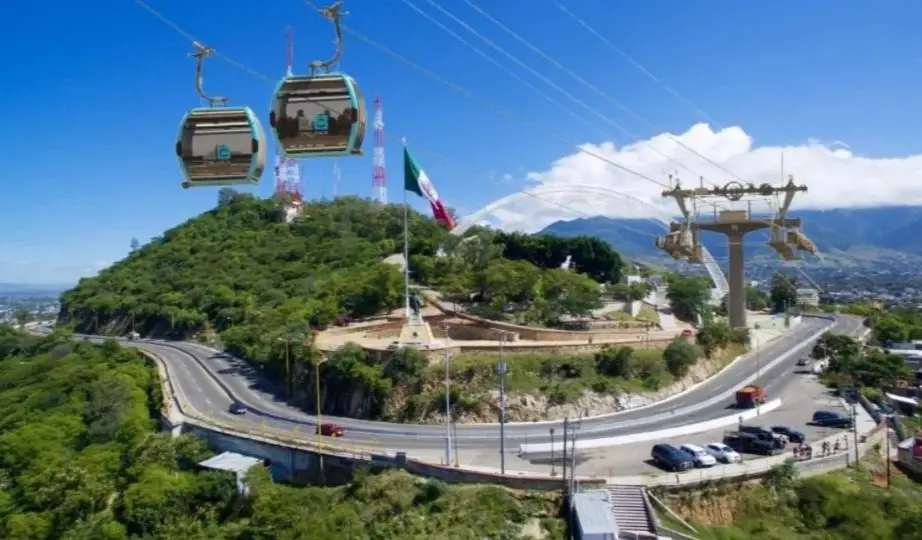

The Oaxaca government, headed by President Salomón Jara Cruz, through the Ministry of Mobility (SEMOVI), has already planned feasibility studies to implement an aerial transportation system, or urban cable car. In other parts of the country, such as Mexico City, these systems are known as Cablebus, and have proven to be a very good public transportation option for citizens.
According to Yesenia Nolasco, head of SEMOVI, two routes are already being evaluated, along with their respective feasibility studies. One route would connect San Felipe del Agua, Colonia Reforma, and the Monumento a la Madre, with three intermediate stations. A second route is still being analyzed to determine its route within the Oaxacan capital.
How much would the first line of the Oaxacan urban cable car project cost?
The results would be ready within a four-month period. Governor Jara Cruz’s approval is still pending. If things progress as planned, the project would cost between 1.5 billion and 2 billion pesos, depending on the length of the urban cable car line through the streets of the Oaxacan capital.
The first line (if approved) would be built in three phases, but first, meetings would be held with authorities from the National Institute of Anthropology and History (INAH), UNESCO (in relation to World Heritage Cities)—which applies in this case to OAXACA—the Federal Electricity Commission (CFE) for the power lines, and the Ministry of the Environment.
These meetings with the involved agencies are being held to ensure compatibility with the city’s historical and environmental heritage. According to the head of Semovi, within a week, Governor Jara Cruz would be in a position to define the initial route for OAXACA’s urban cable car.
What benefits would the urban cable car bring to OAXACA?
Reduction in travel times in high-traffic areas.
Safe, fast, and sustainable transportation.
Reduction in polluting emissions, benefiting the environment.
Improved connectivity between neighborhoods, districts, and the city center.
Promotion of tourism through a modern system with panoramic views.
Nolasco emphasized that the project is based on serious studies and seeks to be respectful of the urban and heritage environment.
In the Heraldo de México OAXACA, we have already shared relevant information about the project and how it works in other cities, as well as its benefits.
This initiative positions Oaxaca in a key debate on the modernization of public transportation, balancing innovation with the preservation of its historical identity at a time when a highly ambitious, well-thought-out, and inclusive mobility policy is being prioritized in the capital and greater Oaxaca area, first with the BinniBus and, soon, the urban cable car is expected to be included.

Source: oaxaca.heraldodemexico