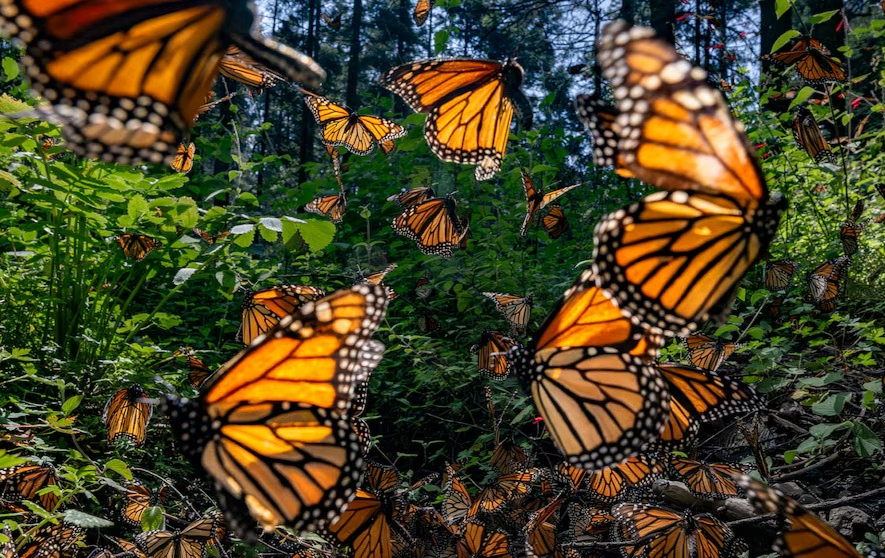

Just one month before the spectacular arrival of the Monarch Butterfly to the forests of the Monarch Butterfly Biosphere Reserve, expectations in Michoacán are high. Environmental authorities, led by Alejandro Méndez López, head of the Ministry of the Environment (Secma), are optimistic and expect a new season with a high monarch butterfly population, continuing the trend of a remarkable recovery seen in the 2024-2025 period.
This optimism is based on the results of the most recent overwintering report. At the beginning of 2025, the World Wide Fund for Nature (WWF), in collaboration with the National Commission of Natural Protected Areas (Conanp), announced encouraging news: the eastern migratory monarch butterfly population nearly doubled.
The insects occupied 1.79 hectares of forest, a 99% increase compared to the 0.90 hectares recorded in the 2023-2024 winter. Or, measured in acres, they increased from 2.22 to 4.42 acres. Although this figure is still well below the historical average, it represents a significant rebound that gives hope to conservation efforts.
The Secretary of the Ministry of Agriculture, Fisheries and Natural Resources (SECMA) has confirmed that the forests of eastern Michoacán are ready to welcome the winged travelers. Among the sanctuaries that will open their doors to the public for the natural phenomenon, which runs from early November to late March, are El Rosario in Ocampo, Sierra Chincua in Angangueo, and the Senguio sanctuary.
The Secret Behind the Rebound: Climate and Conservation Efforts
Scientists and experts attribute much of this population growth to the improved weather conditions that occurred during 2024 and 2025, with less severe droughts along the migratory route in the United States and Canada. A more favorable climate facilitates the butterfly’s reproduction and survival.
Additionally, conservation efforts in Mexico have shown tangible results. The analysis of forest change in the central zone of the Monarch Butterfly Biosphere Reserve reported a 10% decrease in forest degradation. Between April 2023 and February 2024, 9.14 acres were damaged, a decrease from 10.13 acres the previous year. This is thanks to the continued vigilance of local communities, despite persistent challenges such as illegal logging.
However, threats to the species remain serious. Méndez López, a Secma official, acknowledged that the most difficult part of the journey occurs in the United States, where habitat destruction and pesticide use have reduced the availability of milkweed, the only plant the caterpillars feed on.
To continue promoting conservation and celebrate their arrival, the Michoacán Secretariat of Culture (Secum) has begun preparations for the Monarch Butterfly Biocultural Festival, a celebration that will take place in early 2026 and bring together 20 municipalities in the region.
The monarch butterfly migration is one of the most astonishing phenomena on the planet. Weighing less than a gram, these tiny creatures embark on a multigenerational journey that can extend up to 5,000 kilometers across Canada, the United States, and Mexico.
The eastern North American population departs in late summer from southern Canada and the northern United States. This “super generation” of butterflies (the fourth generation of the season) lives much longer than usual and is the only one to complete the outward journey. They cross the continent, following a path that takes them through the Sierra Madre Oriental.
Their wintering destination is the Monarch Butterfly Biosphere Reserve, a forested area of fir and pine trees on the border of Michoacán and the State of Mexico. Here, they congregate by the millions to survive the winter. In March, the same butterflies begin their return north, laying eggs and dying along the way so that new generations can continue the cycle back to Canada and the United States, an astonishing biological relay race that repeats itself year after year.
Protecting this route, from the milkweed in the north to the fir forests in central Mexico, is a trinational endeavor that requires the ongoing collaboration of governments, communities, and citizens.

Source: infobae