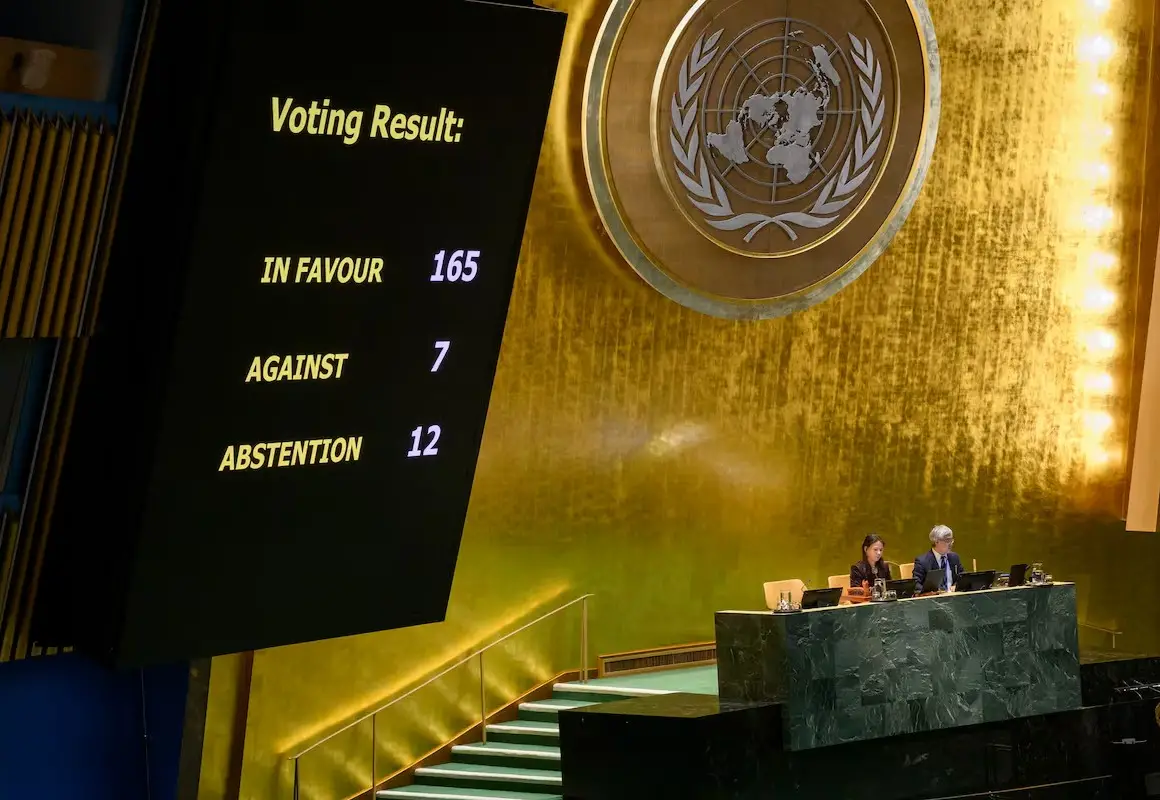

US President Donald Trump is in the midst of a full-blown offensive in the Americas. Mexico, the star pupil, has so far weathered the Republican’s most aggressive policies, which are focused on Venezuela and Colombia, but the balance is, as always, fragile and temporary. Trump’s Under Secretary of State, Christopher Landau, rebuked Mexico this week for supporting Cuba at the UN General Assembly, which every year since 1992 has called for an end to the US embargo against the Caribbean nation. This year’s vote resulted in the lowest support for the Cuban government this century, but it had, as always, the backing of Mexico, a long-standing ally in the region. The Mexican stance is no surprise, but the reaction north of the border has been harsher than usual. “As a friend of Mexico, I am saddened,” said Landau, who also served as ambassador to the country.
The Latin American government, in reality, has not budged from its position. Mexico’s relations with Cuba have been relatively stable for over 65 years, regardless of who was in power. Today, President Claudia Sheinbaum sends oil and receives doctors, as did her predecessor, Andrés Manuel López Obrador, also of the Morena party. Before them, however, Enrique Peña Nieto of the PRI party forgave a large portion of Cuba’s debt to Mexico, a rapprochement that only cooled during the conservative PAN administrations.
“The Mexican Revolution served as an example for the Cuban Revolution and was a process that legitimized Mexico’s foreign policy in the region,” notes Pía Taracena, an expert in international affairs at the Universidad Iberoamericana. In the international landscape that emerged then, with the Cold War as a backdrop, “Mexico acted as a bridge or a channel” between Cuba and the United States, emphasizes historian David Jorge. “Ultimately necessary for both sides,” he adds. This allowed Mexico to “strengthen its status as a trusted neighbor and a leading regional actor.”
Today, the scenario is different, and the words of the Mexican ambassador to the UN, Héctor Vasconcelos, have not gone down well on the other side of the Rio Grande. The representative of the Latin American country accused the United States of being in “continuous defiance” of “the majority will of the international community.” “It seems we still cannot escape the prejudices and intolerances that characterized Cold War politics, which have demonstrated their undeniable failure,” he stated in a speech in which he spoke—as Sheinbaum often does—of a “blockade,” a term that particularly irritates those north of the border, who prefer the word “embargo.” “If we are going to talk about US policy toward Cuba, let’s at least base it on reality and not on fantasies,” Landau rebuked him, threatening to revoke visas for his opponents with a single tweet.
The United States’ complaints herald a changing of the guard. “[Landau] is marking the return of the Trump Administration 2.0, in which there is no acceptance of any perspective contrary to its tenets, regardless of its origin. Anything outside its rhetoric is framed as unacceptable, despite the friendship, as he claims,” notes Abelardo Rodríguez, an international relations expert at the Ibero-American University. “We are at the end of one cycle and the beginning of another, in which the United States is seeking to recover lost ground throughout the hemisphere, invoking the Monroe Doctrine [America for the Americans].”
The question then, Rodríguez poses, is how long this triangular relationship, in which Mexico acts as a hinge between the two nations, can be maintained—a “transcendental element in Mexico’s foreign policy,” and even in Sheinbaum’s, who has had “a personal affinity with the Cuban Revolution since childhood,” the expert says. For now, Mexico has emerged unscathed from a relationship that has begun to take its toll on other countries after the appointment of Marco Rubio to head the State Department, whose Cuban origin has served as a declaration of intent by the Trump Administration.
Mexico sends hundreds of thousands of barrels of oil and diesel to Cuba, which in turn sends hundreds of doctors to the North American country, whose shortage of specialists worsened during the COVID-19 pandemic. Sheinbaum has repeatedly defended both policies, which reaffirm the relationship between the two countries despite any pressure from the United States. “Humanitarian aid, in any case, Mexico will always provide, always, to Cuba and other countries that need it,” the president said this October regarding the fuel shipments. “Collaboration, coordination, but not subordination. Mexico defines its foreign policy,” she had also said in June, regarding the hiring of Cuban doctors, an issue on which Rubio is pressuring other countries in an attempt to cut off a source of funding that helps keep Miguel Díaz-Canel’s government afloat on the island.
In February, the Secretary announced a policy restricting visas for those who support Cuba’s labor export program, especially its medical missions, which the United States considers “forced labor.” In June, the warning was extended to Central American governments that “exploit” Cuban professionals, and in August, two Brazilian officials, Mozart Julio Tabosa Sales and Alberto Kleiman, lost their visas for their role in implementing the Mais Médicos program in their country, which employed Cuban doctors.
The Trump administration is tightening the noose around Cuba, effectively isolating any relations with countries in the Americas. Mexico, which has maintained a clear, albeit cautious, distance from its northern neighbor, has so far turned a blind eye. The former president, a member of the Morena party, displayed a particularly conspicuous display of closeness with Havana. He visited the country on several occasions and awarded Díaz-Canel the Order of the Aztec Eagle, the highest distinction given to a foreign head of state, in 2023, when Democrat Joe Biden was in the White House. “By defending Cuba, you are also defending Mexico,” has been the administration’s philosophy since the PRI era. López Obrador revived and expanded it. Sheinbaum is trying to continue it now, but Abelardo Rodríguez warns: “We are just entering this new context. It will be very difficult for the president to maintain that continuity.”
Source: elpais