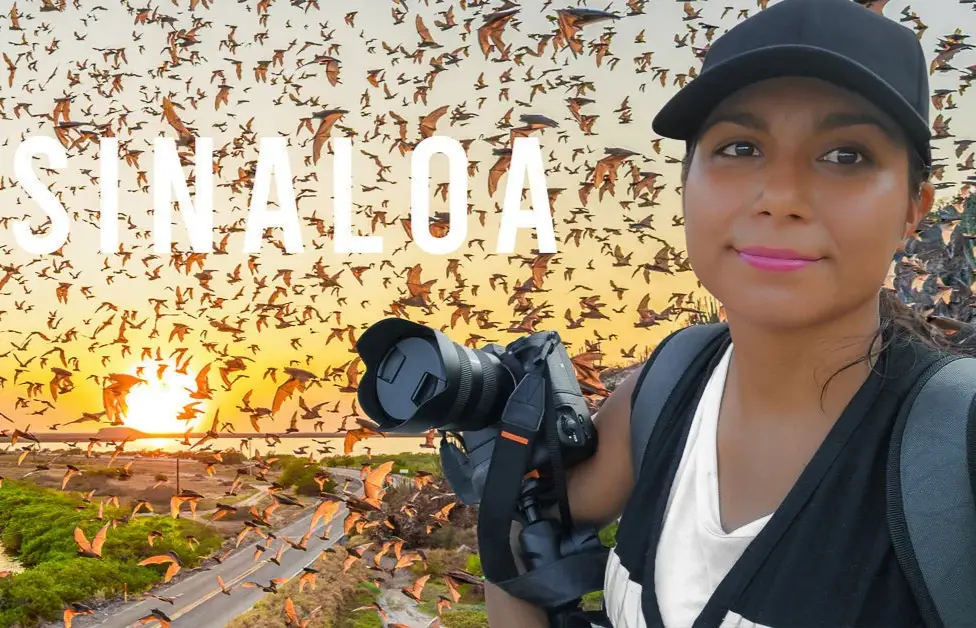

On November 21, 2025, at 6:00 p.m., the photograph “The Flight of the Bats” by Brenda Medina, founder of Eden Dusk, will be exhibited in Room 5 of the Sinaloa Art Museum (MASIN) as part of the exhibition “The Mexico of Mexicans III.” Each piece in the exhibition represents a state of the country, and in this case, a colony of bats will speak for Sinaloa. This entry outlines the journey of this image: field trips, ecological context, collaborations, awards, archive, and shared memory.
“The Flight of the Bats” originates in the twilight of the cave located across from the Topolobampo estuary, very near El Maviri beach. As the sun sets, thousands of specimens of the species Tadarida brasiliensis leave their refuge and form a continuous stream over the coastal highway. The sound of hundreds of wings, the smell of damp rock and salt air, and the rapid transition of light mark the rhythm of each shot.
The photograph freezes the instant the bat colony crosses the frame as the sun dips below the horizon. The road, the hill, and the reflecting pool are enveloped by a cloud of silhouettes, a reminder that night begins long before the landscape is completely dark. The scene was constructed with a wide-angle lens, tripod, and patience: it’s not a single image, but the result of many previous visits during which Brenda and Néstor adjusted exposure times, framing, and distance to avoid disturbing the bats’ roost.
Seeing this same scene now in Room 5 of the MASIN (National Museum of Sinaloa) changes the context without erasing its origin. The intimate field experience translates into a work that engages with the museum audience, surrounded by photographs representing other states. Amid urban portraits, rural scenes, and family moments, the bat colony on the Sinaloa coast adds a nocturnal voice to the conversation about the country.
Topolobampo at Dusk: Ecosystem, Agriculture, and Misinformation
In this coastal region of Sinaloa, bats play a key role in maintaining the ecosystem’s balance. Every night, they consume large quantities of insects, including pests that affect local crops. Their daily flight is, in practice, a form of biological control that benefits agriculture and the regional economy, even though it often goes unnoticed.
During the COVID-19 pandemic, misinformation jeopardized this balance. Erroneous ideas circulated that directly linked bats to the disease, leading to fear and, in some cases, attacks on the roost. Against this backdrop, “The Flight of the Bats” and its associated series became an educational tool: images and texts that emphasized explaining the species’ true role, its relationship with the environment, and the difference between myths and scientific evidence.
By placing the colony against the coastal landscape, the photograph presents the bats not as a threat, but as part of an everyday scene. The estuary, the road, the hill, and the vegetation appear in the same frame as the moving silhouettes. Everything is part of the same story in which the nocturnal life of the wildlife intertwines with human traffic, fishing, tourism, and the daily activities of the area.
Source: edendusk