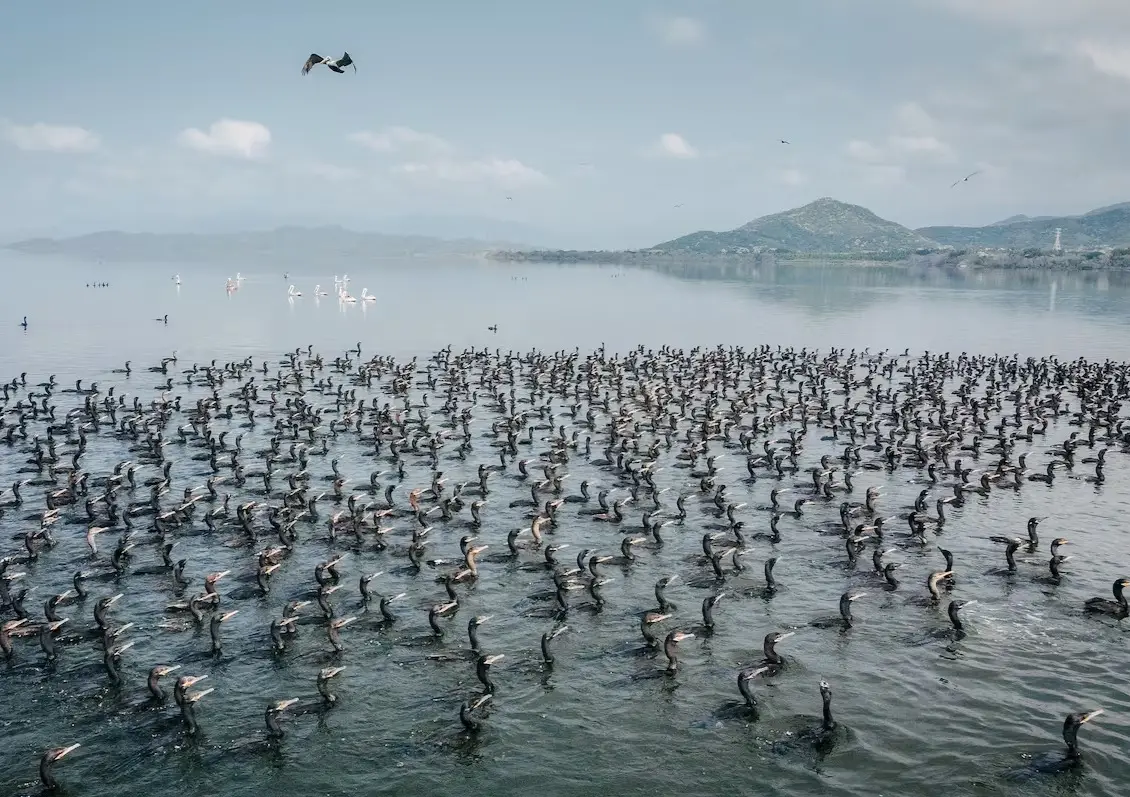

From the roadside along the highway connecting Colima and Manzanillo in western Mexico, hundreds of cormorants can be seen feeding alongside pelicans and herons. They are among the more than 180 bird species recorded in the Cuyutlán Lagoon, the fourth largest wetland in the country and the fifth most important site worldwide for migratory birds. This body of water represents 90% of the wetlands in the state of Colima. The first expansion of the port years ago, as well as the presence of a liquefied natural gas terminal and the impact of a thermoelectric plant, have affected this ecosystem of more than 7,000 hectares, but life continues to find a way. However, it now faces a new threat, according to environmentalists and the fishermen and salt producers who depend on the lagoon for their livelihood.
On August 9th, President Claudia Sheinbaum announced in Colima that the port of Manzanillo will become the most important in Latin America, quadrupling its container handling capacity, a move that threatens the entire lagoon ecosystem. This expansion is part of the flagship infrastructure megaprojects of the Mexico Plan, promoted by the Fourth Transformation government, which has increased political and economic pressure on the Cuyutlán Lagoon, despite warnings about its serious socio-environmental impacts.
In the lagoon’s second basin, where the port expansion is planned, lies the largest concentration of fish that sustains the area’s fishing industry, according to María del Carmen Velasco, leader of the fishing cooperatives Pescadores de la Laguna de Cuyutlán Alameda and Acuacultores de la Laguna de Cuyutlán. This expansion will leave hundreds of families without a livelihood.
In this same area lies a group of islets with significant archaeological value, according to various studies. Researchers such as Margarita Carballal, María Antonieta Moguel, and María de los Ángeles Olay have documented several rescue efforts undertaken in the area due to the arrival of large-scale projects. During these investigations, important discoveries were made, ranging from small artifacts to burial mounds, which, however, were not enough to halt the projects. In fact, the Environmental Impact Statement (EIS) for the expansion project contemplates the complete removal of these islets using explosives to construct a large concrete slab where deep-draft vessels will dock.
The lagoon is home to one of Mexico’s most important biocultural heritage sites, as basins III and IV are included on the Ramsar Convention’s list of Wetlands of International Importance due to their great ecological significance. This is where the artisanal salt of Cuyutlán is extracted, supporting more than 1,500 families through direct and indirect employment, according to Miguel Ramos, president of the Colima Salt Producers Cooperative Society. The cooperative recently celebrated its 100th anniversary, but records indicate that artisanal salt extraction has a tradition dating back more than five centuries.
Data from the Cuyutlán Ecological Center, El Tortugario, dedicated to the study, conservation, and dissemination of information about the Palo Verde estuary, located in basin IV, reveals that this environment is home to four of the six mangrove species found in Mexico, which provide numerous ecosystem services. According to Marco Liñán, a researcher at the University of Colima, coastal lagoons are areas of high biological productivity and function as natural nurseries, since they serve as habitats for the reproduction and growth of commercially important fish, crustaceans and mollusks, and act as natural filters capturing nutrients and pollutants from adjacent basins, and help maintain the quality of coastal waters.
Source: elpais