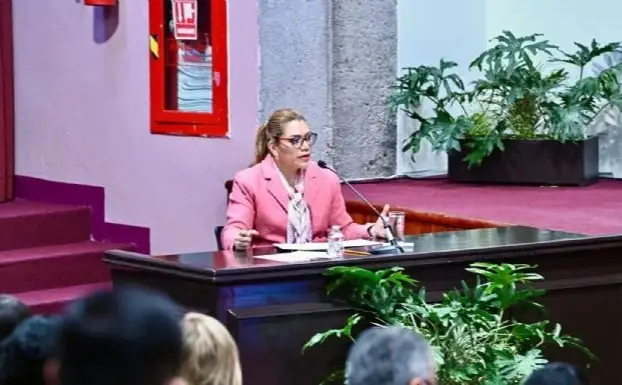

In her appearance before Congress, Veracruz Attorney General Lisbeth Aurelia Jiménez denied that the State Attorney General’s Office had erred in attempting to charge Coatzacoalcos journalist Rafael León Segovia with terrorism, and denied that there is any persecution against journalists or any professional sector.
The official attempted to distance herself from the issue by asserting that the Attorney General’s Office does not issue arrest warrants, but rather that only a judge is qualified to detain a person to answer for a specific act. However, she failed to clarify that the arrest warrants issued by judges are based on accusations made by the Attorney General’s Office itself.
“I want to emphasize that the Attorney General’s Office does not issue arrest warrants. That is the responsibility of a judge. The warrant is merely a means to present a person before the judicial authority,” she stated.
He added that it is the judge who, when issuing the indictment, precisely defines the crime for which the criminal proceedings will continue, thus rejecting the notion that the Prosecutor’s Office made an error in the initial handling of the case.
In the specific case of journalist Rafael León Segovia, he clarified that he was indicted for the crimes of obstruction of justice and crimes against public security institutions, and that he was placed under house arrest for one year.
“It was made very clear what crimes he was indicted for and what the precautionary measure was, under which he remains subject to the proceedings. We do not persecute individuals, sectors, groups, or professionals, much less journalists or media workers,” he said.
Forty-five days after taking office, Jiménez Aguirre appeared before Congress as part of the obligations of autonomous bodies.
There, he also addressed the murder of journalist Carlos Castro, which occurred in Poza Rica. The prosecutor reported that two parallel investigations have been opened, one by the Specialized Prosecutor’s Office for Crimes Against Freedom of Expression and the other by the Poza Rica Regional Prosecutor’s Office for various crimes.
She added that the process has faced technical difficulties, mainly in the analysis of telephone information: “We have had some challenges with telephone data. Unlocking devices to obtain information is not so simple; it requires specialized procedures,” she explained.
She indicated that it is not possible to reveal the lines of investigation at this time, but guaranteed that all possibilities are being exhausted to solve the crime.
The prosecutor also reported that she will undergo a background check in February, the results of which will be made public, as it is a legal requirement to remain in office.
“It is a legal requirement to continue in this position; if I don’t pass, I cannot continue,” she stated.
The head of the State Attorney General’s Office indicated that the recommendations issued by human rights organizations will be reviewed individually, considering them an opportunity to correct institutional failures and, where appropriate, sanction public servants responsible for omissions.
She clarified that she cannot explain the reasons why recommendations were rejected in previous administrations, as these are not matters within her control.
It should be recalled that in 2025, during the administration of former Attorney General Verónica Hernández Giadáns, the National Human Rights Commission (CNDH) issued 15 warnings to the Veracruz Attorney General’s Office for rejecting recommendations related to human rights violations, mostly due to delays in investigations of missing persons.
“I cannot clarify why the recommendations were rejected, because these are not matters within my control; what I can say is what my position will be regarding the recommendations of both the State Commission and the National Commission,” she stated.
She explained that upon assuming office, she accepted two recommendations from the National Human Rights Commission (CNDH) and one from the Veracruz State Human Rights Commission, all related to investigations into enforced disappearances and acts of torture. She added that these cases allow for the identification of flaws in the processes and the strengthening of internal controls and training programs.

Source: proceso