
Along the Yucatán coast, erosion is a problem affecting various beaches, a phenomenon that, according to specialists and authorities, has intensified in recent years.
Following the presentation of the “Permanent Awareness Campaign for the Conservation of the Ciénega de Progreso Estuary” held last Wednesday, Guillermo Humberto Porras Quevedo, the delegate of the Ministry of Environment and Natural Resources (Semarnat) in Yucatán, reported that the federal agency is working on actions to address and control coastal erosion throughout the state.
The official explained that a strategic coastal remediation program is being developed, based on a comprehensive scientific analysis, with the goal of mitigating the progression of the phenomenon and proposing solutions.
“We cannot single out Progreso, Telchac (Puerto), or Dzilam. No. It’s the entire coast,” he emphasized.
Porras Quevedo indicated that erosion is a dynamic natural process, advancing inland at certain times and receding at others, so its management must be comprehensive.
He also detailed that work is already underway on the bypass system in the harbors, which will allow the sand to begin recirculating; however, he clarified that this mechanism is part of a broader coastal management plan.
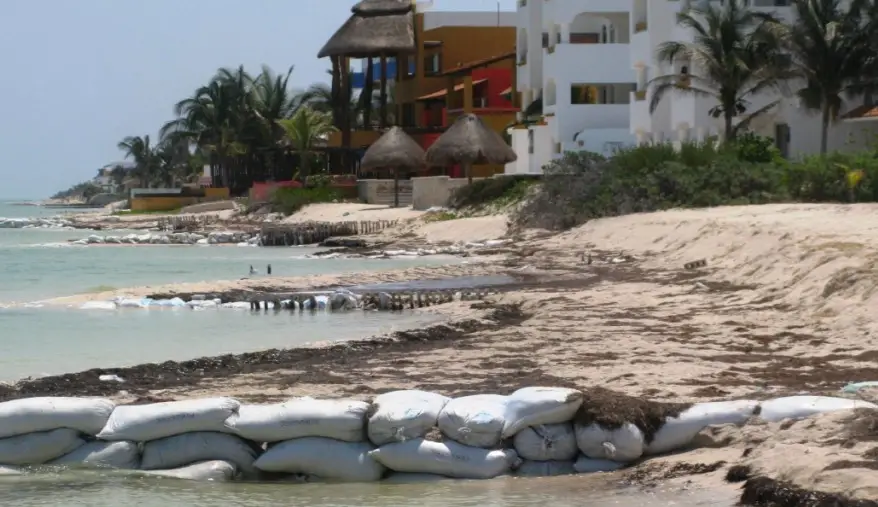
Regarding the most affected areas, he noted that Progreso is one of them, although he specified that meters of beach have been lost along much of the coastline, to the point that in some coastal homes the sea is “already at their doorstep.”
To assist those affected, the Semarnat delegate shared that emergency strategies have been implemented, such as the placement of sandbags, which has allowed for an approximate recovery of 1.5 meters of beach during 2025, in addition to reducing the direct impact on properties.
Thanks to these actions, he added, the placement of geotubes—large, resistant fabric structures filled with sand that were previously used as a containment measure—has been avoided.
Finally, he said that once the shoreline is stabilized, dune restoration work will begin, with the goal of retaining sand and strengthening the natural protection of the coastline.
Porras Quevedo pointed out that while erosion is part of a natural process, human activity has negatively contributed to intensifying this erosion.
With the actions taken by Semarnat, the placement of geotubes—large, resistant fabric structures filled with sand that were previously used as a containment measure—has been avoided.

Source: yucatan