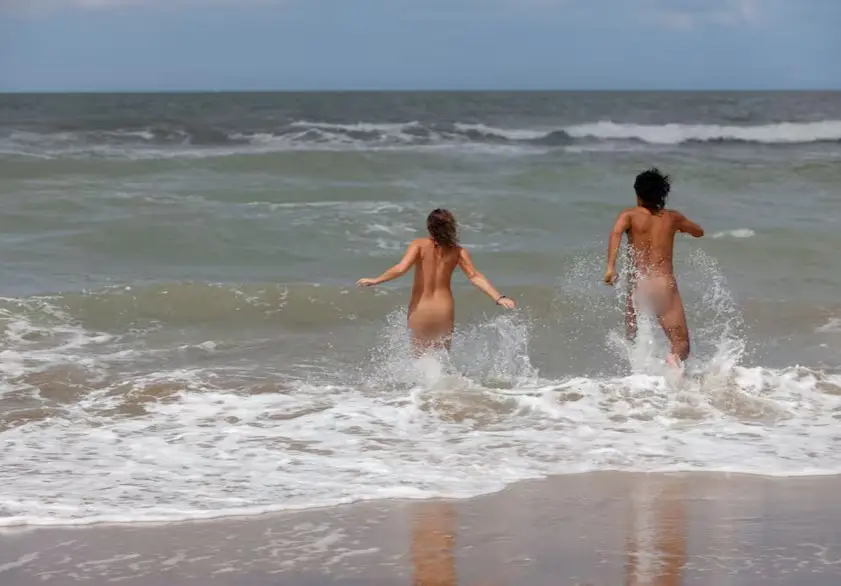

On one side of the Río de la Plata, Playa Querandí, in Villa Gesell. On the other, La Sirena, in the Uruguayan department of Rocha. Their names are practically unknown to most, but if you mention their older sisters, Playa La Escondida and Chihuahua, many will be able to guess what they are.
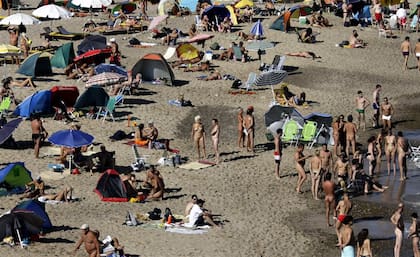
Like a game of similarities, both the Argentine and Uruguayan coasts have naturist beaches—four in total—authorized for nudism. The best-known belong to the “mainstream” of the movement at a regional level. The other two are part of an off-the-beaten-path circuit, cultivating a low profile and seeking to distance themselves from the noise of their predecessors.
Ten years ago, Christian Crizaldo (49) discovered something that impacted him during his vacation in Villa Gesell. A restless soul in search of new adventures, he stumbled upon Playa Querandí during an afternoon walk, one of the best-kept secrets of the Argentine coast.
With a family-friendly atmosphere, just over 140 km north of Playa La Escondida (the first and most well-known beach on this stretch of the Atlantic coast), Querandí stands out as a much more rustic alternative. In contrast to its larger counterpart, which offers paid services such as parking, shade, food, and even a swimming pool, Querandí has only a drinking water pump for refilling water bottles or thermoses for mate, and a lifeguard station. At most, there are a few wooden posts for hanging a hammock from which to watch the sunset over the dunes. That’s it.
“When I discovered Querandí, I was stunned. I couldn’t believe there were people like that, enjoying nature so completely. As soon as I arrived at the campsite where I was staying with Andrea, my partner, I told her about it and said, ‘We have to go.’ She wasn’t very convinced because at that time she was quite structured, but we went. The experience was so incredible that after that day I proposed to her, and the following summer we got married on the beach in a beautiful ceremony,” recalls Christian, who today is part of the community that volunteers each season to care for this 300-meter-long by 200-meter-wide beach, accessible by car from kilometer 429.5 of Route 11 and on foot along the beach from Mar Azul.
Querandí is the only beach of its kind where you can reach the shore in a 4×4 or drive in a Mehari, making it attractive for those who prefer to take things slowly: “There are couples who drive up in their trucks and wait for some people to leave before going into the sea naked. It’s total freedom; people aren’t crowded because the area is very wide open, and there’s a complete communion with nature. The best thing about it is the sunsets over the dunes,” describes Andrea, who also points out that there are no “perfect bodies” there: “Nobody comes to show off or flaunt their figure. I enjoy being able to tan without tan lines; bikinis bother me.”
Querandí is the only beach of its kind where you can reach the shore in a 4×4 or drive in a Mehari. Marcelo Manera – LA NACION
Authorized in 2008 by the municipality of Villa Gesell at the request of the Argentine Association for Naturist Nudism (Apanna), Querandí began attracting a few practitioners of this practice in the country, the so-called “old guard,” as soon as it opened. Today, however, the clientele that comes to this natural paradise of fine sand, rolling dunes, and somewhat choppy sea has changed, attracting everyone from judges and lawyers to business owners like Christian, who owns a women’s clothing store.
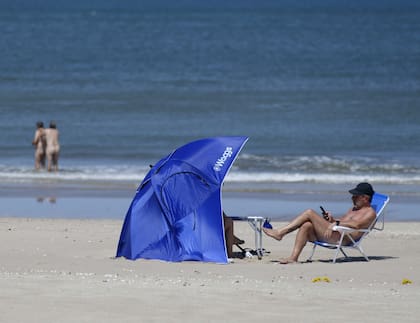
“The people who come here today are much younger and more uninhibited. Before, they might have come and not taken their clothes off because nudism is optional here. But now, men and women under 40 come and undress right away. There are many families too. It’s a family atmosphere, and we want to keep it that way. That’s why the ten families who have been here since the beginning at Querandí prevent any sexual activity. We don’t allow it. This is a naturist beach, and the idea is to be in contact and harmony with nature,” explains Pedro Consilvio, one of the oldest regulars, who celebrates the emergence of this new generation, the ones carrying on the naturist movement.
The rules on the other side of the sign that indicates it’s a nudist beach are clear and must be followed: no taking photos of other bathers, if you interact with children who aren’t part of the group, wear shorts or a cover-up, and don’t be exhibitionist or do anything that might make others uncomfortable. “Everyone understands perfectly how it works; there’s no need to explain anything,” Christian assures.
As if it were a formula that’s replicated, on the other side of the Río de la Plata, naturists have two places to practice nudism: on the one hand, the well-known Chihuahua, 18 km before reaching Punta del Este, which attracts a European clientele much more accustomed to nudism than the locals, and on the other, the almost unknown La Sirena, in the department of Rocha, a stretch of wild, almost virgin beach surrounded by dunes, small wetlands, lagoons, ravines, and pine and acacia groves.
Its profile is so low that it doesn’t even appear among the places highlighted by Apanna for naturism in the region. But La Sirena exists: a sign indicates this, and Jorge Simeone, former Director of Tourism for the department of Rocha, confirms it. Back in 2003, he gave the green light to a project presented by Juan Carlos Cola, a man closely linked to the local tourism sector, to authorize a naturist beach in Rocha.
“In the 1990s, there was a significant naturist movement in Cabo Polonio. We always say that there, everyone goes as they please, at their own pace. Today, there’s a population that practices naturism, and nobody is surprised. We lose some of the comforts of the city, but we gain in nature.”
From a natural perspective, La Sirena is a paradise in oceanic terms. But there’s no infrastructure to support it. There are no lifeguards, no restrooms, nothing for several kilometers around, except for a few private homes. Perhaps that’s why it’s not so well-known.
“There is authorization, but the reality is that this didn’t start out as a commercial venture. A seed was simply planted and it’s still germinating,” Simeone explains.
Source: lanacion