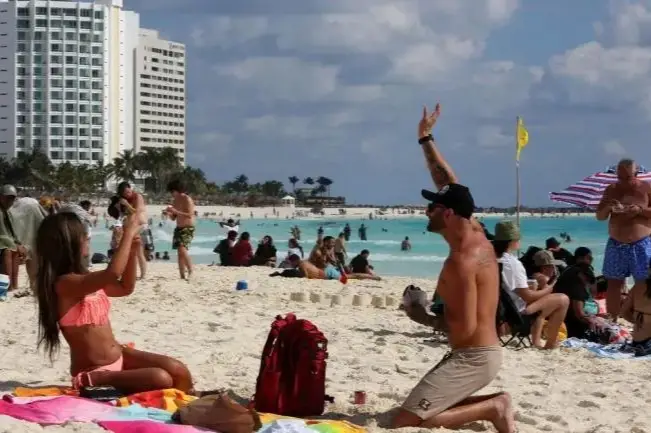

The tourism sector in Mexico continues to show a solid recovery and growth following the health crisis.
At the close of 2015, the nation received 47.78 million international tourists, representing a 6.1% year-over-year increase, according to data reported by the National Institute of Statistics and Geography (INEGI). This upward trend has remained constant since the end of the COVID-19 pandemic.
Despite this increase in the number of visitors, the economic impact presented some important nuances. Total revenue from international tourism reached US$31.7154 billion, a 4.9% increase compared to 2014. However, average spending per visitor experienced a decrease, settling at US$663.69 for the year, equivalent to a 1.2% reduction.
Specifically in December 2025, average spending per foreign visitor contracted by 7.7%, falling to $659.37, even though total spending that month rose slightly by 0.5% year-over-year.
Based on the INEGI report, changes in entry methods to the country stand out. While the majority of international tourists opted for air travel (79.2% of the total in December), the largest proportional growth was observed in land travel, which registered a 15.6% year-over-year increase, totaling 4.5 million visitors by this route during 2025.
On the other hand, the economy directly linked to this activity, referred to by INEGI as tourism GDP, showed a 0.6% year-over-year growth at the close of the third quarter of 2025, driven mainly by the goods sector.
Currently, Mexico remains the sixth most visited country in the world, a position it has held since 2022, according to data provided by the World Tourism Organization.
However, despite this situation, the administration of President Claudia Sheinbaum Pardo has set as a strategic objective to climb the rankings and place Mexico among the top five international destinations with the highest tourist traffic.

Source: diariodemexico