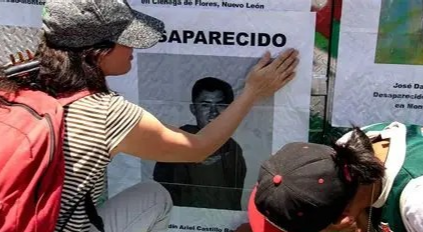

Mexico faces a very bleak situation regarding disappearances. This is not just a perception or the opinion of a few; it is an overwhelming reality that must be addressed immediately.
The situation is even more heartbreaking when it involves children and adolescents who, far from living in a safe country, are being separated from their families and communities.
In just the first three months of 2026, the Network for Children’s Rights in Mexico (REDIM) reported a 30% increase compared to previous years.
It is devastating news to learn that by the end of March 2026, the national registry had surpassed 130,000 disappearances (a record high since 2006), with a marked trend of affecting adolescents and young adults.
The states with the most disappearances are Mexico City, Guanajuato, Chiapas, and the State of Mexico, where the majority of reports are concentrated.
To mention just one example, in Mexico City, between March 20 and 22, 2026, at least nine minors were reported missing, triggering Amber Alerts. This is unacceptable.
Many cases gain attention due to the dissemination of information in the media and on social networks. In this regard, in the first three months of this year, support has been requested to find children and adolescents such as 12-year-old Iker Damián; sisters Azul and Rosa Hernández (disappeared in the State of Mexico); Samantha Aylin (12 years old), Dominic Jeshua (14 years old), Lety Jaqueline (15 years old), and many more.
Each of these cases translates into despair, frustration, fear, and uncertainty, but above all, into a terrible upheaval at the family level that no one should have to experience.
In more detail, eight out of ten missing children are adolescent girls, and although in recent weeks Citlalli Hernández, head of the Women’s Secretariat in Mexico, signed an agreement with Meta, Google, and TikTok to combat digital violence against girls and women, the reality is that children in Mexico are vulnerable to being lured into social media and then “disappearing” in an environment of violence and online harassment.
Efforts must be redoubled and sustained, as it is evident, from figures and data from reliable sources, that Amber Alerts for disappearances are on the rise.
Despite the evidence, the Mexican government insists on not acknowledging this cruel reality and downplays reports such as the one recently issued by the United Nations (UN) on enforced disappearances.
These unfortunate actions only serve to further confuse and anger the population, when what should prevail is a collaborative effort to protect every child and adolescent.
Early Institute urges greater sensitivity to the pain of those with a missing family member and calls for this growing problem to be taken seriously. The risk of becoming a missing person is increasingly high, and this must be stopped.
Primarily, it is essential to strengthen collaboration to promptly address missing persons reports, especially when they involve minors, as time is of the essence and every second is vital for the victim’s recovery.

Source: elfinanciero